Learn Chinese — pick your script, then make it stick
Published July 10, 2026
"Chinese" on an app store listing usually means one course: Simplified characters, mainland conventions, take it or leave it. But the Chinese-speaking world writes in more than one way, and a learner headed for Taipei or Hong Kong is poorly served by a course built for Beijing. Viglot treats the difference honestly: it offers Chinese as three separate course variants — Chinese (Simplified), Chinese (HK Traditional), and Chinese (TW Traditional) — and every one of them gets the full experience, the same as all 42 languages in the app.
Simplified vs Traditional Chinese: which should you learn?
Simplified characters were introduced in mainland China in the 1950s and are standard there and in Singapore today. Traditional characters remain standard in Taiwan, Hong Kong, and Macau. Many characters are identical across the two systems, but thousands differ — and beyond the characters themselves, written conventions and everyday vocabulary differ between Hong Kong and Taiwan too. There's no universally "correct" choice; there's the script the people you want to reach actually read:
- Chinese (Simplified) — for mainland China and Singapore. The most common choice, and the script behind most Mandarin teaching material worldwide.
- Chinese (TW Traditional) — for Taiwan. Traditional characters with Taiwanese written conventions.
- Chinese (HK Traditional) — for Hong Kong. Traditional characters with Hong Kong's own written conventions.
In Viglot each variant is its own course, not a re-labeled copy: pick one, and every scenario, phrase, image, and audio clip is built in that variant. If you later need the other script, that's a separate course you can start any time.
Chinese lessons built around your interests
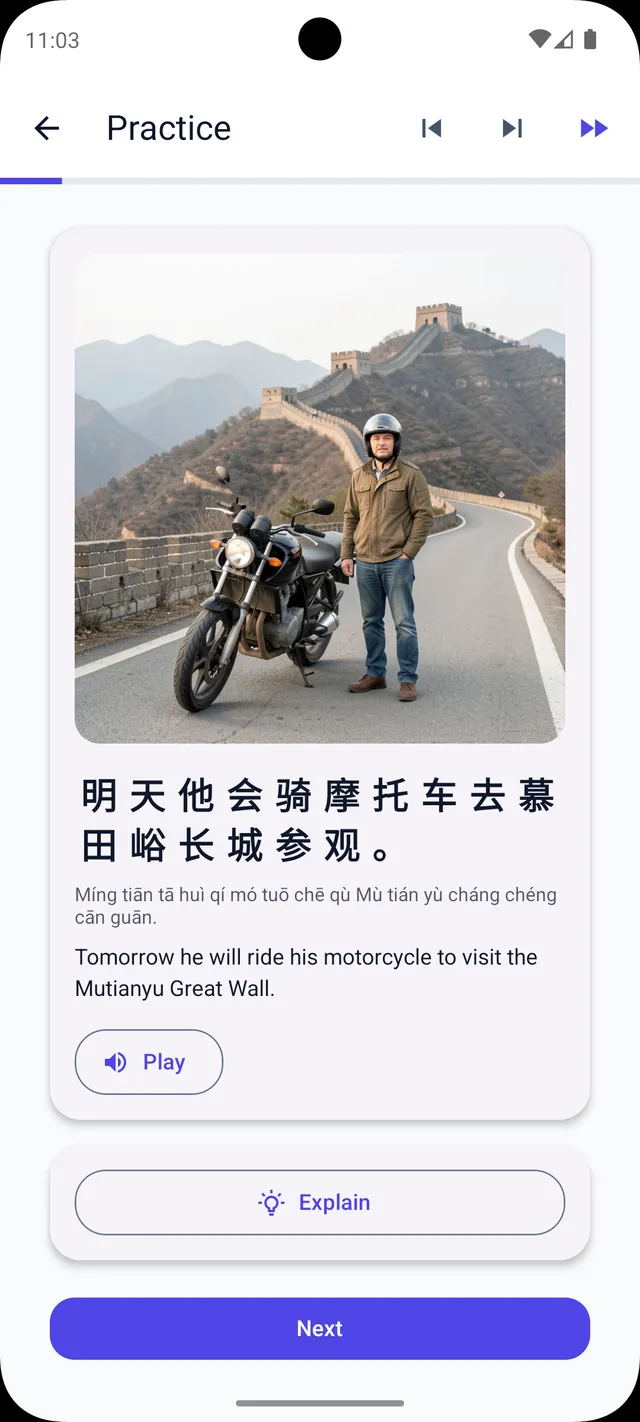
Tell Viglot what you actually care about — your work, your hobbies, the trips you're planning — and it generates complete Chinese scenarios around those interests at your level. Not a fixed lesson tree with the same topics for every learner. Vocabulary that connects to something you care about is vocabulary that sticks; generic phrases about hobbies you don't have won't. Here's a generated lesson for a learner who rides motorcycles:
Tones need audio — every phrase gets a native voice
Mandarin is a tonal language: the same syllable with a different tone is a different word, and no amount of silent reading teaches your ear the difference. In Viglot, every phrase in every session is read aloud by a native-quality voice, alongside a freshly generated image and the text on screen. You hear the tones, the rhythm, and where words run together before you ever try to say the sentence yourself. Three retrieval cues per phrase — visual, auditory, textual — instead of one, every time. Most apps pair audio with some phrases and images with others; doing both for every phrase, in every language, is expensive — and it's the point.
Chinese speaking practice for the intermediate plateau
If you can read Chinese but freeze when it's your turn to talk, recognition drills won't fix it. Viglot only counts a word as learned once you've produced it yourself — said it out loud, rebuilt the sentence, placed it back in context. That production-first rule is most of what it takes to get from B1 to B2. On top of the core exercises, the premium speaking exercises push production directly:
- Pronunciation practice — hear the native audio first, then read the Chinese phrase aloud and get feedback on how your words actually came across. For a tonal language, having the native model in your ear before you speak matters.
- Voice Tasks — hold a spoken conversation with a concrete goal, like ordering at a night market or asking for directions. Your conversation partner replies in character and you're scored on whether you achieved the goal.
- Make Yourself Understood — your partner deliberately misunderstands you and you rephrase until your meaning lands. The exact repair skill you use in a real conversation abroad.
- What Would You Say? — see a situation, speak your response in Chinese, and get scored on whether it was appropriate, grammatical, and natural.
Premium also adds listening comprehension (dialogues and monologues), cultural nuance — predict-then-reveal questions about real customs — and graded free-text grammar. Underneath it all, per-word spaced repetition brings each word back just before you'd forget it, and adaptive difficulty follows what you actually retain — not just the level you picked.
Learn Chinese from German, French — or any of 40+ base languages
Most apps only teach Chinese from English, which forces many learners to translate through a third language. Viglot supports any pair of its 42 languages in either direction: Chinese from German, Chinese from French, Chinese from Spanish — whatever your base language is, that's the language your translations, instructions, and situation prompts appear in. If you're a German speaker, you never have to route Chinese through English at all.
Which CEFR level should you start Chinese at?
Viglot covers the full range, A1 through C2, and it's tuned for intermediate and advanced learners (B1+). Beginners are welcome — the early levels lean on recognition and word banks to build a base — though if you're starting Chinese from absolute zero, a foundational course first won't hurt. Not sure where you stand? The guide to CEFR levels A1–C2 explains what each level actually means in practice.
Weighing Chinese against another East Asian language? Viglot gives Japanese the same full-depth treatment, listening and speaking included.
Frequently asked questions
Should I learn Simplified or Traditional Chinese?
It depends on where you'll use the language. Simplified characters are standard in mainland China and Singapore. Traditional characters are standard in Taiwan, Hong Kong, and Macau — with written conventions that differ between Hong Kong and Taiwan. Viglot offers all three as separate courses, so you learn the script and conventions you'll actually encounter.
What's the difference between the three Chinese courses in Viglot?
Viglot offers Chinese (Simplified), Chinese (HK Traditional), and Chinese (TW Traditional) as three separate course variants. Each one is a full course — the same 17 exercise types, generated scenarios, native-quality audio, and per-word spaced repetition — built in the script variant you chose.
Can I learn Chinese from German or French instead of English?
Yes. Viglot supports any pair of its 42 languages in either direction, so you can learn Chinese from German, French, Spanish, or any other supported base language. Your base language is the language your translations, instructions, and situation prompts appear in.
Is Viglot free?
You can start free with a trial — no credit card. After that there's a paid plan. The premium exercises — live voice conversation, listening comprehension, cultural nuance, and graded grammar production — sit behind the paid tier; the core practice loop stays usable for free.

Start learning Chinese today
Simplified, HK Traditional, or TW Traditional — pick your script and practice it in scenarios built around your life. A native voice for every phrase. Free to start — no credit card.