Learn German — producing correct German, not just recognizing it
Published July 10, 2026
German has a specific way of humbling learners: you understand far more than you can say. You read the sentence fine — then it's your turn, and the case endings scatter, the verb lands in the wrong place, and the article is a coin flip. Recognition quizzes never fix this, because picking the right option and building the sentence yourself are different skills. Viglot is a German conversation practice app built around the second one: scenarios generated from your own life at your CEFR level, German speaking practice with feedback, grammar exercises that grade what you actually wrote, and a course you can take from any of 42 base languages — not just English.
German cases and word order: graded free-text production
Four cases, three genders, verb-second in main clauses, verb-final in subordinate ones — none of it is hard to recognize, all of it is hard to produce. Multiple-choice grammar drills let you lean on recognition forever: you spot dem among the options without ever having to retrieve it yourself. Viglot's graded grammar exercises take the options away. You write the German sentence freely, in your own words, and the app grades the sentence you actually produced — the case ending you chose, where you put the verb, whether the whole thing holds together — and explains what went wrong. That retrieval-under-pressure is the skill a real conversation demands, and it's exactly what recognition formats can't train.
The same principle runs through the whole app: across the 17 exercise types, a word only counts as learned once you've produced it — said it aloud, rebuilt the sentence, placed it back in context. Until then, it's just a word you recognize.
Learn German from your own language — any of 42
If you live in Germany and your native language is Turkish, Ukrainian, Arabic, or Polish, most apps make you learn German through English — translating twice on every sentence, through a language that may itself be shaky. Viglot supports any pair of its 42 languages in either direction. Pick your own language as the base, and every translation, instruction, and situation prompt appears in it. German from Turkish, German from Ukrainian, German from Farsi — the course meets you in the language you actually think in.
German scenarios from your real life
Tell Viglot what your life actually involves and it generates complete German scenarios around it, at your level. If your week includes a team meeting, a doctor's appointment, or yet another form-and-appointment errand at an office, those are the situations you can ask for — a work discussion, explaining symptoms, handling paperwork, small talk with neighbors. Not a fixed lesson tree where everyone gets the same airport dialogue. Vocabulary tied to situations you'll genuinely be in is vocabulary your brain has a place for; generic phrases about hobbies you don't have won't survive the week.
A native-quality voice and an image for every phrase
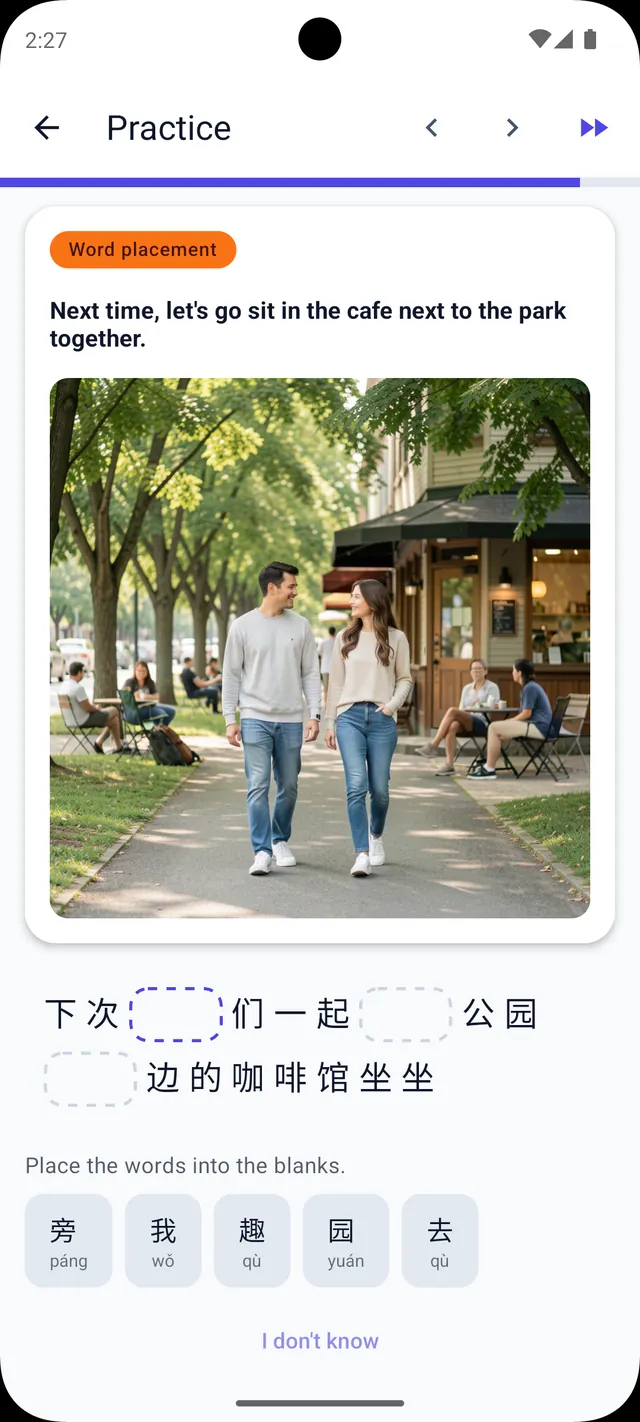
Every phrase in every session is read aloud by a native-quality voice, alongside a freshly generated image and the text on screen. You hear the rhythm of the German sentence — where the stress falls, how the words run together — before you try to say it yourself. Three retrieval cues per phrase (visual, auditory, textual) instead of one, every time. Underneath, per-word spaced repetition brings each word back just before you'd forget it, and adaptive difficulty follows what you actually retain, not just the level you picked.
German speaking practice with real feedback
Understanding German is the entry fee; the game is speaking it. On top of the core exercises, the premium speaking exercises push spoken production directly:
- Voice Tasks — hold a spoken German conversation with a concrete goal, like renting an apartment or rescheduling an appointment. Your conversation partner replies in character, and you're scored on whether you achieved the goal.
- Make Yourself Understood — your partner deliberately misunderstands you, and you rephrase until your meaning lands. The exact repair skill you need when your first attempt at a German sentence comes out tangled.
- What Would You Say? — see a situation, speak your response in German, and get scored on whether it was appropriate, grammatical, and natural.
- Pronunciation practice — read a German phrase aloud and get feedback on how your words actually came across, not a reflexive thumbs-up.
Stuck at B1 or B2 German? That's the plateau
Most self-taught German learners stall somewhere between B1 and B2: comfortable in rehearsed situations, lost the moment the conversation goes off script. The cause is almost always a diet of recognition drills — practice aimed at a skill you already have. The fix is switching to production-heavy work: speaking reps with a verdict, scenarios outside your comfort zone, grammar you write rather than pick. We wrote a full breakdown of how to get from B1 to B2 and why the jump is the hardest on the scale.
Which CEFR level should you start German at?
Viglot covers the full range, A1 through C2, and it's tuned for intermediate and advanced learners (B1+). Beginners are welcome — the early levels lean on recognition and word banks to build a base — though if you're starting German from absolute zero, a foundational course first won't hurt. Not sure where you stand? The guide to CEFR levels A1–C2 explains what each level actually means in practice.
Learning more than one language? Viglot gives French the same full treatment — with listening exercises aimed at the gap between written and fast spoken French.
Frequently asked questions
Can I learn German from a language other than English?
Yes. Viglot supports any pair of its 42 languages in either direction, so you can learn German from Turkish, Ukrainian, Arabic, French, or any other supported base language. Your translations, instructions, and prompts appear in the base language you choose — you never have to route German through English.
Does Viglot help with German cases and word order?
Yes — by making you produce them. The graded grammar exercises ask you to write German freely and then grade what you actually wrote, so a wrong case ending or a misplaced verb gets caught and explained instead of hidden behind multiple-choice options.
What level of German can I learn with Viglot?
Viglot covers CEFR A1 through C2 and is tuned for intermediate and advanced learners (B1+). Beginners are welcome — the early levels lean on recognition and word banks to build a base — but if you're starting from absolute zero, a foundational course first won't hurt.
Is Viglot free?
You can start free with a trial — no credit card. After that there's a paid plan. The premium exercises — live voice conversation, listening comprehension, cultural nuance, and graded grammar production — sit behind the paid tier; the core practice loop stays usable for free.
Start learning German today
Scenarios built around your real life. Grammar graded on what you actually wrote. A native-quality voice for every phrase. Free to start — no credit card.