Learn Korean — speaking practice for real situations
Published July 10, 2026
Most people who learn Korean can read far more than they can say. The alphabet comes quickly, the recognition drills pile up — and then a real conversation arrives and the sentences won't come out, or they come out in the wrong register. Viglot is built for exactly that gap. Korean is one of its 42 languages, with lessons generated around your own interests at your CEFR level, a native-quality voice and matching image for every phrase, and speaking practice that scores how you actually came across. The whole app is tuned for intermediate and advanced learners (B1+) — the people who know some Korean already and want to start using it.
Korean speaking practice that tells you what landed
Reading a sentence silently and saying it out loud are different skills, and only one of them helps in Seoul. Viglot's premium speaking exercises make production the whole point:
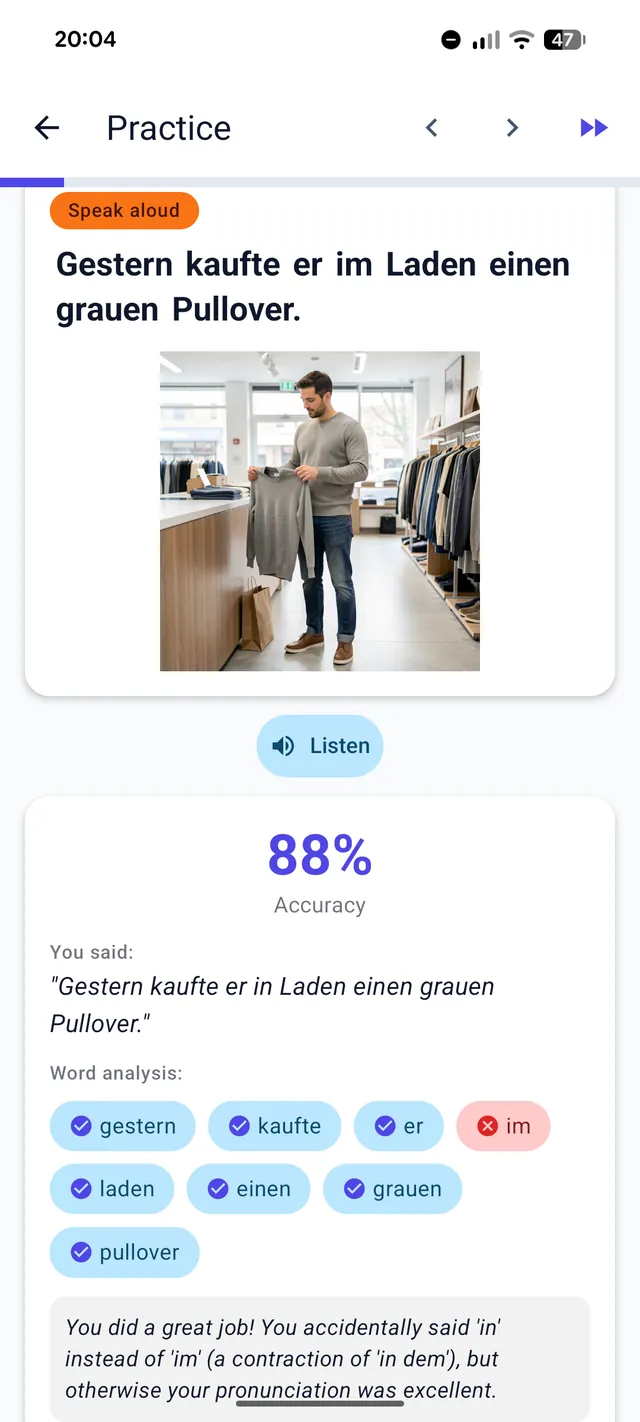
- Pronunciation practice — read a Korean phrase aloud and get feedback on how your words actually came across, flagged word by word, not a reflexive thumbs-up.
- Voice Tasks — hold a spoken conversation with a concrete goal, like ordering at a restaurant or sorting out a booking. Your conversation partner replies in character, and at the end you're scored on whether you achieved the goal.
- Make Yourself Understood — your partner deliberately misunderstands you, and you rephrase until your meaning lands. The exact repair skill you need when your first attempt at a Korean sentence doesn't get through.
- What Would You Say? — see a situation, speak your response in Korean, and get scored on whether it was appropriate, grammatical, and natural.
Politeness levels, learned where they actually live: in situations
Korean speech levels are the thing textbooks explain and learners still get wrong, because the rules aren't the hard part — knowing which register fits this moment is. A conjugation table can't teach that; a situation can. In What Would You Say?, you're shown a concrete situation — talking to a new colleague, a friend's grandmother, a shop owner — and you speak your response. The scoring on appropriateness and naturalness is exactly where your choice of register shows up: a reply that's grammatically perfect but too casual for the person in front of you isn't a natural reply. Practicing across many situations builds the instinct that no rule summary delivers.
The customs behind the language: cultural nuance you predict, not just read
Register is only half of Korean etiquette — the rest is custom: how things are offered and received, what's said before a meal, what politeness looks like in practice. Viglot's cultural-nuance exercises take a real custom and turn it into a predict-then-reveal question: you commit to what you think happens in the situation, then see the answer and the reasoning behind it. Committing to a prediction first is what makes the reveal stick — and for Korean, where getting the culture right matters as much as getting the grammar right, it's some of the highest-value practice in the app.
Korean scenarios built around your interests
Tell Viglot what you actually care about — your work, your hobbies, the situations you expect to be in — and it generates complete Korean scenarios around those interests at your level: a late-night food stall, a first day at a new office, a conversation about the music you like. Not a fixed lesson tree with the same topics for every learner. Vocabulary that connects to your own life is vocabulary that sticks; generic phrases about hobbies you don't have won't. And because Viglot supports any pair of its 42 languages in either direction, you can learn Korean from German, French, Spanish — whatever your base language is, that's the language your translations and instructions appear in.
Every Korean phrase: a voice, an image, and the text
Every phrase in every session is read aloud by a native-quality voice, alongside a freshly generated image and the text on screen. You hear how the sentence actually sounds — the rhythm, where syllables run together — before you ever try to say it. Three retrieval cues per phrase (visual, auditory, textual) instead of one, every time. Most apps pair audio with some phrases and images with others; doing both for every phrase, in every language, is expensive — and it's the point.
Past the intermediate plateau
The Korean plateau is real: you understand your favorite shows better every month, but your own sentences stay short and safe. Viglot attacks it from two sides. First, a word only counts as learned once you've produced it — said it out loud, rebuilt the sentence, placed it back in context — so passive recognition never masquerades as ability. Second, per-word spaced repetition brings each word back just before you'd forget it, and adaptive difficulty follows what you actually retain, not just the level you picked. If that stuck-in-the-middle feeling sounds familiar, the guide on getting from B1 to B2 goes deeper into why the plateau happens and what breaks it.
Which CEFR level should you start Korean at?
Viglot covers the full range, A1 through C2, with 17 exercise types across the levels, and it's tuned for intermediate and advanced learners (B1+). Beginners are welcome — the early levels lean on recognition and word banks to build a base — though if you're starting Korean from absolute zero, a foundational course first won't hurt. Not sure where you stand? The guide to CEFR levels A1–C2 explains what each level actually means in practice.
Weighing Korean against another East Asian language? Viglot gives Japanese the same full treatment.
Frequently asked questions
Can I learn Korean from German or French instead of English?
Yes. Viglot supports any pair of its 42 languages in either direction, so you can learn Korean from German, French, Spanish, or any other supported base language — your translations, instructions, and situation prompts appear in that language, not just English.
Does Viglot teach Korean politeness levels?
Not as a separate register course — through situations. Speaking exercises like What Would You Say? drop you into a concrete situation and score whether your spoken response was appropriate, grammatical, and natural, which is exactly where the choice of speech level shows up. Cultural-nuance questions add the customs behind the registers.
What level of Korean can I learn with Viglot?
Viglot covers CEFR A1 through C2 and is tuned for intermediate and advanced learners (B1+). Beginners are welcome — the early levels lean on recognition and word banks to build a base — but if you're starting from absolute zero, a foundational course first won't hurt.
Is Viglot free?
You can start free with a trial — no credit card. After that there's a paid plan. The premium exercises — live voice conversation, listening comprehension, cultural nuance, and graded grammar production — sit behind the paid tier; the core practice loop stays usable for free.

Start learning Korean today
Scenarios built around what you care about. A native-quality voice for every phrase. Speaking practice that scores how you came across. Free to start — no credit card.