Learn Spanish — pick your side of the Atlantic
Published July 10, 2026
Most apps teach one blended "Spanish" — a compromise variety that belongs to no country in particular, with a Peninsular word here and a Mexican one there. Viglot doesn't. It offers Spanish (Spain) and Spanish (Latin America) as two separate course options: you pick the one that matches your life, and every scenario, phrase, and exercise is built in that variety. Like every one of Viglot's 42 languages, both get the full experience — 17 exercise types, generated scenarios, per-word spaced repetition, and speaking practice tuned for intermediate and advanced learners (B1+).
Castilian vs Latin American Spanish: which should you learn?
The two varieties are fully mutually intelligible — a learner of either will be understood everywhere Spanish is spoken — but they differ in ways you hear and use every day:
- Pronunciation — most of Spain distinguishes the sounds in casa and caza: the letters z and soft c are pronounced like the "th" in "think" (distinción). Latin America pronounces both as "s" (seseo), so casa and caza sound identical.
- Addressing a group — Spain uses vosotros for an informal plural "you", with its own verb endings. Latin America uses ustedes for every plural "you", formal or not — one whole set of conjugations you can skip. Parts of Latin America, notably Argentina and Uruguay, also use vos instead of tú.
- Everyday vocabulary — a car is a coche in Madrid and a carro in most of Latin America; a computer is an ordenador versus a computadora; a mobile phone is a móvil versus a celular. Small words, but they're the ones you use constantly.
The practical rule: pick the variety of the place you'll actually use Spanish. Moving to Barcelona, working with a Spanish company, family in Valencia — choose Spain. Traveling through Mexico, Colombia, or Argentina, working with Latin American colleagues, or just want the variety spoken by the large majority of native speakers — choose Latin America. Whichever you pick, the other stays fully understandable to you.
Two Spanish courses, not one compromise
In Viglot, the two Spanish options are full separate courses, not one course with a toggle. The variety you choose shapes everything: the phrases you learn, the audio you hear, the vocabulary that comes back in spaced repetition. You won't drill vosotros forms you'll never use in Bogotá, and you won't sound like a textbook from the wrong continent in Seville. Most apps blend the two and leave you to sort out later which words belong where; Viglot makes the choice explicit up front.
Spanish scenarios built around your interests
Tell Viglot what you actually care about — your work, your hobbies, the situations you expect to be in — and it generates complete Spanish scenarios around those interests at your CEFR level: a tapas bar, a job interview, an apartment viewing, a night out with friends. Not a fixed lesson tree with the same topics for every learner. Vocabulary that connects to something you care about is vocabulary that sticks; generic phrases about hobbies you don't have won't.
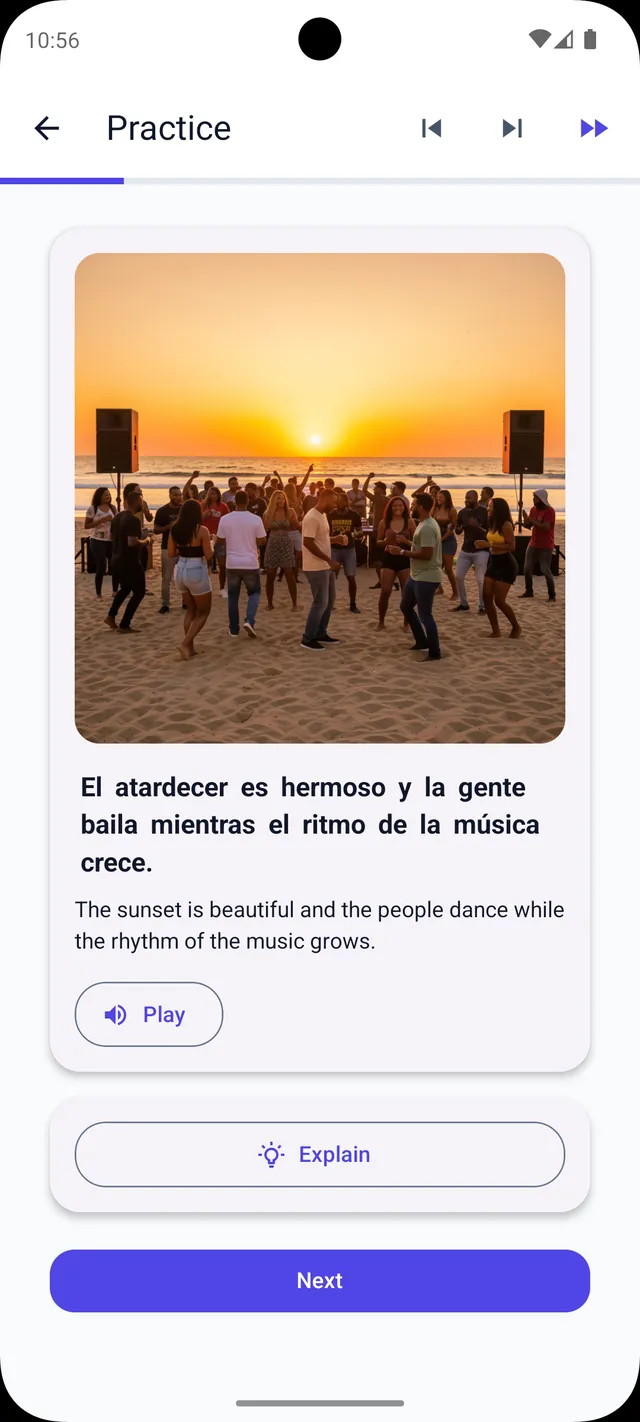
A native-quality voice and an image for every phrase
Every phrase in every session is read aloud by a native-quality voice in the variety you chose, alongside a freshly generated image and the text on screen. You hear how the sentence actually sounds — the rhythm, where words run together, whether that c is a "th" or an "s" — before you ever try to say it. Three retrieval cues per phrase (visual, auditory, textual) instead of one, every time. Most apps pair audio with some phrases and images with others; doing both for every phrase, in every language, is expensive — and it's the point.
Spanish speaking practice for the intermediate plateau
Spanish is famously friendly to beginners — and famously good at stranding people at B1, able to read the news but freezing in a fast conversation. Recognition drills won't fix that. Viglot only counts a word as learned once you've produced it yourself — said it out loud, rebuilt the sentence, placed it back in context. On top of the core exercises, the premium speaking exercises push production directly:
- Pronunciation practice — read a Spanish phrase aloud and get feedback on how the words actually came across, not a reflexive thumbs-up.
- Voice Tasks — hold a spoken conversation with a concrete goal, like returning a purchase or booking a table. Your conversation partner replies in character, and you're scored on whether you achieved the goal.
- Make Yourself Understood — your partner deliberately misunderstands you and you rephrase until your meaning lands. The exact repair skill you use in a real conversation abroad.
- What Would You Say? — see a situation, speak your response in Spanish, and get scored on whether it was appropriate, grammatical, and natural.
Premium also adds listening comprehension (dialogues and monologues), cultural nuance, and graded free-text grammar. Underneath it all, per-word spaced repetition brings each word back just before you'd forget it, and adaptive difficulty follows what you actually retain — not just the level you picked. If that stuck-at-intermediate feeling sounds familiar, the guide to getting from B1 to B2 goes deeper on why the plateau happens and what actually moves you past it.
Which CEFR level should you start Spanish at?
Viglot covers the full range, A1 through C2, and it's tuned for intermediate and advanced learners (B1+). Beginners are welcome — the early levels lean on recognition and word banks to build a base — though if you're starting Spanish from absolute zero, a foundational course first won't hurt. Not sure where you stand? The guide to CEFR levels A1–C2 explains what each level actually means in practice.
And because Viglot supports any pair of its 42 languages in either direction, you can learn Spanish from German, French, English, or any other supported base language — your base language is simply the language your translations and instructions appear in. Eyeing another Romance language with the same two-variant question? Viglot treats Portuguese the same way — Brazilian and European as separate courses — and gives French the same full treatment too.
Frequently asked questions
Should I learn Castilian or Latin American Spanish?
It depends on where you'll use it. Choose Spanish (Spain) if your life connects to Spain — you'll get distinción, vosotros, and Peninsular vocabulary. Choose Spanish (Latin America) for the Americas — seseo, ustedes for every plural "you", and the vocabulary used across most of the Spanish-speaking world. The two varieties are mutually intelligible, so nothing you learn is wasted either way.
Does Viglot teach Spain Spanish and Latin American Spanish separately?
Yes. Viglot offers Spanish (Spain) and Spanish (Latin America) as two separate course options. Each gets the full set of 17 exercise types, pronunciation feedback, generated scenarios, and per-word spaced repetition — built in that variety, not a blend.
Can I learn Spanish from German or French instead of English?
Yes. Viglot supports any pair of its 42 languages in either direction, so you can learn Spanish from German, French, Portuguese, or any other supported base language — not just English. Your base language is the language of your translations and instructions.
Is Viglot free?
You can start free with a trial — no credit card. After that there's a paid plan. The premium exercises — live voice conversation, listening comprehension, cultural nuance, and graded grammar production — sit behind the paid tier; the core practice loop stays usable for free.

Start learning Spanish today
Spain or Latin America — pick your Spanish and practice it in scenarios built around your life. A native-quality voice for every phrase. Free to start — no credit card.