Learn the Arabic people actually speak
"Arabic" on an app store listing usually means one thing: Modern Standard Arabic. That's the Arabic of news broadcasts, official documents, and textbooks — and it's nobody's language for ordering coffee, arguing about football, or catching up with a neighbor. Everyday life across the Arab world happens in dialects, and the dialects differ enough that a learner who only knows MSA can follow a newspaper but get lost in a kitchen.
Viglot treats this honestly. Instead of one generic "Arabic," it offers three separate course options: Modern Standard Arabic, Egyptian Arabic, and Levantine Arabic. You pick the one that matches your goal, and every scenario, phrase, and exercise is built in that variety.
Which Arabic dialect should I learn?
There's no universal answer, but the trade-offs are well known:
- Modern Standard Arabic (MSA) — the shared formal register. Learn it if your priority is reading — news, literature, official writing — or understanding formal speech. It's taught in schools across the Arab world and understood everywhere in formal contexts, but no one grows up speaking it at home.
- Egyptian Arabic — the dialect with the widest media reach. Egypt's film, television, and music industries have exported Egyptian Arabic across the region for decades, so it's the most widely understood spoken variety. A strong default if you want everyday conversation and don't have a specific country in mind.
- Levantine Arabic — spoken in Lebanon, Syria, Jordan, and Palestine, and common in diaspora communities. Choose it if your family, work, or travel connects you to the Levant.
A common long-term path is one spoken dialect for conversation plus MSA for reading. There's no need to decide your whole future up front: pick the variety you'll actually use first.
Three Arabic courses, not one compromise
In Viglot, each of the three Arabic options is a full course, not a re-labeled copy. Every language in the app — all 42 of them — gets the same depth: all 17 exercise types, AI-generated scenarios, pronunciation feedback, per-word spaced repetition, and adaptive difficulty. Every phrase comes with a freshly generated image and native-quality audio alongside the text, so each word has three retrieval cues instead of one.
Scenarios are generated around what you actually do — your work, your hobbies, real situations at your CEFR level — because vocabulary that connects to something you care about is the vocabulary that sticks. Here's a generated Arabic lesson set in a Beirut restaurant:
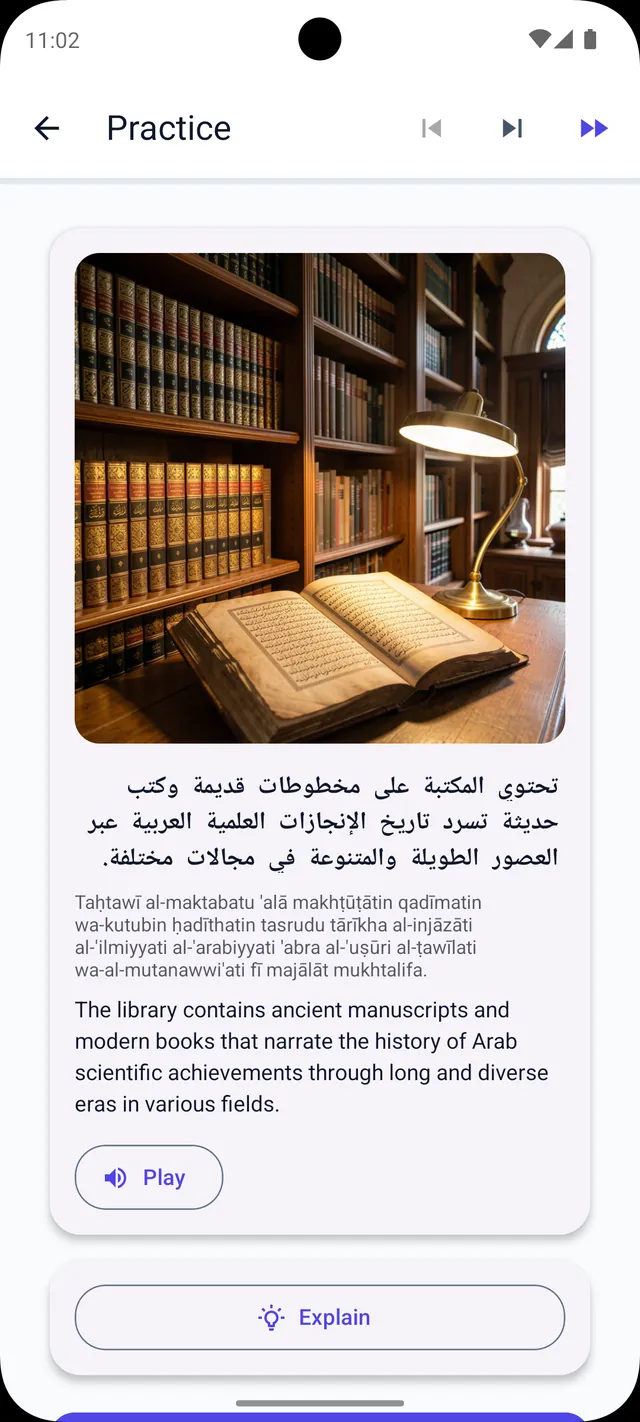
And Viglot only counts a word as learned once you've produced it yourself — said it out loud, rebuilt the sentence from scrambled pieces, placed it back in context. Recognition-only exercises fade out as you progress; production carries the weight. If you're not sure where your Arabic sits on the A1–C2 scale, see our guide to CEFR levels.
Full right-to-left support
Arabic script runs right to left, and plenty of apps treat that as an afterthought. In Viglot, RTL languages — Arabic, Persian, and Hebrew — get the same depth as the major European languages: the same exercise types, the same generated images and audio, the same spaced repetition. Word placement and sentence reconstruction exercises work naturally with Arabic script and right-to-left text direction. If Persian is on your list too, see learning Persian with Viglot.
Pronunciation feedback in Arabic
Arabic has sounds that don't exist in English or most European languages — the emphatic consonants, ʿayn, the throat sounds learners dread. Viglot's speech exercises have you read phrases aloud and score how the words came across, flagging the ones that didn't land cleanly. Speech recognition isn't perfect — it will mishear sometimes — but the signal is real, and it builds the habit of actually speaking instead of reading silently. Premium learners also get live conversation modes: Voice Tasks with a concrete goal, and "Make Yourself Understood," where the AI deliberately misunderstands you and you have to rephrase until your meaning lands.
Frequently asked questions
Which Arabic dialect should I learn first?
It depends on your goal. Choose Modern Standard Arabic if you mainly want to read and understand formal Arabic. Choose Egyptian Arabic for the widest reach in everyday conversation and media. Choose Levantine Arabic if your life connects to Lebanon, Syria, Jordan, or Palestine. Many learners eventually combine MSA with one dialect.
Does Viglot teach Modern Standard Arabic or a dialect?
Both. Viglot offers Modern Standard Arabic, Egyptian Arabic, and Levantine Arabic as three separate course options. Each gets the full set of 17 exercise types, pronunciation feedback, AI-generated scenarios, and per-word spaced repetition.
Does Viglot handle right-to-left Arabic script properly?
Yes. Arabic has full right-to-left support, and RTL languages get the same depth as the major European languages — the same exercise types, generated images, native-quality audio, and per-word spaced repetition.

Start learning the Arabic you'll actually use
Modern Standard, Egyptian, or Levantine — pick your Arabic, and practice it in scenarios built around your life. Free to start, no credit card.
Download Viglot