Learn Italian — conversation practice that scores you
Published July 10, 2026
Italian is a language people learn to speak — nobody dreams of silently reading a menu in Rome. Yet most apps teach it as a recognition game: tap the right tile, match the pairs, never open your mouth. Viglot flips that. Italian is one of its 42 languages, with lessons generated around your own interests at your CEFR level, a native-quality voice and matching image for every phrase, and spoken conversation practice with goals and honest scores. The whole app is tuned for intermediate and advanced learners (B1+) — the people who know some Italian already and want to actually use it.
Conversation first: speak Italian with a goal on the line
The centerpiece of Viglot's premium speaking practice is Voice Tasks: you enter a spoken conversation with a concrete goal — book the table, sort out the wrong order, negotiate the price at the market. Your conversation partner replies in character, in Italian, and you have to reach the goal through dialogue. No script, no answer tiles. At the end you get a verdict: did you pull it off, and what specifically worked or didn't. A conversation that can't go wrong can't tell you what to fix — so in Viglot, it can go wrong.
What Would You Say? works the moment before the conversation even starts: you see a situation, speak your response in Italian on the spot, and get scored on whether it was appropriate, grammatical, and natural.
Make Yourself Understood: the skill that saves you in Italy
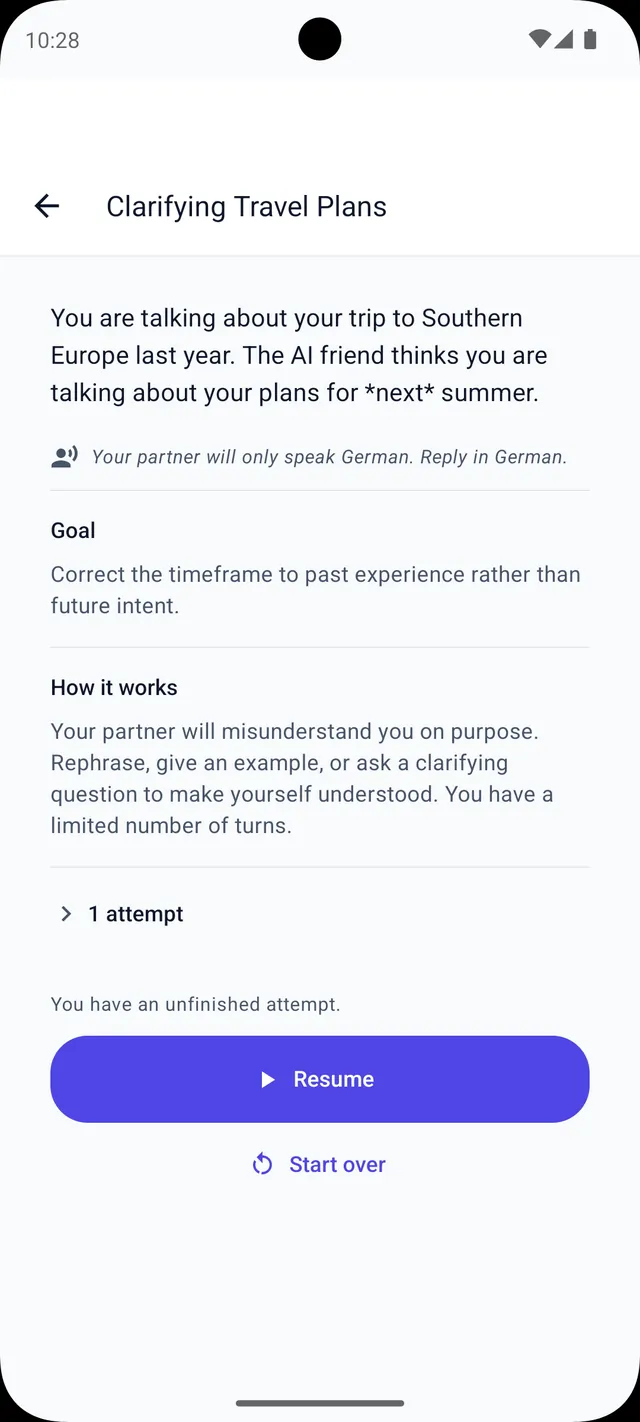
Real Italian conversations don't fail politely — the waiter squints, the landlord answers a different question than the one you asked. Make Yourself Understood trains exactly that: your conversation partner deliberately misunderstands you, and you rephrase, give an example, or clarify until your meaning lands. It's the repair skill that keeps a real conversation alive when your first sentence doesn't get through — and no textbook drills it.
Pronunciation confidence, word by word
Italian pronunciation is friendlier than most — but double consonants, rolled r's, and stress placement still separate "understood immediately" from "please repeat." Viglot's pronunciation practice has you read an Italian phrase aloud and tells you how the words actually came across, flagged individually — so you know exactly which word to work on instead of getting a single pass/fail. And because every phrase in every session is read aloud by a native-quality voice alongside a freshly generated image and the text, you've heard the rhythm and the melody of the sentence before you ever try to say it — three retrieval cues per phrase, every time.
Italian scenarios built around your interests
Tell Viglot what you actually care about — your work, your hobbies, the trips you're planning — and it generates complete Italian scenarios around those interests at your level: an evening market in a small town, an apartment viewing, a long dinner conversation about the things you'd actually talk about. Not a fixed lesson tree with the same topics for every learner. Vocabulary tied to your own life sticks; generic phrases about hobbies you don't have won't. For color beyond the language itself, cultural-nuance exercises turn real customs into predict-then-reveal questions — useful in a country where the gestures, the coffee rituals, and the regional differences carry as much meaning as the words.
And because Viglot supports any pair of its 42 languages in either direction, you can learn Italian from German, French, Spanish — whatever your base language is, that's the language your translations and instructions appear in. No routing through English.
Past the intermediate plateau
The Italian plateau usually looks like this: you follow conversations fine, but your own sentences stay short and your vocabulary stops growing. Viglot attacks it from two sides. First, a word only counts as learned once you've produced it — said it out loud, rebuilt the sentence, placed it back in context — so passive recognition never masquerades as ability. Second, per-word spaced repetition brings each word back just before you'd forget it, and adaptive difficulty follows what you actually retain, not just the level you picked. If that stuck feeling sounds familiar, the guide on getting from B1 to B2 digs into why the plateau happens and what breaks it.
Which CEFR level should you start Italian at?
Viglot covers the full range, A1 through C2, with 17 exercise types across the levels, and it's tuned for intermediate and advanced learners (B1+). Beginners are welcome — the early levels lean on recognition and word banks to build a base — though if you're starting Italian from absolute zero, a foundational course first won't hurt. Not sure where you stand? The guide to CEFR levels A1–C2 explains what each level actually means in practice.
Torn between Romance languages? Viglot gives Spanish and French the same full treatment.
Frequently asked questions
Can I practice speaking Italian without a partner?
Yes — that's what the speaking exercises are built for. In Voice Tasks you hold a spoken conversation with a concrete goal, your conversation partner replies in character in Italian, and at the end you're scored on whether you achieved the goal. Make Yourself Understood and What Would You Say? train rephrasing and on-the-spot responses the same way.
Can I learn Italian from German or French instead of English?
Yes. Viglot supports any pair of its 42 languages in either direction, so you can learn Italian from German, French, Spanish, or any other supported base language — your translations, instructions, and situation prompts appear in that language, not just English.
What level of Italian can I learn with Viglot?
Viglot covers CEFR A1 through C2 and is tuned for intermediate and advanced learners (B1+). Beginners are welcome — the early levels lean on recognition and word banks to build a base — but if you're starting from absolute zero, a foundational course first won't hurt.
Is Viglot free?
You can start free with a trial — no credit card. After that there's a paid plan. The premium exercises — live voice conversation, listening comprehension, cultural nuance, and graded grammar production — sit behind the paid tier; the core practice loop stays usable for free.

Start learning Italian today
Conversations with a goal and an honest score. Scenarios built around what you care about. A native-quality voice for every phrase. Free to start — no credit card.