Practice real conversations with an AI that actually listens
Most speaking apps let you talk and say "good job." Viglot gives every conversation a goal — buy the ticket, explain the symptoms, clear up the misunderstanding — then scores whether you actually pulled it off. Four speaking modes, each with a different job.
Why goal scoring beats free-form chatbot practice
Chatting freely with an AI feels like practice, but there's no way to fail — so there's no signal about whether you're improving. The chatbot keeps the conversation going no matter what you say, and a conversation that can't go wrong can't tell you what to fix.
Viglot structures every speaking exercise around a task with an outcome. You enter with a mission, the AI plays its role in the target language, and at the end you get a verdict: did your message land, and what specifically worked or didn't. Evaluation covers goal completion, grammar, vocabulary range, and confidence — with detailed feedback on strengths and weaknesses, not a thumbs-up.
These speaking exercises run real AI on every attempt, so they sit in the paid tier. You can start free with a trial — no credit card.
Speech exercises: pronunciation feedback on every attempt
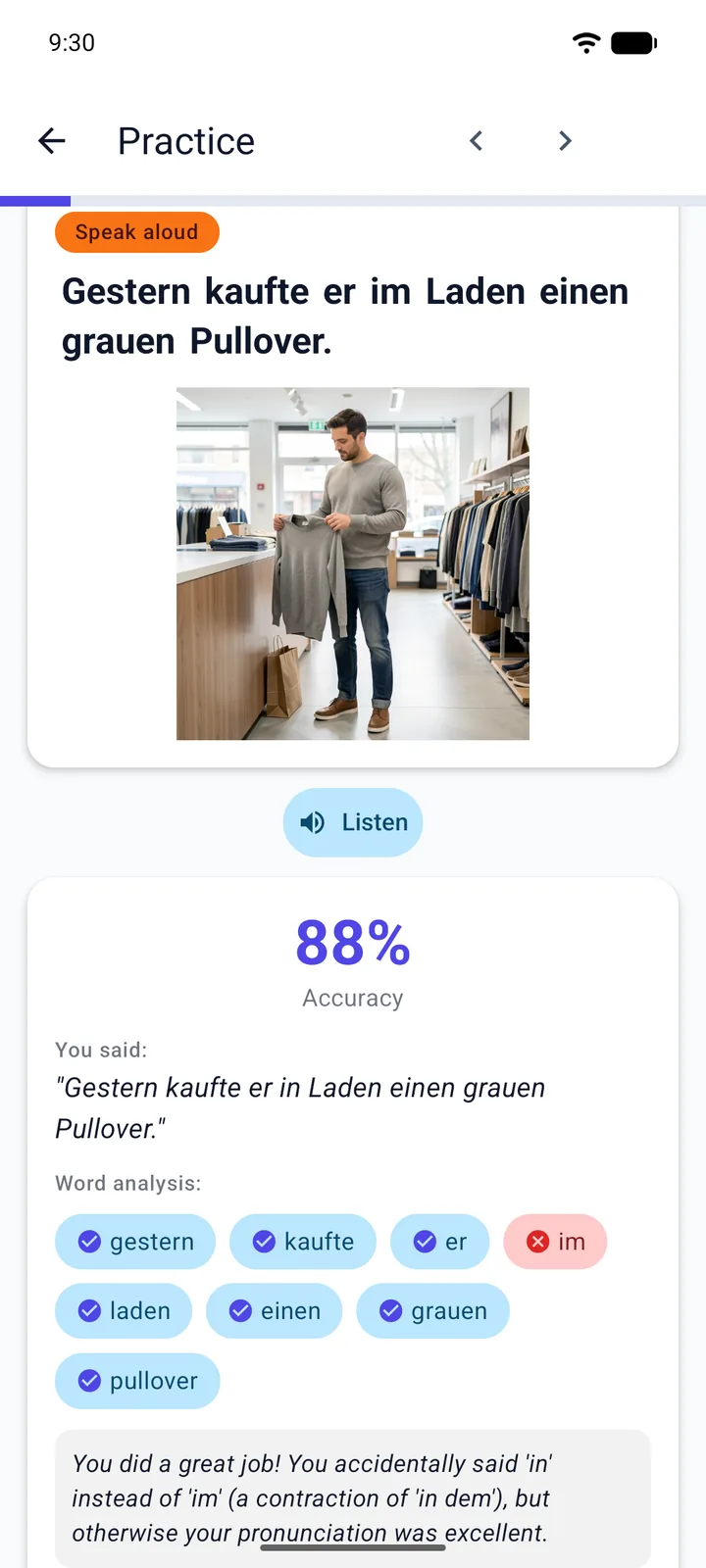
You read a target phrase aloud and record it. Speech recognition scores how the words came across and flags the ones that didn't land cleanly — word-level feedback, so you know exactly which sounds to work on rather than getting a single pass/fail.
Honest caveat: speech recognition isn't perfect and will mishear sometimes. The signal is useful, not flawless — but it builds the habit of speaking out loud instead of reading silently, which is where most self-study breaks down.
Voice Tasks: live AI conversation with a goal to complete
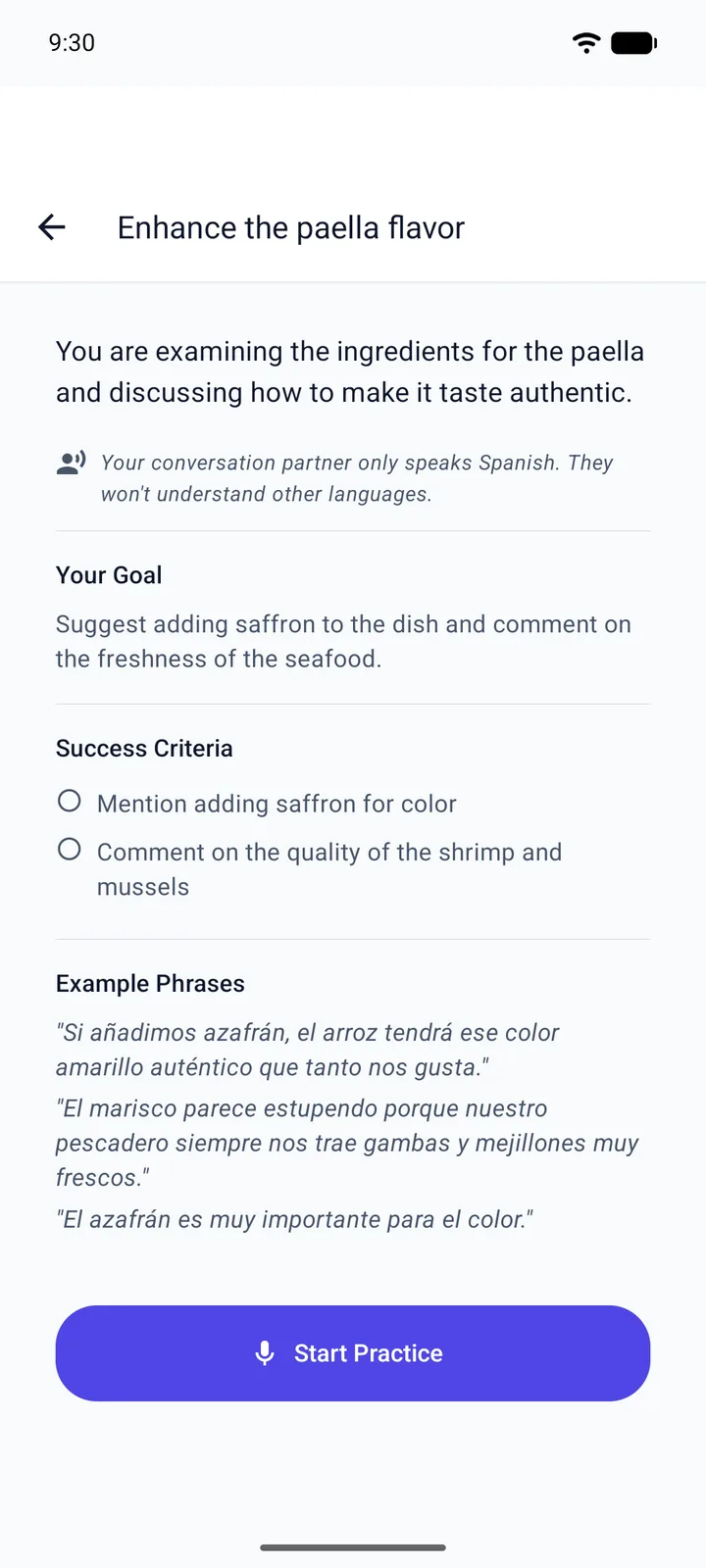
You enter a scenario with a specific goal — buy train tickets to Madrid, explain your symptoms, calm the client. The AI answers in character, in the target language, and you have to accomplish the goal through dialogue. No script, no multiple choice.
When the conversation ends, the evaluation covers four things: did you complete the goal, how your grammar held up, the range of vocabulary you used, and how confidently you spoke — with detailed feedback on strengths and weaknesses so the next attempt is better.
Make Yourself Understood: conversational repair practice
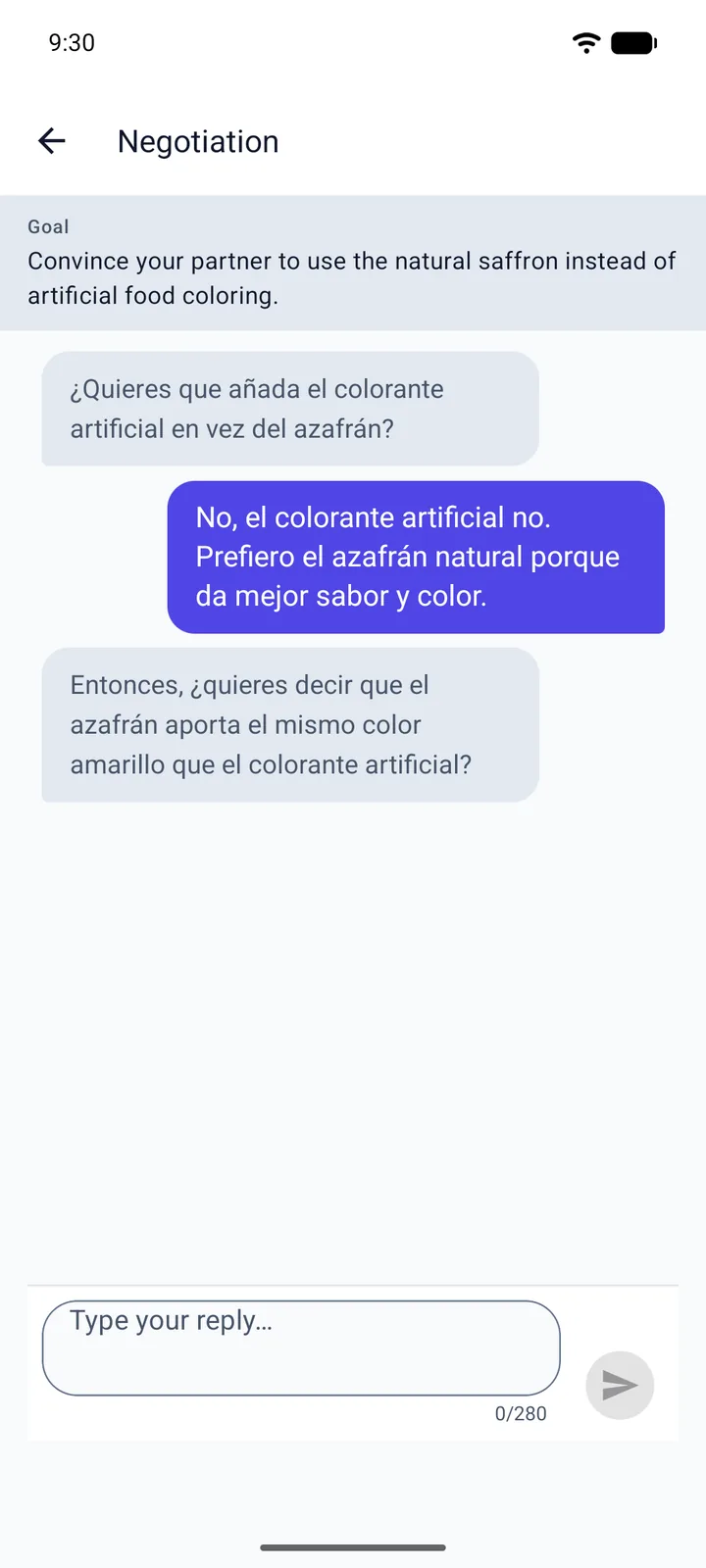
This is the skill no textbook teaches: being misunderstood and fixing it. The AI deliberately misunderstands you across a short dialogue, and you have to rephrase, give an example, or ask a clarifying question until your meaning lands.
The app then evaluates two things: whether the misunderstanding was actually resolved, and how good your repair strategy was. It's the exact muscle you use in a real conversation abroad, where the first version of your sentence often doesn't get through — and where giving up isn't an option.
What Would You Say? Spoken responses to real situations
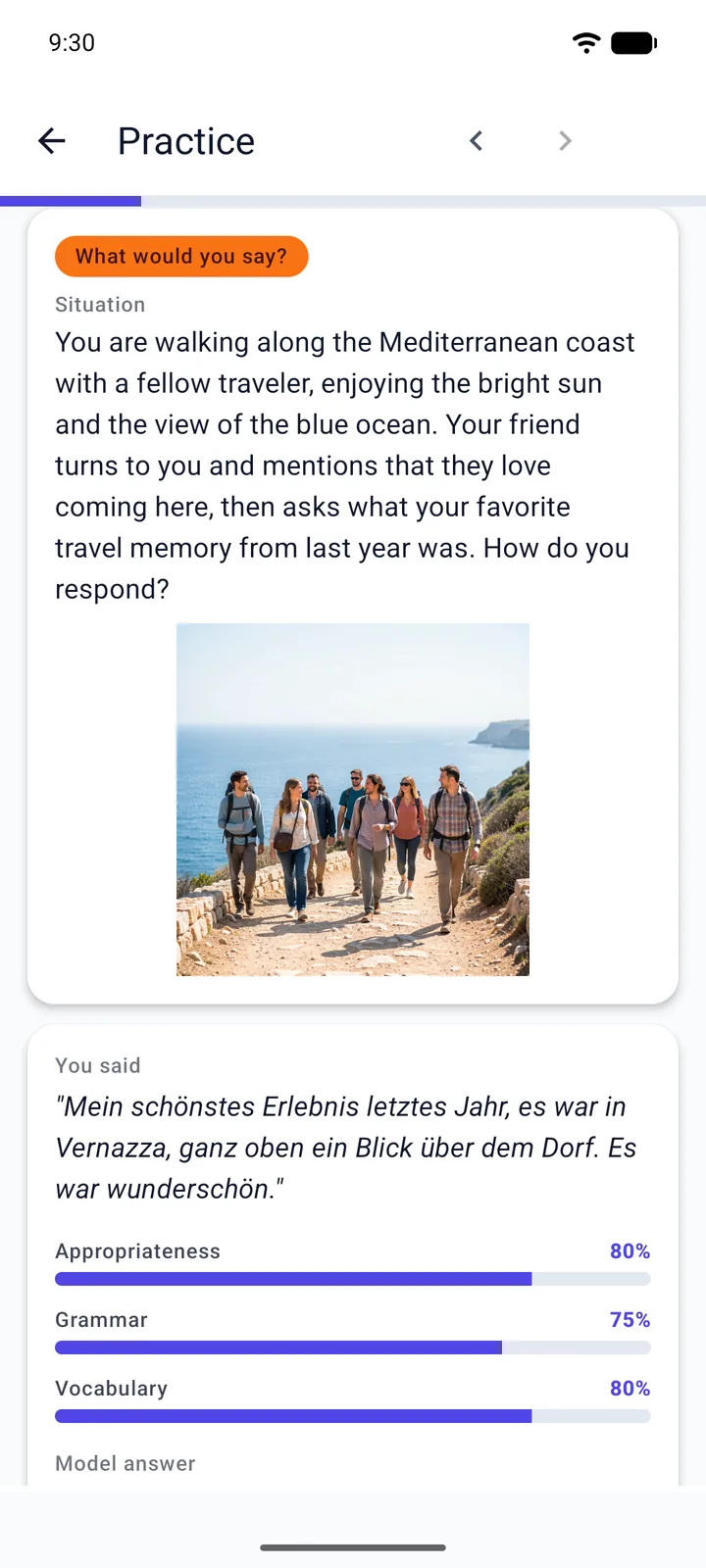
You see a situation described in your own language plus a scene image — and you speak your response in the target language. No answer options to lean on: you have to produce the response yourself, out loud, on the spot.
Your answer is scored on appropriateness, grammar, and vocabulary, and you get an ideal model answer in the target language to learn from. It trains the moment that matters most in real life: someone says something, and you have seconds to respond. Available from level A2 up.
Common questions about AI speaking practice
Can I practice speaking a language without a partner?
Yes — that's what these exercises are built for. You speak with an AI conversation partner that answers in the target language, and every conversation comes with a concrete goal. At the end, the AI tells you whether you accomplished it, with detailed feedback on strengths and weaknesses — the accountability you'd otherwise need a tutor for.
Does the AI correct my mistakes?
Yes. Speech exercises flag the words that didn't come across cleanly. Voice Tasks evaluate grammar, vocabulary range, and confidence alongside goal completion, with detailed feedback on strengths and weaknesses. What Would You Say? scores your response on appropriateness, grammar, and vocabulary, and shows an ideal model answer in the target language to learn from.
Which languages support voice practice?
All 42 supported languages get pronunciation feedback and the full set of exercise types — including Spanish, French, German, Arabic, Persian, Chinese, Japanese, Korean, Turkish, and Russian. Right-to-left languages like Arabic, Persian, and Hebrew are fully supported.

Speak, get scored, improve.
Four speaking modes, a goal in every conversation, and honest feedback on whether you pulled it off — across 42 languages.
Download Viglot