
French for Canada immigration: preparing for TEF Canada or TCF Canada, and for life in French
You are preparing for TEF Canada or TCF Canada, and for a working life in French. But most courses and apps teach café and holiday French, while you need to call a landlord, convince someone who disagrees, write a formal email and get through a job interview. Viglot lets you type that exact scene and builds the whole lesson from it: phrases with pictures and audio, exercises, listening and spoken role-plays with a conversation partner, explained in your own language. Below: the skills, phrase tables, register, a practice plan and notes for your first language.
Why a general app or course is not enough
A general French course is a good foundation, and a general app is fine for a start. But most of them teach the French of a tourist: ordering a coffee, booking a hotel, talking about your holidays and your hobbies. You need to get information on the phone, argue a point and write formally, then face job interviews, landlords, clinics, daycares and colleagues who do not slow down for you. These are the gaps general material tends to leave:
- Your skills move at different speeds. A course moves the class forward evenly and may not notice that your writing lags behind your listening.
- The tasks are specific. Asking for information, persuading someone who objects, arguing a point of view in writing: skills to drill, not topics met once.
- Your profession has its own vocabulary. A nurse needs triage and medication words, an engineer project and safety words, an early childhood educator words for meals, naps and small accidents.
- Workplace talk and phone calls are their own skill: fast, informal and without visual support.
- Patients and clients do not adjust to you. They speak quickly, worry and interrupt.
- Canada adds a regional layer of accent and vocabulary, one more reason to get your standard French solid first.
Viglot closes this gap by letting you practice exactly the scenes you will face, not a café or a beach. Here is how.
How Viglot solves this: you practice your own scenes
You create a course from your language to French at your level and type a topic: your test, or a scene from your job or your new life, in your own language or in French. Viglot builds a whole scenario around that one scene: phrases with a picture, native-sounding audio and a translation into your language, then exercises, listening and spoken role-plays that all use the same scene and its words. Explanations come in your language, and spaced repetition brings the words back so they stay. You practice your own conversations every day, without needing a partner.
- You need to prepare for the test itself. Type “TEF Canada” or “TCF Canada” as the topic and set your level in the course. Viglot plans a syllabus for that test, unit by unit at your level, each unit set in an everyday scene. Our exam preparation guide explains how this works.
- No course covers your job and your new life. Type the scene yourself, in your own language or in French, for example “Entretien d’embauche pour un poste d’infirmière”, “Accueillir un patient aux urgences” or “Recoger a mi hijo en la guardería y hablar con la educadora”. The more specific the scene, the more specific the vocabulary. Alternate test units and work scenes in one course.
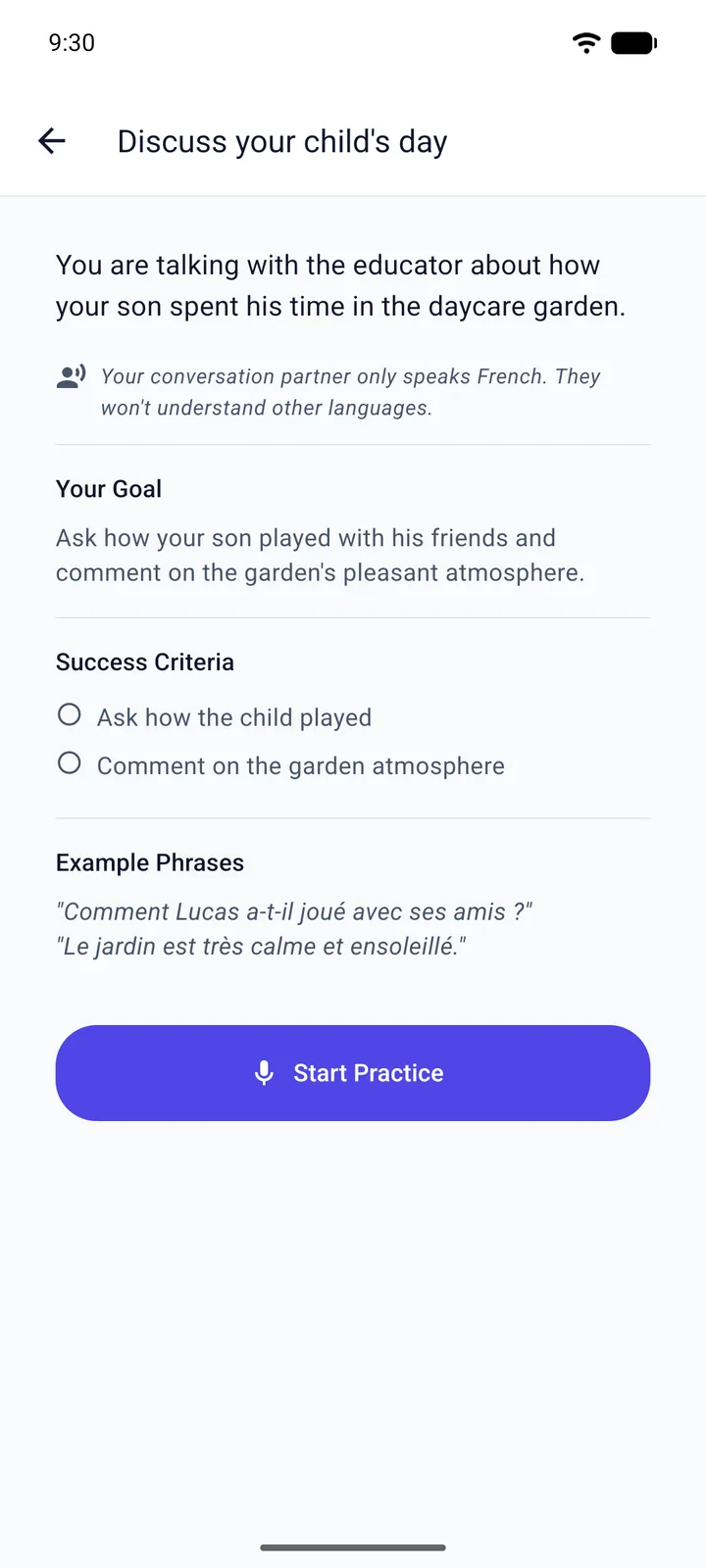
- You have no one to speak French with. Voice tasks are spoken role-plays with a conversation partner who stays in character. Before you start, you see the situation, your goal and the success criteria, and you can reveal example phrases. Afterwards you see whether you met each criterion, with feedback and corrections on what you said.
- You freeze when you must answer fast. What Would You Say? describes a situation in your own language; you answer out loud in French and compare with a model answer. People don’t understand you? Make Yourself Understood is typed: your conversation partner misunderstands on purpose, and you rephrase until your meaning lands.
- Your writing lags, or natural-speed French loses you. Grammar exercises make you produce French, not just recognize it, and In Your Own Words has you say the same thing in other words, for example more formally. Listening comprehension plays a dialogue set in the same scene, plus a monologue from A2 up.
- Everything explained in your language. Explanations, translations and task briefings come in the language you speak, such as Spanish (Latin America), Portuguese (Brazil), Persian or Arabic.
The core exercises and spaced repetition are free, with a limited number of new scenarios each week. Pronunciation, voice tasks, Make Yourself Understood, What Would You Say?, In Your Own Words, listening comprehension, cultural nuance and grammar exercises are Premium.
What Viglot is not. It is independent and not affiliated with Le français des affaires (CCI Paris Île-de-France), France Éducation international or Immigration, Refugees and Citizenship Canada. It offers no mock tests and cannot promise a score, a level or a visa. For timed practice, use the official sample material from Le français des affaires (TEF Canada) or France Éducation international (TCF Canada). Requirements differ between immigration programs and change, so check the current rules on IRCC’s website. This guide is not legal advice.
Speaking: asking for information and persuading
For many learners, speaking is the hardest skill, because you cannot cram it from a book. What counts, in the test and in real life, is doing the task: asking the questions a real person would ask, reacting to what the other person says, and building an argument someone could actually be convinced by.
Getting the information you need
Expect conversations in which you have to find something out. The same skill carries you through real life in Canada: calling about an apartment, a daycare place, a course or a job. Ask many different, well-formed questions, cover every aspect a real person would care about (price, times, conditions, what is included), and react to each answer before you ask the next one.
| Phrase | Use it to |
|---|---|
| Bonjour, je vous appelle au sujet de votre annonce. | say why you are calling |
| Je voudrais savoir si c’est encore disponible. | ask a polite yes-or-no question |
| Pourriez-vous me dire combien ça coûte exactement ? | ask for a precise detail |
| Est-ce que le prix comprend … ? | check what is included |
| Et en ce qui concerne les horaires, comment ça se passe ? | move on to the next topic |
| D’accord. Et s’il y a un problème, qui faut-il contacter ? | react, then ask a follow-up |
| Si je comprends bien, il faut réserver à l’avance ? | check that you understood |
| Excusez-moi, vous pourriez répéter un peu plus lentement ? | ask the other person to repeat |
| Très bien, merci beaucoup pour ces précisions. Bonne journée ! | close the call politely |
Persuading someone
Expect conversations in which you have to convince someone, and expect objections, as you would in any real conversation. A strong answer gives several different reasons, answers each objection instead of repeating the same argument, and stays friendly. Before you start, ask yourself what the other person cares about (time, money, health, family) and aim your arguments there.
| Phrase | Use it to |
|---|---|
| Tu sais, j’ai vu quelque chose qui devrait te plaire. | open the conversation |
| Ce qui est bien, c’est que … | give your first argument |
| En plus, … / Et puis, surtout, … | add a new argument |
| Je comprends que tu hésites, mais … | acknowledge an objection |
| Tu n’as pas tort, sauf que … | concede a point, then counter it |
| Imagine un peu : … | make the benefit concrete |
| Et si on essayait une seule fois, juste pour voir ? | offer a compromise |
| Alors, je compte sur toi samedi ? | ask for a decision |
Sample dialogue: convincing a friend to join the neighborhood community garden
Lucía : Tu sais, le quartier ouvre un jardin partagé derrière la bibliothèque. Je m’inscris, et j’aimerais bien que tu viennes avec moi.
Marc : Un jardin ? Je n’ai pas le temps, je travaille toute la semaine.
Lucía : Je comprends, mais ce n’est que deux heures le samedi matin. Et ce qui est bien, c’est que tu repars avec des légumes frais pour toute la semaine.
Marc : Je n’y connais rien, moi. Je ne sais même pas planter des tomates.
Lucía : Justement, il y a des bénévoles qui expliquent tout aux débutants. Et puis, surtout, c’est l’occasion de rencontrer les voisins. Tu disais l’autre jour que tu ne connaissais personne dans l’immeuble.
Marc : C’est vrai… Mais s’il pleut ?
Lucía : Alors on boit un café dans la serre et on prépare les semis. Écoute, et si on essayait une seule fois, juste pour voir ? Si ça ne te plaît pas, je n’insiste plus.
Marc : Bon, d’accord. Une fois.
Lucía : Super ! Alors je compte sur toi samedi, neuf heures.
Why this works: each objection gets its own answer (time, skill, weather), the arguments are concrete rather than general, Lucía reuses something Marc said earlier, and the compromise at the end lets him say yes without losing face.
Writing: accuracy, structure and register
Fluent speakers are often surprised by how hard writing is: agreement of adjectives and past participles, the subjunctive after il faut que, and a casual tone where a formal one was needed are mistakes a listener would never notice but a reader always does. Practice short opinion texts, reactions to something you read, and formal messages.
- Plan for two minutes before you write. One idea per paragraph, an example for each, and a clear conclusion. Linking words such as d’abord, ensuite, en revanche, par conséquent and pour conclure carry a lot of weight.
- Keep time to reread. Check the endings of every verb, adjective and past participle; that is where most mistakes hide.
- Write to the clock in practice, so you know how long a complete, well-structured text takes you and never run out of time before you reread.
- Match the register to the reader. A message to a friend uses tu and short sentences; a letter to an employer, a landlord or a newspaper uses vous and formal openings and closings.
Sample: a formal email to a landlord after a phone call
Objet : Visite de l’appartement, 12 rue des Érables
Madame, Monsieur,
À la suite de notre conversation téléphonique de ce matin, je vous confirme mon intérêt pour l’appartement de trois pièces. Comme convenu, je suis disponible jeudi à 18 heures pour la visite. Pourriez-vous me préciser si une place de parking est comprise dans le loyer ? Vous trouverez ci-joint une attestation de mon employeur ainsi que mes deux derniers bulletins de salaire.
Je vous prie d’agréer, Madame, Monsieur, l’expression de mes salutations distinguées.
Ana Ríos
The samples use standard French. In Canada you will more often see talon de paie for a payslip, stationnement for parking, apartments listed by room count as 3 ½ or 4 ½, and, outside Quebec, carte santé for the health card.
French for work and settling in: phrase tables
The test is a door, not the destination. Once you arrive, you will use French in interviews, with colleagues and clients, on the phone, in writing and in errands where nobody slows down for you. Practicing these scenes now pays off twice: they build the speaking and writing you need for the test, and they are the conversations of your first months. Each table below makes a good Viglot scene.
A job interview
| Phrase | Use it to |
|---|---|
| Je suis infirmière depuis huit ans, dont cinq en soins intensifs. | sum up your experience |
| Dans mon poste précédent, j’étais responsable de … | describe your responsibilities |
| Les démarches de reconnaissance de mon diplôme sont en cours. | explain where your credential recognition stands |
| Ce qui m’attire dans ce poste, c’est … | say why you want the job |
| Je peux vous donner un exemple concret. | back up a claim with an example |
| Mon point faible, c’est …, mais j’y travaille en … | answer the weakness question honestly |
| Comment se passe l’intégration des nouveaux employés ? | ask about onboarding |
| Quelles seraient les prochaines étapes ? | close the interview with a question |
Welcoming a patient at a clinic
| Phrase | Use it to |
|---|---|
| Bonjour, qu’est-ce qui vous amène aujourd’hui ? | ask the reason for the visit |
| Avez-vous votre carte d’assurance maladie, s’il vous plaît ? | ask for the health insurance card |
| Depuis quand avez-vous ces douleurs ? | ask when the symptoms started |
| Sur une échelle de 0 à 10, à combien évaluez-vous la douleur ? | ask about pain intensity |
| Prenez-vous des médicaments en ce moment ? | ask about current medication |
| Êtes-vous allergique à quelque chose ? | ask about allergies |
| Je vais prendre votre tension et votre température. | explain what you are about to do |
| Installez-vous, le médecin va vous recevoir dans quelques minutes. | ask the patient to wait |
Talking to parents at a daycare
| Phrase | Use it to |
|---|---|
| Bonjour ! Est-ce qu’il a bien dormi cette nuit ? | check in with a parent at drop-off |
| Votre fille a passé une très bonne journée. | start the pickup conversation on a positive note |
| Elle a bien mangé à midi, mais elle n’a pas beaucoup dormi à la sieste. | report on meals and nap time |
| Il est tombé dans la cour ; on lui a mis de la glace et tout va bien. | report a minor incident calmly |
| Pensez à apporter des vêtements de rechange demain. | give a friendly reminder |
| Je vous laisse un petit mot dans son cahier. | say you will follow up in writing |
On the phone at work
Phone calls are hard in any new language: no gestures, no lip-reading, and often a bad line. A few fixed phrases buy you time and make you sound in control.
| Phrase | Use it to |
|---|---|
| Bonjour, je vous appelle de la part de … | say who you are calling for |
| Ne quittez pas, je vous la passe. | put a caller through to a colleague |
| Je peux vous rappeler dans dix minutes ? | offer to call back |
| Je note : mardi à 14 heures, salle 3. C’est bien ça ? | read back details to check them |
| Pardon, la ligne est mauvaise. Vous pouvez épeler votre nom ? | ask someone to spell a name |
| Je vous envoie un compte rendu par écrit. | follow up a call in writing |
Register: vous, tu, and standard versus Canadian French
Use vous with anyone you don’t know, with patients, clients and parents, and in every formal text. In a role-play, follow the role: with an official or a stranger on the phone, vous; when the role is a friend, tu is natural. Whichever you choose, stay consistent.
In many Canadian francophone workplaces, especially in Quebec, colleagues often switch to tu sooner than they would in France. Let the other person lead, or simply ask: “On peut se tutoyer ?”
Viglot teaches standard French, not Canadian or Québécois French, and standard French is understood everywhere in Canada. There you will hear a different accent and local words such as courriel (email), fin de semaine (weekend), dépanneur (corner store) and magasiner (to go shopping). Pick them up as you meet them.
A 12-week plan, weakest skill first
In a test, as in your first months in Canada, your weakest skill is the one that holds you back: a fluent speaker who cannot write a formal email still gets stuck. So a balanced plan is the wrong plan. Measure first, then give your weakest skill about half your study time, the second weakest a quarter, and the rest to keeping the other two from slipping. Aim for 45 to 60 minutes a day, six days a week, and speak out loud every day.
| Weeks | Focus | What to do |
|---|---|---|
| 1 | Diagnose | Take the official sample material for your test, skill by skill and with real timing. Rank your four skills from weakest to strongest. |
| 2–4 | Rebuild the weakest skill | Half your time on that skill. Writing: one short text a day, then check the endings. Speaking: ten recorded minutes a day. Listening: natural-speed audio, first without, then with a transcript. Use settlement scenes: calls, appointments, an apartment search. |
| 5–8 | Train the task types | Each week, two timed information role-plays, two persuasion role-plays and two full-length texts. Switch to scenes from your profession: the interview, your first week, calls with clients or patients. |
| 9–11 | Measure again and rebalance | Repeat the timed sample tests. If another skill is now the weakest, it gets the half share. Keep speaking daily and keep writing to the clock. |
| 12 | Test conditions | One complete timed run of the official sample material, light review, and logistics: your booking, ID and route to the test center. |
Be honest with the calendar. Twelve weeks is one pass, not a promise: repeat weeks 2 to 11 as often as you need until every skill is where you want it. Our guide to how many hours each CEFR level takes helps you make a realistic estimate.
What changes with your first language
Where you start from shapes the route: which skills come easily, which mistakes you are likely to make, and where to spend most of your practice.
If Spanish is your first language
Shared Latin roots make reading and listening come quickly; the risk is in speaking and writing, where Spanish habits cause mistakes. Watch the false friends: entendre means to hear, not to understand (that is comprendre); attendre means to wait; rester means to stay; large means wide; constipé means constipated, not that you have a cold (that is enrhumé). In pronunciation, practice u versus ou (dessus, dessous), the nasal vowels (vin, vent, vont), silent final consonants and the voiced s between vowels: poisson is a fish, poison is poison.
Spanish grammar helps more than you might think: the subjunctive, two past tenses that split the work much as in French, and gender agreement are already familiar, so map them across instead of learning them from zero. What Spanish does not prepare you for is written French: silent endings (ils parlent sounds like il parle), accents that change the meaning (a and à, ou and où), and agreement you cannot hear. Write a little every day. In Viglot, choose Spanish (Latin America) as the language you speak, so explanations and briefings come in the Spanish you use every day.
If Portuguese is your first language
Portuguese already has nasal vowels and the sounds of j and z, so French sounds familiar, but the nasal vowels are not the same ones: train the four French nasals (vin, vent, vont, un) as new sounds. Brazilian speakers often add a small vowel after a final consonant, which turns parc into something like parqui; practice ending words cleanly. Separate u from ou, and watch the false friends: entendre means to hear, attendre to wait, prétendre to claim, not to intend, and pousser means to push, the opposite of puxar.
In Viglot, choose Portuguese (Brazil) as the language you speak, so every explanation and briefing comes in Brazilian Portuguese.
If Persian is your first language
Without a Romance head start, plan for a longer path and be patient with it. You do have help: Persian already uses French loanwords such as merci, ascenseur, chauffeur and ambulance. The hard parts are grammatical gender, which Persian does not have, the articles le, la, un and une, verb conjugation, and the vowels u, eu and the nasals. Learn every noun with its article from the first day, and give speaking and writing the larger share, since they are usually the bottleneck.
In Viglot, the whole interface can be in Persian, right to left, while the French phrases stay left to right. Explanations, translations and briefings come in Persian, so you never need English as a bridge.
If Arabic is your first language
If you grew up with French at school or at work, as many people in the Maghreb and Lebanon do, your listening and reading may already be strong: spend your time on written accuracy, especially agreement, on choosing the right register, and on timed practice of the task types. If French is new to you, plan for the full path and build speaking from the start.
Typical sound traps: p and b (pain is bread, bain is a bath), v and f, and the vowels u, ou and e. Grammatical gender exists in Arabic too, but it often differs from French, so learn every noun with its article. In Viglot you can choose Arabic (Standard), Arabic (Egypt) or Arabic (Shami) as the language you speak, with the whole interface right to left.