The exam preparation app that follows your syllabus: telc, Goethe, HSK, JLPT, IELTS and more
Published October 10, 2026
Viglot builds lessons around whatever you need to learn, and that includes your exam syllabus. Type the name of your exam into the topic field, and Viglot plans a syllabus for that program and level, then turns each unit into an everyday scene you practice with pictures, native-speaker audio, listening, grammar and real conversations. Want something else tomorrow, like your job or your next trip? The same field takes any topic.
Why prepare for your language exam with Viglot
Most exam preparation means word lists, grammar tables and mock papers. They have their place, but every modern language exam asks one question: can you actually use the language? You read a notice, follow an announcement, write a message, talk to an examiner. Here is what changes when you prepare with Viglot.
The syllabus becomes scenes you live through
Each unit of your plan has a title, a learning focus (the grammar, vocabulary and skills of that unit) and an everyday scene: a flat viewing, a call to the doctor’s office, a complaint at the bakery. Every exercise in the scenario follows that focus. You meet the unit’s words and structures inside a situation instead of a list, which is how exam tasks present them too.
Speaking practice in every scenario
Speaking is where many candidates lose the most points, because it is the one skill you can’t cram. Viglot has you speak: read phrases aloud and get pronunciation feedback, answer What Would You Say? situations out loud, and hold voice tasks, spoken conversations with a goal, where a conversation partner answers in character and tells you afterwards whether you reached it. Make Yourself Understood trains the repair moves examiners listen for: rephrasing, giving an example, asking back. That is useful for IELTS speaking, the DELE B2 oral, the telc B1 speaking part or the TOPIK speaking test alike. These speaking exercises are part of Premium, and you can try all of them free during the trial.
You cover the syllabus in order, and you know where you are
Viglot plans 6 to 12 units for your program and level, and each new scenario takes the next one. The plan covers the exam’s task types, so the different parts of the test come up along the way. Your course groups the scenarios under the level’s name, such as one “HSK 3” unit, so the path stays visible. When the plan is finished, it starts again as review passes instead of stopping.
Vocabulary that is still there on exam day
Cramming works until the next morning. Viglot schedules every word and phrase you practice with FSRS-6 spaced repetition and brings it back just before you would forget it, and the reviews make you produce it, not just recognize it. Start a few weeks ahead and the first units are still fresh when you sit the exam.
Any exam, in any of 40+ languages
There is no fixed list of supported exams. Viglot recognizes a program by what it is (an exam, a certificate, a proficiency test or a standardized syllabus), so “Goethe-Zertifikat A2”, “JLPT N4”, “DELF B1” and “TOPIK II” all work, with or without a level and typed in any language. That holds across all 40+ languages Viglot teaches, from German and Japanese to Finnish, Greek and Korean.
Learn from your own language
The app interface is available in 36 languages, and translations, explanations and feedback come in the language you learn from. An Arabic speaker preparing for telc Deutsch B1 gets German scenes explained in Arabic; a Brazilian preparing for IELTS learns in Portuguese. You never have to decode one foreign language to learn another.
How it works
Set up exam practice in three steps
Pick your languagesChoose the language you speak and the language of your exam: German for telc or Goethe, Chinese for HSK, Japanese for JLPT, English for IELTS or TOEFL.
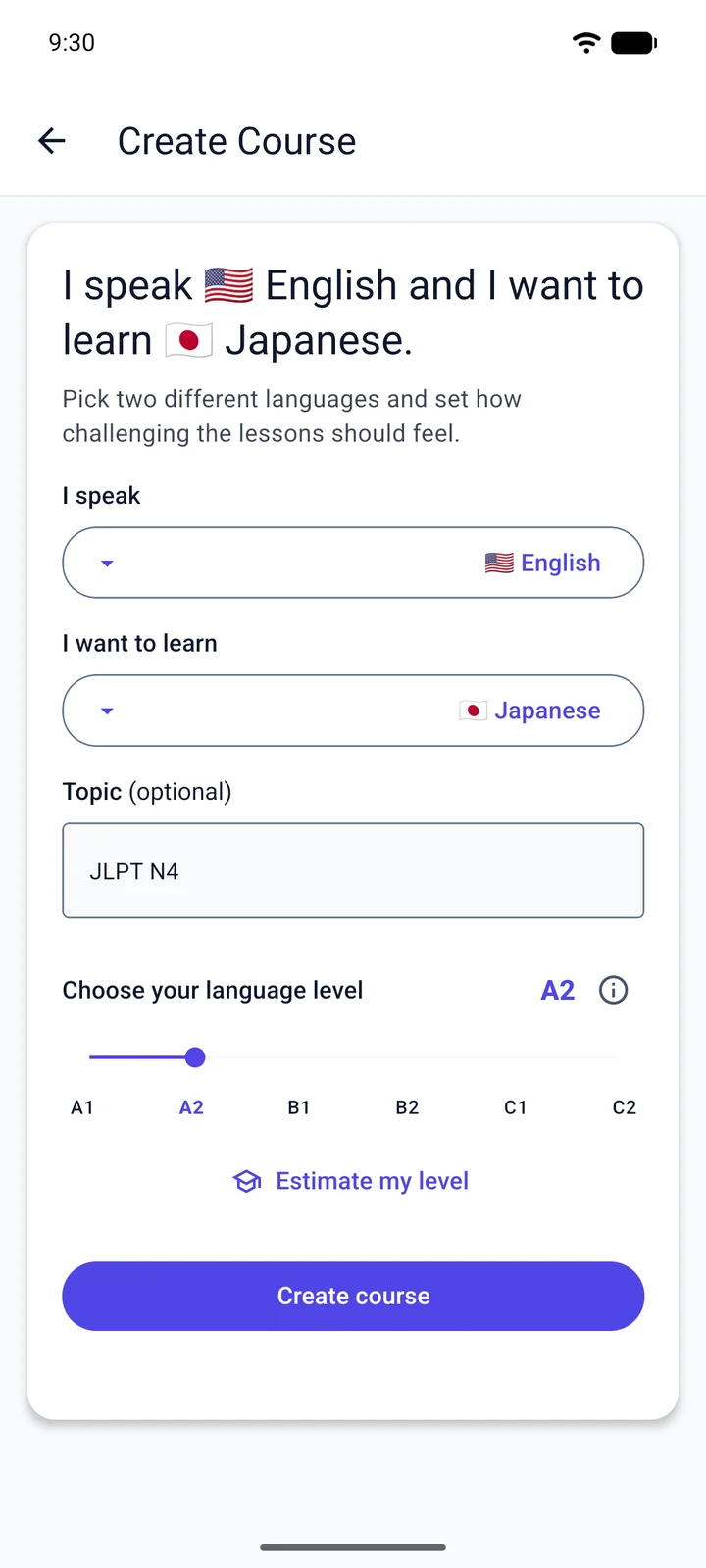
Type your exam or any topicEnter the exam or certificate in the topic field, for example “telc Deutsch B1”, “HSK 3” or “JLPT N4”, and set your level. The same field takes any other topic too: your job, a trip, a hobby.
Practice unit by unitViglot plans the syllabus for that program and level, and your first scenario follows unit one. Add the next scenario with the same exam name and level, and it picks up at the next unit, with cards, listening, cultural nuance and speaking practice on that unit’s focus, plus grammar exercises on the unit’s grammar focus (on by default from A2 to C1).
Not just exams: any topic, any goal
Exam preparation is one way to use Viglot, not the only one. The topic field takes anything you need the language for: your job, an upcoming trip, a hobby, a doctor’s visit, a football match, a family dinner, a work meeting. Viglot builds complete scenarios around it, at your level. Leave the field empty and you get varied everyday scenes.
You can mix freely inside one course. Practice the next telc unit on Monday, add a scenario about your real job on Tuesday and one about Friday’s flat viewing after that. Your exam plan keeps its place: a scenario on another topic neither uses up nor resets a unit. A few ideas:
Learn German for work: “handover on a hospital ward”, “appointment at the tax office”
Spanish for travel: “road trip through Andalusia”, “lost luggage at the airport”
Japanese for your hobbies: “buying a used guitar in Tokyo”, “joining a hiking club”
Everyday life: “parent-teacher meeting”, “family dinner”, “Saturday football match”
Exam preparation by language
These are the exams Viglot learners most often prepare for, each in a language Viglot teaches. Type the exam name and level the way you would say it. Any exam that isn’t listed works the same way.
German exam preparation: Goethe-Zertifikat, telc Deutsch, DTZ, TestDaF, DSH and ÖSD
Goethe-Zertifikat: the Goethe-Institut’s certificates from A1 (Start Deutsch 1) to C2; from B1 up, each skill is tested in a separate module. “Goethe-Zertifikat A1” or “Goethe B2” sets up the matching plan.
telc Deutsch: telc exams from A1 to C2, including the DTZ (Deutsch-Test für Zuwanderer, A2–B1) at the end of German integration courses and telc Deutsch C1 Hochschule for university admission. “telc B1 exam” and “DTZ” both work.
TestDaF and DSH: the two classic entrance exams for German universities. TestDaF reports levels 3 to 5 (roughly B2 to C1); the DSH is set by each university.
ÖSD: the Austrian German diploma, A1 to C2, widely used in Austria.
English exam preparation: IELTS, TOEFL iBT, Cambridge English, TOEIC and PTE Academic
IELTS: Academic or General Training, with a face-to-face speaking test. IELTS speaking practice is where daily voice tasks pay off most.
TOEFL iBT: the internet-based test used for university admission. Spoken answers are recorded rather than given to an examiner, so fluency under time pressure matters.
Cambridge English: A2 Key, B1 Preliminary, B2 First, C1 Advanced and C2 Proficiency, each tied to a CEFR level. The speaking test is usually taken in pairs.
TOEIC and PTE Academic: workplace English and a computer-based academic test. Type the test name and set your CEFR level.
French exam preparation: DELF, DALF, TCF and TEF
DELF and DALF: the French Ministry of Education’s diplomas, DELF A1–B2 and DALF C1–C2, valid for life. DELF B1 and DELF B2 are frequent goals for study and work.
TCF: a test that places you on the A1–C2 scale, with versions for immigration such as TCF Canada.
TEF: run by the Paris Île-de-France chamber of commerce and best known as TEF Canada for Canadian immigration.
Spanish exam preparation: DELE and SIELE
DELE: the Instituto Cervantes diplomas from A1 to C2, issued on behalf of Spain’s Ministry of Education and valid indefinitely. DELE B2 speaking practice (describing, arguing, reacting) fits voice tasks especially well.
SIELE: a computer-based test backed by the Instituto Cervantes and universities in Spain, Mexico and Argentina, reporting results from A1 to C1.
Italian certificates: CILS, CELI and PLIDA preparation
CILS (University for Foreigners of Siena), CELI (University for Foreigners of Perugia) and PLIDA (Società Dante Alighieri) all certify levels A1 to C2. B1 is the level asked for in Italian citizenship applications.
Portuguese exam preparation: CAPLE and Celpe-Bras
CAPLE (University of Lisbon) certifies European Portuguese, from CIPLE at A2 to DUPLE at C2, so choose Portuguese (Portugal) as your target. Celpe-Bras is Brazil’s official certificate: one exam, graded from intermediate to advanced superior, so choose Portuguese (Brazil).
HSK preparation (HSK 1–6 and HSK 3.0), HSKK and TOCFL
HSK: the standard Chinese proficiency test. Most learners know levels HSK 1 to HSK 6; the newer HSK 3.0 standard defines nine levels, and test centres are moving to it in stages. Type the one you’re preparing for, such as “HSK 3” or “HSK 3.0 level 4”.
HSKK: the separate speaking test (beginner, intermediate, advanced), where practicing out loud matters most.
TOCFL: Taiwan’s test, in traditional characters. Choose Chinese (Taiwan) as your target language.
JLPT N5–N1 practice
The Japanese-Language Proficiency Test runs from N5 (basic) to N1 (advanced) and is usually held in July and December, though some locations offer only one session. It tests vocabulary, kanji, grammar, reading and listening, with no speaking section. For JLPT N5, N4 or N3 practice, Viglot’s value is the vocabulary, the grammar focus and the listening in every unit, plus speaking practice that makes what you learn usable outside the exam hall.
TOPIK I and TOPIK II preparation
TOPIK I covers levels 1–2 and TOPIK II levels 3–6. Both test listening and reading, and TOPIK II adds writing; a separate TOPIK speaking test also exists. Type “TOPIK I” or “TOPIK II level 4” to plan the matching units.
TORFL (ТРКИ) preparation
The Test of Russian as a Foreign Language, ТРКИ in Russian, has six levels, from the elementary level (A1) up to TORFL-4 (C2); TORFL-1 (B1) is often required for university study. Typing “TORFL-1” or “ТРКИ-1” both work.
Dutch exam preparation: Staatsexamen NT2 and CNaVT
The Staatsexamen NT2 (Dutch as a second language) has Programme I at B1 and Programme II at B2, for work and study in the Netherlands. The CNaVT (Certificaat Nederlands als Vreemde Taal) tests Dutch in practical profiles from A2 to C1.
Swedish, Norwegian, Danish and Finnish: Swedex, TISUS, Norskprøven, Prøve i Dansk and YKI
Swedish: Swedex certifies A2, B1 and B2; TISUS is the test for university studies in Sweden.
Norwegian: Norskprøven tests reading, listening, writing and speaking, and is used for permanent residence and citizenship.
Danish: Prøve i Dansk 1, 2 and 3 follow the Danish language-school courses, and Studieprøven opens the way to higher education.
Finnish: YKI, the National Certificates of Language Proficiency, at basic, intermediate and advanced level; intermediate level 3 is the usual target for citizenship.
Polish, Czech, Greek and Turkish language certificates
Polish: the state certificate exams in Polish as a foreign language, A1 to C2; B1 is needed for Polish citizenship.
Czech: CCE, the Czech Language Certificate Exams of Charles University, A1 to C2.
Greek: the Certificate of Attainment in Greek (Ellinomatheia) from the Centre for the Greek Language, A1 to C2.
Turkish: the Turkish Proficiency Exam (TYS) of the Yunus Emre Institute and the TÖMER certificates used for university study in Turkey.
What Viglot is, and what it isn’t
Viglot is
A daily practice tool that follows your exam’s syllabus unit by unit, in everyday scenes.
Speaking, listening, grammar and vocabulary practice on each unit’s focus, with feedback.
Spaced repetition that keeps what you learn until exam day.
Viglot isn’t
Official preparation material. Viglot is not affiliated with or endorsed by the Goethe-Institut, telc, ETS, Cambridge, the Instituto Cervantes, the Japan Foundation or any other exam provider.
A mock-exam simulator. It doesn’t reproduce full papers, timings or official scoring.
A guarantee. Nobody can promise you a pass, and we won’t.
Our advice: practice with Viglot every day to build the skills, and work through the official sample papers from your exam provider in the final weeks to learn the format and the timing.
What’s free and what’s Premium
You can prepare for your exam with the free version. Premium adds the exercises that train the speaking and listening parts of the test.
Free
Your exam plan, unit by unit, in everyday scenes with images and native-speaker audio.
The core exercises: flashcards, multiple choice, fill-in-the-blank, sentence reconstruction, error correction, word placement and more.
Spaced repetition, with a limited number of new scenarios each week.
Premium
For the speaking part: pronunciation practice, voice tasks, Make Yourself Understood and What Would You Say?
Listening comprehension, grammar exercises, cultural nuance and In Your Own Words.
Many more new scenarios every week, enough for a new unit almost every day.
Try every Premium exercise free during the trial, no credit card needed.
FAQ
Questions about exam preparation with Viglot
Which exams does Viglot support?
Any language exam, certificate, proficiency test or standardized syllabus in any of the 40+ languages Viglot teaches. There is no fixed list: Viglot recognizes the program from its name, so telc, Goethe-Zertifikat, TestDaF, IELTS, TOEFL, Cambridge English, DELF, DELE, HSK, JLPT, TOPIK and many others work.
How do I start preparing for my exam?
Create a course, choose your languages, type the exam and level into the topic field, for example “telc Deutsch B1” or “HSK 3”, and set your level. Your first scenario follows unit one of the plan. For the next unit, add a new scenario with the same exam name and level.
Can I use Viglot for things other than exams?
Yes. Exams are one use of the topic field, not the only one. Type your job, a trip, a hobby, a doctor’s appointment or a family dinner, and Viglot builds the scenario around it; leave the field empty for varied everyday scenes. You can mix exam units and other topics in the same course, and your syllabus keeps its place.
Is Viglot official preparation material for telc, Goethe, HSK or JLPT?
No. Viglot is independent and not affiliated with any exam provider; exam names belong to their owners and are used only to describe what you can practice. Viglot doesn’t simulate full mock exams and can’t guarantee a pass, so combine it with your exam’s official sample papers.
Does Viglot help with the speaking part of the exam?
That is where it helps most. You read phrases aloud with pronunciation feedback, answer situations out loud and hold voice tasks: spoken conversations with a goal, where a conversation partner tells you afterwards whether you reached it and what to say better. The format differs from your exam’s oral, but the skill, speaking spontaneously on the unit’s topics, is the same.
What happens when I finish every unit of the syllabus?
The plan wraps into review passes: the next scenario starts again at unit one with new scenes, while spaced repetition keeps bringing back the vocabulary you have already practiced.
Is it free?
Yes, you can start free and try every Premium exercise free during the trial, no credit card needed. The free version covers your exam plan, the core exercises and spaced repetition, with a limited number of new scenarios each week. Pronunciation practice, voice tasks, Make Yourself Understood, What Would You Say?, In Your Own Words, listening comprehension, cultural nuance and grammar exercises are Premium.
Type your exam, practice the next unit every day and speak from the very first scenario, in 40+ languages. Start free, and try every Premium exercise free during the trial, no credit card needed.