
The German B1 speaking exam: every task, useful phrases and how to practice alone
Goethe-Zertifikat B1, ÖSD Zertifikat B1, telc Deutsch B1 and the DTZ all test speaking, usually in pairs, and their tasks overlap: introduce yourself, talk about a topic or a picture, give a short presentation, plan something with your partner. This guide explains what each task asks, gives you phrases that work and original sample answers, and shows where candidates lose points. It ends with a four-week plan for practicing on your own, no partner needed.
The B1 speaking exams at a glance
Four exams lead to a German B1 certificate, and their speaking parts have more in common than their names suggest. Every one of them includes the same task: planning something together with your partner. Goethe and ÖSD, which run one joint exam, add a short presentation and a round of feedback. telc and the DTZ open with a conversation about yourself and add a topic or a picture.
| Exam | Parts | Length | Preparation | Passing the speaking part |
|---|---|---|---|---|
| Goethe-Zertifikat B1 | 3: plan something together (Teil 1), present a topic (Teil 2), discuss the presentations (Teil 3) | About 15 minutes for two candidates | 15 minutes, on your own | Speaking is a separate module: at least 60 of 100 points |
| ÖSD Zertifikat B1 | 3: the same tasks as Goethe (one joint exam) | Same as Goethe | Same as Goethe | Same as Goethe: at least 60 of 100 points |
| telc Deutsch B1 (Zertifikat Deutsch) | 3: get to know each other (Teil 1), talk about a topic (Teil 2), plan something together (Teil 3) | About 15 minutes with two candidates | 20 minutes | At least 60%: 45 of 75 points, assessed separately from the written part |
| DTZ (Deutsch-Test für Zuwanderer) | 3: talk about yourself (Teil 1), talk about your experiences from a picture (Teil 2), plan something together (Teil 3) | About 16 minutes, usually in pairs | None: the keywords are on the task sheet | Results come as levels: a B1 certificate needs B1 in speaking; below A2 in speaking means no certificate |
Exam formats get revised from time to time, so look at the current model test for your exam before you start. The links to the official model tests are further down this page.
Introducing yourself and getting to know each other
telc Deutsch B1 opens with Teil 1, “Einander kennenlernen”: you and your partner get to know each other by asking and answering questions. The DTZ opens with “Über sich sprechen”: you take turns introducing yourselves from a few keywords on a sheet, such as your name, where you were born, where you live, your work and your family, and the examiner then asks each of you a follow-up question. That takes about two minutes per person.
This part feels like a warm-up, but it counts toward your result. Aim to sound like someone in a friendly conversation, not someone reading out a résumé: a sentence or two per keyword, one detail that makes the answer yours, and in telc, a question back to your partner.
| Phrase | Use it to |
|---|---|
| Ich heiße … und komme ursprünglich aus … | say who you are and where you’re from |
| Ich wohne seit … Jahren in … | say where you live and for how long |
| Ich arbeite als … / Zurzeit mache ich eine Ausbildung als … | talk about your job or your training |
| Ich bin verheiratet und habe zwei Kinder. | talk about your family |
| Außer … spreche ich auch … | list the languages you speak |
| Ich lerne Deutsch, weil … | explain why you’re learning German |
| In meiner Freizeit gehe ich gern … | talk about your free time |
| Und du? Woher kommst du? | hand the question back to your partner |
| Was machst du beruflich? | ask about your partner’s work |
| Das klingt interessant. Wie lange machst du das schon? | react and ask a follow-up question |
| Entschuldigung, könnten Sie die Frage bitte wiederholen? | ask the examiner to repeat a question |
Sample: introducing yourself from keywords
Ich heiße Tomasz Nowak und komme aus Polen, aus einer kleinen Stadt in der Nähe von Krakau. Seit vier Jahren wohne ich in Leipzig. Ich bin Elektriker und arbeite bei einer Firma, die Solaranlagen installiert. Ich bin verheiratet und wir haben eine Tochter. Sie ist sechs und spricht schon besser Deutsch als ich! Außer Polnisch spreche ich Englisch und ein bisschen Russisch. Deutsch brauche ich jeden Tag, vor allem bei der Arbeit, wenn ich mit Kunden spreche. Am Wochenende fahren wir oft mit dem Fahrrad an einen See.
Typical follow-up questions. In the DTZ they come from the examiner; in telc your partner asks similar ones, probably with du:
- Was gefällt Ihnen an Ihrer Arbeit?
- Wie haben Sie Deutsch gelernt?
- Was vermissen Sie aus Ihrer Heimat?
- Was möchten Sie in fünf Jahren machen?
- Wie verbringen Sie am liebsten Ihr Wochenende?
Answer follow-up questions in two or three sentences: the answer, a reason, an example. A one-word answer like “Gut” is correct German, but it gives the examiners nothing to rate.
Talking about a topic or a picture
In telc Deutsch B1, Teil 2 is “Über ein Thema sprechen”: you talk about a topic and exchange views on it with your partner. In the DTZ, Teil 2 is “Über Erfahrungen sprechen”: you each get a different picture, say what it shows and what situation it might be, and then answer the examiner’s questions about your own experience, for about three minutes per person. The prompts differ, so check your exam’s model test, but the same four steps carry you through both.
- Describe Say what the topic is about or what you see: who is in the picture, where they are, what is happening. Then say what you think is going on. A guess is fine, as long as you present it as one.
- Your own experience Connect it to your life: when did you last do this, and how did it go? A short story in the past tense tells the examiners more about your German than a list of facts.
- Your home country Compare: is this common where you come from, and what is different? One concrete example beats a general statement.
- Your opinion Say what you think and why. If you are talking with a partner, finish by asking for their view.
| Phrase | Use it to |
|---|---|
| Auf dem Bild sehe ich … | start describing the picture |
| Im Vordergrund … / Im Hintergrund … | say where things are |
| Ich vermute, dass … / Wahrscheinlich … | make a guess about the situation |
| Das kenne ich gut. Letztes Jahr habe ich … | link the topic to your own experience |
| Bei uns in … ist das ganz anders. | compare with your home country |
| In meinem Heimatland ist es üblich, dass … | describe what is normal at home |
| Meiner Meinung nach ist … | give your opinion |
| Ich finde das gut, weil … | give a reason |
| Was denkst du darüber? | bring your partner in |
| Das ist eine gute Frage. Ich glaube, … | win a moment to think |
Sample: talking about a picture of a weekly market
Auf dem Bild sehe ich einen Wochenmarkt. Im Vordergrund kauft eine ältere Frau Tomaten, und im Hintergrund stehen viele Stände mit Obst, Käse und Blumen. Ich glaube, es ist Samstagvormittag, denn der Markt ist sehr voll.
Ich gehe selbst gern auf den Markt, weil das Gemüse dort frischer ist als im Supermarkt. Außerdem kenne ich inzwischen ein paar Verkäufer, und wir reden immer kurz miteinander.
In meinem Heimatland, in Vietnam, kaufen viele Leute jeden Tag auf dem Markt ein, oft schon früh am Morgen. Supermärkte werden aber auch dort immer beliebter.
Meiner Meinung nach sind Märkte wichtig für eine Stadt: Man kauft regionale Produkte und trifft Menschen. Allerdings sind die Preise manchmal etwas höher.
Presenting a topic in five steps
In Goethe-Zertifikat B1 and ÖSD Zertifikat B1, Teil 2 is “Ein Thema präsentieren”. You choose one of two topics and present it for about three minutes, guided by five slides. You prepare in the 15 minutes before the exam, on your own. You may make notes, but you are expected to speak freely, so write keywords rather than full sentences.
The five slides ask for the same things every time. Learn the skeleton below, and on exam day all you have to do is fill it with the topic.
| Slide | Phrases |
|---|---|
| 1. Introduce your topic and how your talk is structured | Ich möchte heute über das Thema „…“ sprechen. Zuerst erzähle ich von meinen Erfahrungen, dann berichte ich über die Situation in meinem Heimatland. Danach spreche ich über Vor- und Nachteile und sage meine Meinung. |
| 2. Your own situation or an experience | Ich habe damit selbst Erfahrungen gemacht. Vor zwei Jahren habe ich … |
| 3. The situation in your home country, with examples | In meinem Heimatland ist das etwas anders. Zum Beispiel … |
| 4. Pros and cons, and your opinion, with examples | Ein Vorteil ist, dass … Ein Nachteil ist aber, dass … Ich persönlich finde, dass …, weil … |
| 5. Conclusion and thanks | Zum Schluss möchte ich sagen, dass … Vielen Dank fürs Zuhören! |
Sample presentation: working from home, slide by slide
Folie 1: Ich möchte heute über das Thema „Arbeiten im Homeoffice“ sprechen. Zuerst erzähle ich von meinen eigenen Erfahrungen. Danach berichte ich, wie die Situation in meinem Heimatland ist. Dann nenne ich Vor- und Nachteile und sage meine Meinung.
Folie 2: Ich arbeite bei einer Versicherung und bin seit zwei Jahren zwei Tage pro Woche im Homeoffice. Am Anfang war das schwierig, weil ich keinen Schreibtisch hatte und meine Kinder oft zu Hause waren.
Folie 3: In meinem Heimatland, in Brasilien, arbeiten heute auch viele Leute von zu Hause aus, besonders in den großen Städten. Dort braucht man oft mehr als eine Stunde bis zur Arbeit, zum Beispiel in São Paulo.
Folie 4: Ein großer Vorteil ist, dass man keine Zeit im Verkehr verliert. Man kann sich die Zeit auch besser einteilen. Ein Nachteil ist aber, dass man die Kollegen seltener sieht. Ich vermisse zum Beispiel die Gespräche in der Mittagspause. Meiner Meinung nach ist eine Mischung am besten: zwei oder drei Tage zu Hause und den Rest der Woche im Büro.
Folie 5: Zum Schluss möchte ich sagen: Homeoffice ist praktisch, aber nicht für jeden und nicht jeden Tag. Vielen Dank fürs Zuhören!
Notice the signposts: zuerst, danach, dann, zum Schluss. They help your listeners follow you, which counts toward coherence, and they give you something to hold on to when you lose your thread.
Feedback and questions (Teil 3)
Teil 3, “Über ein Thema sprechen”, takes about two minutes. After your presentation, you react to feedback and questions from your partner and the examiner. After your partner’s presentation, you give feedback on it and ask one question. So listen actively while your partner presents, and note one thing you found new or interesting: it becomes both your feedback and your question.
| Phrase | Use it to |
|---|---|
| Danke für deine Präsentation, sie hat mir gut gefallen. | open your feedback |
| Besonders interessant fand ich, was du über … gesagt hast. | say what stood out |
| Neu für mich war, dass … | mention something you learned |
| Ich habe noch eine Frage: Wie ist das bei dir, wenn …? | ask your one question |
| Danke für die Frage. Also, bei mir ist es so: … | start your answer to a question |
| Da hast du recht / Da haben Sie recht, daran habe ich nicht gedacht. | accept a good point |
| Vielleicht habe ich das nicht klar genug gesagt. Ich meine, dass … | clear up a misunderstanding |
Planning something together
This is the one task every B1 speaking exam shares. It is Teil 1 in Goethe and ÖSD (about three minutes) and Teil 3 in telc Deutsch B1 and the DTZ (about six minutes for the two of you in the DTZ). You and your partner get a situation and a few points to decide on, and together you plan something: an outing, a party, a visit, a favor for someone. It is the most interactive part of the exam, and the one where examiners hear most clearly whether you can hold a real conversation.
Think of it as a series of moves rather than a list of opinions: propose, react, agree or disagree politely, make a counterproposal, decide, and sum up at the end. Make sure every point on the sheet gets a decision, and keep your turns short so the conversation goes back and forth.
The phrases below use du, as two candidates often do; with the examiners, stay with Sie. If you and your partner prefer Sie, that works too, as long as you stay consistent.
| Move | Phrases |
|---|---|
| Propose | Wie wäre es, wenn wir …? Ich schlage vor, dass wir … Wollen wir …? |
| Ask for your partner’s view | Was meinst du? Was ist dir lieber: … oder …? |
| Agree | Gute Idee, so machen wir das. Da bin ich ganz deiner Meinung. |
| Disagree politely | Ich weiß nicht, ob das klappt, weil … Das ist eine Möglichkeit, aber … |
| Make a counterproposal | Was hältst du davon, wenn wir stattdessen …? Wir könnten auch … |
| Decide | Also, dann machen wir es so: … Gut, dann nehmen wir … |
| Sum up | Lass uns kurz zusammenfassen: … Ich kümmere mich um …, und du … |
Here is a complete example. The situation: your neighbor, Frau Becker, is moving away, and you want to throw her a farewell picnic. The points to decide: when, where, who brings what, and what to do if it rains.
Sample dialogue: a farewell picnic for a neighbor
Ana: Frau Becker aus dem dritten Stock zieht ja nächsten Monat zu ihrer Tochter nach Hamburg. Wie wäre es, wenn wir für sie ein Abschiedspicknick organisieren?
Karim: Gute Idee! Ich würde Sonntag in zwei Wochen vorschlagen, so gegen drei Uhr. Passt dir das?
Ana: Sonntag passt mir gut, aber um drei schaffe ich es nicht, ich arbeite bis zwei. Wollen wir lieber um fünf anfangen?
Karim: Einverstanden, um fünf. Und wo feiern wir? Im Hof ist ziemlich wenig Platz.
Ana: Stimmt. Was hältst du davon, wenn wir in den Park an der Ecke gehen? Dort gibt es Tische und Bänke.
Karim: Das finde ich gut, dann hat Frau Becker auch keinen langen Weg. Und was machen wir mit dem Essen? Ich könnte einen Kuchen backen.
Ana: Super. Ich frage die anderen Nachbarn, ob jeder etwas mitbringt, zum Beispiel einen Salat oder Getränke.
Karim: Gut. Aber was machen wir, wenn es regnet?
Ana: Daran habe ich noch gar nicht gedacht. Vielleicht können wir den Gemeinschaftsraum im Erdgeschoss reservieren?
Karim: Ja, das ist eine gute Lösung. Ich rufe morgen bei der Hausverwaltung an.
Ana: Also, lass uns kurz zusammenfassen: Sonntag in zwei Wochen um fünf im Park, bei Regen im Gemeinschaftsraum. Du backst einen Kuchen und kümmerst dich um den Raum, ich spreche mit den Nachbarn.
Karim: Genau, so machen wir es.
Why this works: every turn reacts to the one before it, both partners make proposals, each point gets a decision, the one disagreement comes with a reason and a counterproposal, and the last turn sums up who does what.
Topics to prepare
B1 tasks come from everyday life. You won’t know your exact topic in advance, but you can prepare words and an opinion for each area below. For every topic, make sure you can describe your own situation, compare it with your home country and say what you think, with a reason.
| Topic | Be ready to talk about | Words worth knowing |
|---|---|---|
| Work | your job and your day, colleagues, applying for a job, working from home | die Bewerbung, die Arbeitszeit, der Feierabend, kündigen |
| Housing | your apartment, neighbors, moving, looking for a place to live | die Miete, die Nebenkosten, der Umzug, die Hausverwaltung |
| Health | seeing a doctor, staying healthy, exercise and sleep | der Termin, die Krankenkasse, sich erkälten, sich krankmelden |
| Shopping | markets and supermarkets, buying online, returning things | die Quittung, das Angebot, umtauschen, online bestellen |
| Free time | weekends, hobbies, clubs, going out with friends | der Verein, ausgehen, sich verabreden, das Hobby |
| Travel | trips, vacation plans, where to stay, what went wrong | die Unterkunft, buchen, die Sehenswürdigkeit, Urlaub machen |
| Media | the news, streaming and TV, social media, your phone | die Nachrichten, die Werbung, soziale Medien, das Handy |
| Environment | recycling, saving energy, weather and climate | die Mülltrennung, Energie sparen, umweltfreundlich, das Klima |
| Celebrations | birthdays, holidays, traditions at home and in Germany | das Fest, feiern, einladen, die Tradition |
| Learning languages | why you learn German, what helps you, courses and apps | der Sprachkurs, üben, sich verbessern, die Prüfung |
| Food and cooking | eating habits, cooking at home or eating out, dishes from your country | das Gericht, das Rezept, selbst kochen, vegetarisch |
| Transportation | getting to work, buses and trains, cycling, traffic | die Verbindung, umsteigen, die Verspätung, die Monatskarte |
How the speaking exam is scored, and where points get lost
Each exam has its own rating sheet, but they all come down to one question: did you do what the task asked, in German your listeners can follow?
- Goethe-Zertifikat B1 and ÖSD Zertifikat B1 (one joint exam): speaking is a separate module worth up to 100 points, and you pass it with 60. Examiners rate whether you completed each task (Erfüllung). In the planning task and the presentation they also rate your vocabulary (Wortschatz) and grammar (Strukturen), plus how you interact while planning (Interaktion) and how coherent your presentation is (Kohärenz). Pronunciation (Aussprache) is rated across all three parts. If task completion gets zero points, the whole part scores zero.
- telc Deutsch B1: the oral exam is worth 75 points (15 for getting to know each other, 30 for the topic, 30 for planning together), and you pass it with 60%, that is 45 points, separately from the written part. The rating criteria are in the official practice test (Übungstest) on telc.net.
- DTZ: examiners rate how well you handle each task (Aufgabenbewältigung), your pronunciation and intonation (Aussprache/Intonation), fluency (Flüssigkeit), accuracy (Korrektheit) and vocabulary (Wortschatz). For a B1 certificate, you need B1 in speaking plus B1 in either the listening and reading part or the writing part. A speaking result below A2 (“unter A2”) means no certificate at all.
Six ways candidates lose points
- Reading a script. Notes are there to jog your memory, not to be read aloud. The examiner script in the Goethe practice set even asks candidates not to read everything off their notes. Write keywords, not sentences, and look at your listeners.
- Monologuing in the planning task. Two people taking turns at speeches are not having a conversation. Keep each turn to two or three sentences, and end many of them with a question to your partner.
- Ignoring your partner. React to what your partner just said before you add your own idea. “Gute Idee, aber …” followed by a reason shows more interaction than a perfect sentence that ignores them.
- Freezing instead of rephrasing. When a word is missing, talk around it: “so etwas wie …”, “das Ding, mit dem man …”, “mir fällt das Wort gerade nicht ein, aber …”. Silence gives the examiners nothing to rate; a workaround shows exactly the skill B1 is about.
- Skipping points on the sheet. Every guide point and every slide counts toward task completion, and each one you leave out costs points. Before you wrap up, glance at the sheet and check you covered them all.
- Running out of time. The parts are short. Spend two minutes on your first slide and you never reach your opinion or your conclusion, which count just as much. Practice with a timer until the length feels natural.
How to practice for the speaking exam on your own: a four-week plan
A partner helps, but you can do most of your preparation alone. What you need is to speak out loud every day, under a little time pressure, with honest feedback. Here is a plan for the four weeks before your exam. Every week, record yourself at least once, time it and listen back: you will hear the filler words, the long pauses and the repeated mistakes you never notice while speaking.
Week 1: Introduce yourself, and react out loud
Write keywords for your self-introduction (where you’re from, where you live, work, family, languages, free time) and practice until you can talk for two minutes without looking at them. Prepare answers to five likely follow-up questions. Then train quick reactions: in Viglot’s What Would You Say?, you see a situation and a picture, answer out loud, and get feedback on whether your answer was appropriate and correct, plus a model answer to learn from.
Week 2: Pictures, topics and opinions
Work through two topic areas from the list each day. Take a photo from a newspaper or your phone and describe it in the four steps: what you see, your experience, your home country, your opinion. To build the flexibility you need when a word is missing, rephrase sentences in writing with In Your Own Words: you get a phrase and rewrite it with different words and the same meaning.
Week 3: Presentations and planning conversations
If you are taking Goethe or ÖSD, build one five-slide presentation a day on a new topic: 15 minutes of keyword notes, then present it out loud in about three minutes and record it. If you are taking telc or the DTZ, spend that time on the topic or picture task instead. For the planning task, hold conversations with a goal: in Viglot’s voice tasks you speak with a conversation partner who answers in character, and afterwards you get a verdict on whether you reached your goal, with feedback on grammar, vocabulary, fluency and pronunciation.
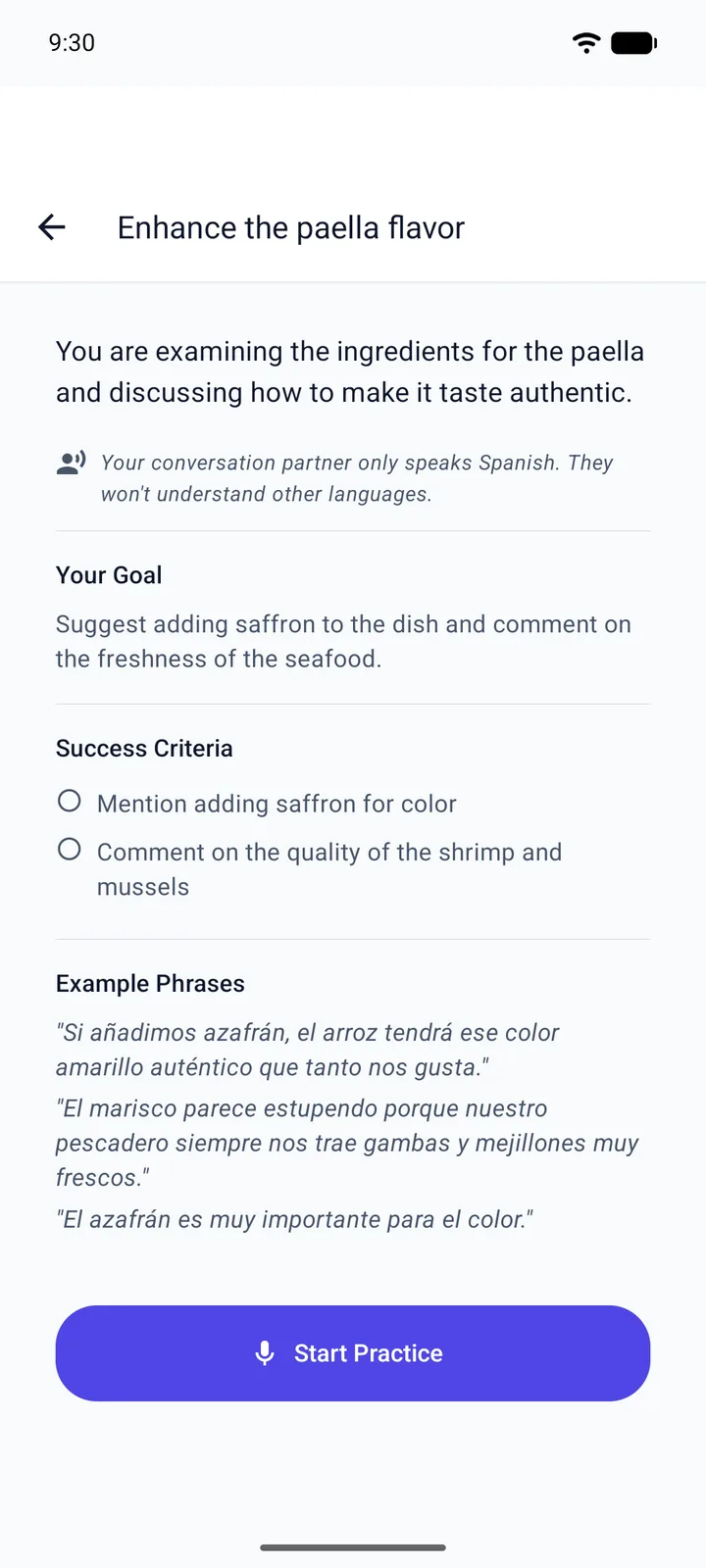
Week 4: Repair moves and the official model test
Practice getting unstuck. In Make Yourself Understood, your conversation partner misunderstands you on purpose, and you clarify, rephrase or give an example until your meaning lands. That is exactly what saves you when you freeze in the exam. In the last days, work through your exam’s official model test with real timing, ideally with a friend playing your partner, so the format holds no surprises.
To keep every scenario on exam themes, type “Goethe-Zertifikat B1”, “telc Deutsch B1”, “ÖSD Zertifikat B1” or “DTZ” as the topic when you create your course. Viglot plans the exam’s syllabus unit by unit, and each new scenario takes the next unit, with vocabulary, listening and speaking practice built around that unit’s theme.
The core exercises and spaced repetition are free. Pronunciation, voice tasks, Make Yourself Understood, What Would You Say?, In Your Own Words, listening comprehension, cultural nuance and grammar exercises are Premium, and you can try them all free during the trial, no credit card needed.
What Viglot is, and isn’t
Viglot is a daily practice app. It trains the skills the speaking exam rates, such as reacting quickly, planning with someone, giving an opinion and repairing a misunderstanding, in short scenarios on everyday themes, with feedback on what you said. Viglot is independent and not affiliated with the Goethe-Institut, telc or ÖSD. It does not simulate full mock exams and cannot guarantee a pass, so combine it with the official model tests: the Goethe-Zertifikat B1 practice set, the ÖSD Zertifikat B1 model test, the telc Deutsch B1 practice test and the DTZ model test.