
German for live-in carers: the conversations of a rotation in Austria and Germany
In 24-hour care you are alone with your client and their family for weeks. Nobody translates when the doctor’s practice calls back, when the daughter explains a new medication or when your client wakes at three in the morning and wants to go home, and a general German course never practiced any of these conversations with you. Viglot does: you type your own situation, such as calling the family doctor, and practice exactly that scene, out loud, until you can say your part. Below are the twelve situations every rotation brings, each with a short dialogue and a mistake to avoid, plus Austrian everyday words and a practice plan.
Why general courses and apps leave you unprepared
Most German courses and apps are written for a tourist or a newcomer: ordering coffee, booking a hotel, talking about hobbies and holidays. Those phrases are not wrong, but they are not the German of a rotation. Yours is domestic, physical and urgent, and you need it with nobody beside you to help.
- The vocabulary is specialized. Personal hygiene, continence, blood sugar, pressure sores, medication schedules: words a general course never reaches, and words you have to say respectfully.
- The talk is about work. Reporting, checking, suggesting, disagreeing politely with a relative: skills of the workplace, not of a café.
- Phone calls are hardest. No face, no gestures, background noise, a practice assistant in a hurry. Phone German needs its own practice.
- Your clients are not language teachers. They may be hard of hearing, confused or speak dialect, and their relatives may be stressed. You have to understand them anyway.
- Phrase lists stop at the first sentence. A printed list helps on day one, but real situations have a second and third turn, and that is exactly where conversations break down.
What works is practicing exactly the scenes you will face, the way they actually unfold and out loud, until you can say your part without thinking. That is what Viglot is built for.
How Viglot lets you practice your own rotation
You type the scene you need, in your own language or in German, for example “calling the family doctor because my client has a fever”. Viglot builds a whole lesson from that one scene: phrases with a picture, audio and a translation into your language, exercises that all use that scene and its words, a listening dialogue and a spoken role-play. Explanations come in your language, and spaced repetition brings the words back. You practice your own conversations daily, without needing a partner.
- A call to the doctor or a talk with the son → a voice task. A conversation partner plays the other side and stays in character. Before you start you see the situation, your goal and the success criteria, and you can reveal example phrases. Afterwards you see whether you met each criterion, with feedback and corrections on what you said.
- A question you didn’t see coming → What Would You Say? The situation is described in your language, for example the daughter asking how the night was. You answer out loud in German, then compare with a model answer.
- A relative or a practice assistant who doesn’t follow you → Make Yourself Understood. Your partner misunderstands you on purpose, and you rephrase in writing until your meaning lands.
- Sounding too blunt with the family → In Your Own Words. You say a sentence again with different words and the same meaning, for example more politely.
- Fast speech and unfamiliar customs → listening comprehension and cultural nuance. You hear a dialogue set in the same scene, and answer a question about a real custom in it, which is then explained.
- Want a certificate too? Type an exam name such as “ÖSD Zertifikat B1” as the topic and Viglot plans that level unit by unit, in everyday scenes. Alternate those with your own care scenes, which bring the care vocabulary. See the exam preparation guide and the guide to CEFR levels.
Example topics carers have good reason to type, in their own language or in German:
- Gespräch mit der Tochter über die Medikamente
- Nachts beruhigend sprechen, wenn die Seniorin nach Hause will
- Übergabe an die Ablöse am Ende des Turnus
- Kochen nach Diabetes-Diätplan
- Or in your own language: “Calling the family doctor because my client has a fever”
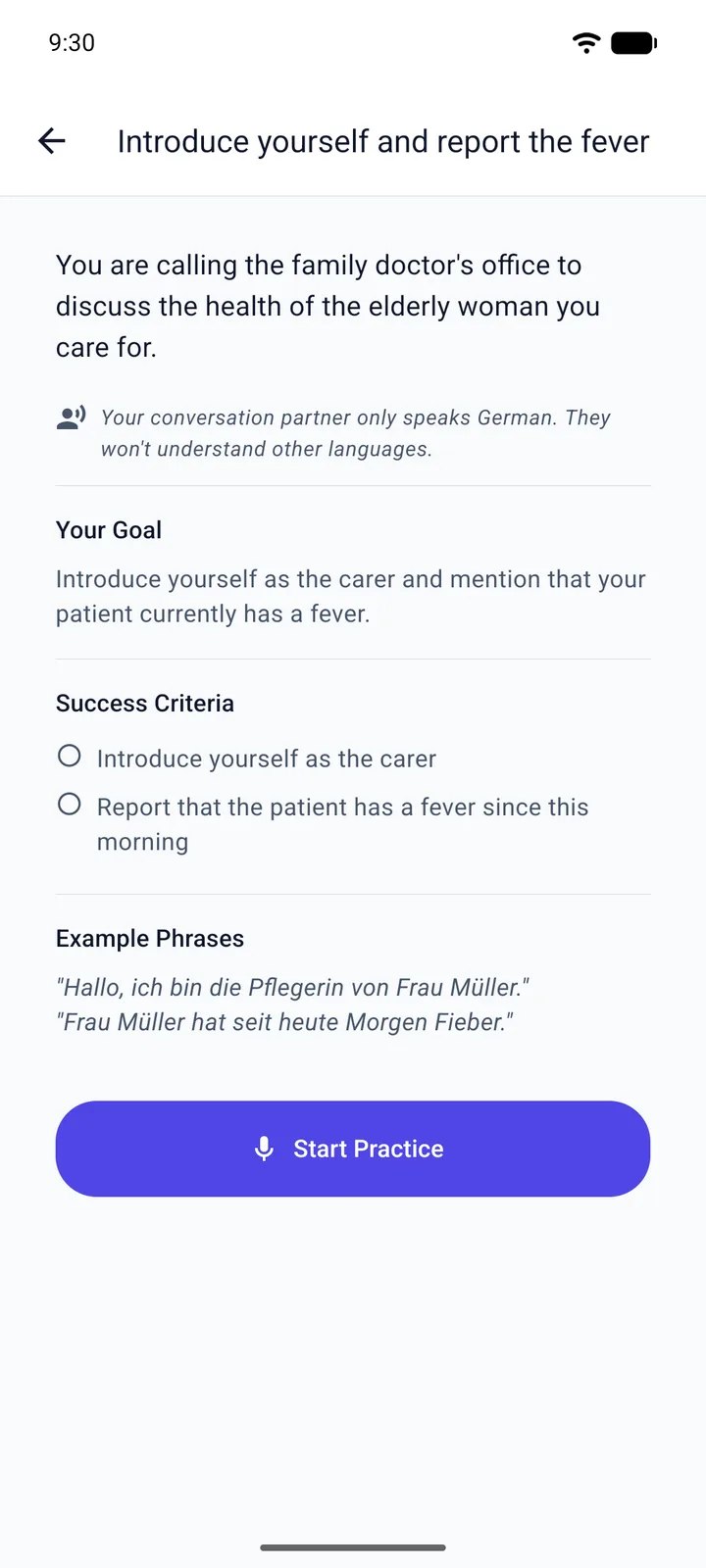
Viglot teaches standard German, not dialect: the dialect phrases on this page and time with your client cover that part.
The core exercises, spaced repetition and a limited number of new scenarios each week are free. Pronunciation, voice tasks, Make Yourself Understood, What Would You Say?, In Your Own Words, listening comprehension, cultural nuance and grammar exercises are Premium.
Viglot is independent and not affiliated with any agency, exam provider or authority. It cannot promise a placement, a certificate or a level, and its content is language practice, not care instructions.
The 12 situations of a rotation
The dialogues are short on purpose: this is the German of the job. The client in every example is the fictional Frau Huber, 87, who lives in a small Austrian town and has early dementia. Read each one aloud, then cover the carer’s lines and say them yourself.
1. Arrival: meeting the family
Dialogue: the daughter welcomes you at the door
Tochter: Grüß Gott, Sie sind sicher Frau Ionescu. Hatten Sie eine gute Fahrt?
Betreuerin: Grüß Gott! Ja, danke, ein bisschen lang, aber gut. Ich heiße Maria. Wie darf ich Ihre Mutter ansprechen?
Tochter: Sagen Sie einfach Frau Huber. Auf dem linken Ohr hört sie schlecht, sprechen Sie sie also bitte von rechts an.
Betreuerin: Gut, das merke ich mir. Können Sie mir zeigen, wo die Medikamente und die wichtigen Telefonnummern sind?
You greet, give your first name, ask how your client wants to be addressed and, on day one, ask where the medication and the important phone numbers are. Those two questions show the family straight away that you think ahead.
Mistake to avoid: greeting an 87-year-old with “Hallo” or using du because your course taught it first. Use Sie and “Frau Huber” or “Herr Huber” until they offer something else.
2. Morning care with a client who has dementia
Dialogue: waking up and washing
Betreuerin: Guten Morgen, Frau Huber. Ich bin’s, die Maria. Haben Sie gut geschlafen?
Frau Huber: Wer sind Sie? Wo ist meine Tochter?
Betreuerin: Ich bin die Maria, ich helfe Ihnen hier im Haus. Ihre Tochter kommt am Nachmittag. Jetzt helfe ich Ihnen beim Waschen, und dann gibt es Frühstück. Zuerst das Gesicht. Möchten Sie den Waschlappen selbst nehmen?
Frau Huber: Ja, das kann ich schon allein.
Betreuerin: Sehr gut. Und welche Bluse möchten Sie heute anziehen, die blaue oder die weiße?
Introduce yourself again every morning, without any hint of reproach. Give one step at a time, let her do what she still can and offer a choice between two things instead of an open question.
Mistake to avoid: long sentences with several instructions at once, or open questions like “Was möchten Sie anziehen?”, which overwhelm someone with dementia. And never “Sie kennen mich doch!” (“But you know me!”): it embarrasses her and fixes nothing.
3. Continence care, described with dignity
Dialogue: a discreet change
Betreuerin: Frau Huber, ich glaube, wir sollten die Einlage wechseln. Gehen wir kurz ins Bad?
Frau Huber: Ach, das ist mir so peinlich.
Betreuerin: Das muss Ihnen nicht peinlich sein, das passiert vielen. Ich mache die Tür zu, und wir machen das schnell zusammen.
| German | What it means |
|---|---|
| die Einlage / die Inkontinenzhose | the pad / the incontinence pants: neutral words adults accept |
| Müssen Sie auf die Toilette? | Do you need the toilet? |
| der Toilettenstuhl | the commode chair |
| Brennt es beim Wasserlassen? | Does it burn when you pass water? (worth telling the doctor) |
| Ich hole Ihnen frische Wäsche. | I’ll get you fresh underwear. |
Mistake to avoid: saying “Windel” (diaper), the word for babies, or mentioning it in front of visitors. Say “Einlage”, keep your voice low and close the door.
4. A diabetic meal plan
Dialogue: the son asks about cooking
Sohn: Der Arzt sagt, sie soll weniger Zucker essen. Haben Sie schon Erfahrung mit Diabetes?
Betreuerin: Ja, bei meiner letzten Klientin. Gibt es einen Ernährungsplan vom Arzt? Und soll ich die Blutzuckerwerte aufschreiben?
Sohn: Ja, der hängt am Kühlschrank. Aber sie isst so gern Mehlspeisen.
Betreuerin: Dann backe ich am Sonntag einen Apfelkuchen mit wenig Zucker. Ist ein kleines Stück in Ordnung, oder soll ich zuerst den Arzt fragen?
You show experience, ask for the doctor’s plan and what the family expects of you instead of guessing, and offer a solution that respects what the client loves. “Mehlspeisen” is the Austrian word for cakes, pastries and sweet dishes.
Mistake to avoid: missing that older people often say “Zucker haben” (literally “to have sugar”) for diabetes. If Frau Huber says “Ich hab Zucker”, she means her illness, not the sugar bowl.
5. Going through the medication with the daughter or son
Dialogue: the weekly pill organizer
Tochter: Schauen wir den Wochendispenser gemeinsam durch. Morgens die weiße Tablette für den Blutdruck, mittags nichts, abends eine halbe gelbe.
Betreuerin: Die halbe gelbe: vor oder nach dem Essen?
Tochter: Nach dem Abendessen. Und die Tropfen nur, wenn sie Schmerzen hat. Wie oft, steht auf dem Medikamentenplan.
Betreuerin: Ich wiederhole kurz, damit ich nichts verwechsle: morgens die weiße, abends nach dem Essen die halbe gelbe, die Tropfen nur bei Schmerzen und nach Plan. Und wenn sie eine Tablette ausspuckt, rufe ich Sie an.
| German | What it means |
|---|---|
| der Medikamentenplan | the medication schedule from the doctor |
| der Wochendispenser | the weekly pill organizer |
| nüchtern | on an empty stomach (in other contexts: sober) |
| die Tropfen, die Salbe, das Pflaster | drops, ointment, patch or plaster |
| das Rezept | the prescription (and also a recipe) |
| Habe ich das richtig verstanden: …? | Have I understood correctly: …? |
Mistake to avoid: nodding “ja, ja” to be polite while missing half of it. Repeat the schedule back in your own words. Relatives trust a carer who checks far more than one who always says yes.
6. Calling the family doctor
Dialogue: a fever since last night
Assistentin: Ordination Dr. Berger, grüß Gott.
Betreuerin: Grüß Gott, hier spricht Maria Ionescu. Ich bin die Betreuerin von Frau Anna Huber, Lindenweg 7. Frau Huber hat seit gestern Abend Fieber, 38,5, und sie hustet. Sie trinkt sehr wenig.
Assistentin: Hat sie Atemnot?
Betreuerin: Nein, sie atmet normal, aber sie ist sehr müde. Kann der Herr Doktor einen Hausbesuch machen?
Assistentin: Er kommt heute nach der Ordination, so gegen fünf.
Betreuerin: Danke. Ich wiederhole: heute gegen fünf Uhr. Auf Wiederhören.
A good call has a fixed order: who you are, who the patient is and where she lives, what happened and since when, the numbers (temperature, blood pressure, blood sugar), and what you need. In Austria you will often hear “Ordination” for the practice; in Germany it is the “Praxis”. On the phone, say goodbye with “Auf Wiederhören”.
Mistake to avoid: starting with the problem before saying who you are and who you are calling about, then struggling with numbers. Practice saying temperatures and times out loud: “achtunddreißig Komma fünf”, “Viertel nach acht”.
7. At the pharmacy
Dialogue: a medication that isn’t in stock
Betreuerin: Grüß Gott, ich hole ein Medikament für Frau Huber ab. Hier ist ihre e-card.
Apothekerin: Das haben wir leider nicht lagernd. Ich kann es bestellen, dann ist es morgen Vormittag da.
Betreuerin: Ja, bitte. Sie hat nur noch zwei Tabletten und nimmt eine am Abend. Reicht das bis morgen?
Apothekerin: Ja, das geht sich aus.
Betreuerin: Gut. Und haben Sie noch eine Creme gegen trockene Haut, ohne Parfum?
The e-card is the Austrian health insurance card; in Germany it is the “Gesundheitskarte”, often called the “Krankenkassenkarte”. Always count how many tablets are left before you go, so you can ask whether they will last.
Mistake to avoid: not understanding “Das geht sich aus”, an everyday Austrian phrase for “that will be enough” or “that works out”. You will hear it about time, money and tablets alike.
8. After a fall: the emergency call
Know the emergency numbers before you need them. On day one, ask the family which numbers to call for an ambulance, for the on-call doctor and for health advice when it is not an emergency, and write them on a card by the phone together with the full address, the floor and the doorbell name.
Call script: Frau Huber has fallen in the bathroom
Leitstelle: Rettungsnotruf. Wo genau ist der Notfallort?
Betreuerin: Lindenweg 7 in Kirchdorf, ein Einfamilienhaus, das Bad ist im ersten Stock.
Leitstelle: Was ist passiert?
Betreuerin: Eine 87-jährige Frau ist im Bad gestürzt. Sie ist wach und spricht, aber sie kann nicht aufstehen. Ihre rechte Hüfte tut sehr weh.
Leitstelle: Blutet sie? Atmet sie normal?
Betreuerin: Sie blutet nicht, sie atmet normal. Sie hat Demenz und nimmt Medikamente für den Blutdruck.
Leitstelle: Wer spricht?
Betreuerin: Maria Ionescu, ich bin ihre Betreuerin. Meine Handynummer ist 0664 …
Leitstelle: Bleiben Sie am Telefon.
Where, what happened, how she is now, who is calling. Then do what the dispatcher tells you and let them end the call. When the ambulance crew arrives, hand them the medication schedule.
Mistake to avoid: panicking about grammar. In an emergency nobody grades your German: short sentences and a complete address are what count. Practice this script until you can say it without reading.
9. A calm night when she “wants to go home”
Dialogue: three in the morning
Frau Huber: Ich muss jetzt nach Hause, meine Mutter wartet auf mich.
Betreuerin: Sie möchten nach Hause. Sie denken an Ihre Mutter.
Frau Huber: Ja, sie macht sich sicher Sorgen.
Betreuerin: Erzählen Sie mir von Ihrer Mutter. Wie war sie denn?
Frau Huber: Streng. Aber sie hat den besten Apfelstrudel gemacht.
Betreuerin: Apfelstrudel! Den backen wir morgen zusammen. Jetzt ist es mitten in der Nacht und draußen kalt. Ich bleibe bei Ihnen. Möchten Sie einen warmen Tee?
Many carers find that arguing with the facts makes nights worse. What tends to work better: name the feeling, let her talk about the person she is thinking of, then offer something concrete and calm, like tea, a blanket or a photo album. Speak slowly and quietly.
Mistake to avoid: “Ihre Mutter ist doch schon lange tot.” (“But your mother died long ago.”) It is true, and she may experience the loss as if for the first time.
10. A client who is hard of hearing or speaks dialect
| German | What it means |
|---|---|
| Haben Sie die Hörgeräte drin? | Are your hearing aids in? |
| Soll ich es aufschreiben? | Shall I write it down? |
| Wie bitte? Können Sie das noch einmal sagen? | Sorry? Could you say that again? |
| Meinen Sie …? | Do you mean …? (check instead of guessing) |
| Geh, bring ma a Glasl Wasser. | Austrian dialect for “Bring me a glass of water, would you?” |
| I hob kan Hunger. | Dialect for “Ich habe keinen Hunger”: I’m not hungry. |
Face your client in good light so they can see your lips, and speak slower and lower, not louder. Many older people in rural Austria and southern Germany speak dialect. You don’t need to speak it, but learn the common forms: “i” for ich, “hob” for habe, “kan” (in Bavaria “koan”) for keinen, “a” for ein.
Mistake to avoid: shouting. A raised voice distorts sounds and sounds angry. If something is still not understood, write one or two keywords in large letters.
11. Telling relatives about last night
Dialogue: the son calls in the morning
Sohn: Wie war die Nacht?
Betreuerin: Ehrlich gesagt, eher unruhig. Ihre Mutter ist zweimal aufgestanden, gegen eins und gegen vier. Beim zweiten Mal wollte sie nach Hause gehen. Wir haben zusammen Tee getrunken, danach hat sie bis sieben geschlafen. Gestürzt ist sie nicht.
Sohn: Hat sie gestern etwas gegessen?
Betreuerin: Zum Abendessen nur eine halbe Portion, aber sie hat gut getrunken, ungefähr anderthalb Liter. Wenn das so bleibt, sollten wir es dem Hausarzt sagen. Was meinen Sie?
Facts first, with times. Then what you did, how it ended and a suggestion that leaves the decision to the family. Relatives, the doctor and the next carer all want this kind of short spoken report, so it is worth practicing until it flows.
Mistake to avoid: saying “Alles gut” to spare the family, who then hear otherwise later. And watch the grammar: past events take the perfect tense, and verbs of movement or change take sein: “sie ist aufgestanden”, “sie ist gestürzt”.
12. The handover note for the next carer
Sample handover note
Übergabe für Elena, Freitag
- Medikamente: neuer Medikamentenplan seit Montag, er liegt in der Küchenlade. Abends jetzt nur eine halbe gelbe Tablette.
- Hausarzt: Kontrolle bei Dr. Berger am Donnerstag um 10 Uhr, die Tochter fährt.
- Nächte: meistens ruhig. Manchmal will Frau Huber gegen vier nach Hause, dann helfen Tee und das Fotoalbum.
- Essen: wenig Zucker (Diabetes). Sie mag Gemüsesuppe und Topfen mit Kräutern.
- Einkaufen: am Samstag mit dem Sohn. Das Haushaltsgeld ist in der blauen Dose, die Rechnungen liegen dabei.
- Wichtig: Die Tochter möchte nach jedem Sturz sofort angerufen werden.
A good handover covers changes to the medication, upcoming appointments, how the nights go, food, money and what the family has asked for. Write it during the rotation, a few lines each evening, not in the last hour before your bus. “Lade” is Austrian for drawer, “Schublade” in Germany.
Mistake to avoid: writing only in your own language because the next carer is from your country too. The family and the doctor may need to read it, so keep at least the medication and the appointments in German.
Austrian everyday words, and Sie or du
Most courses teach the German of Germany. In an Austrian household you will hear different words for food, months and things around the house from the first day. You don’t need to use them yourself, but you need to understand them when you go shopping or cook.
| In Austria | In Germany | Meaning |
|---|---|---|
| Grüß Gott / Servus | Guten Tag / Hallo | hello (Servus only with people you call du) |
| Paradeiser | Tomaten | tomatoes |
| Erdäpfel | Kartoffeln | potatoes |
| Topfen | Quark | curd cheese |
| Obers / Schlagobers | Sahne / Schlagsahne | cream / whipped cream |
| Semmel | Brötchen | bread roll |
| Karfiol | Blumenkohl | cauliflower |
| Marille | Aprikose | apricot |
| Jänner | Januar | January |
| Sackerl | Tüte | plastic or paper bag |
| Polster / Leintuch | Kissen / Bettlaken | pillow / bed sheet |
| Stiege | Treppe | stairs |
Sie or du: with your client and their family, start with Sie and the surname, and switch to du only when they offer it. Some families soon call you by your first name while still saying Sie (“Maria, könnten Sie…”); that is friendly, not an invitation to say du back. Many older Austrians still value titles: if the door sign says “Dr.”, say “Herr Doktor” or “Frau Doktor” until told otherwise. With other carers, du is usual.
A plan: four weeks before you leave, ten minutes a day on rotation
Most carers have neither a teacher nor regular free time. This plan needs only a phone and the quiet half hour you can find most days. Speak out loud every time: you are preparing for conversations, not for a written test.
Week 1: arrival, mornings and meals
Learn dialogues 1 to 4 until you can say the carer’s lines without reading. Add the Austrian words from the table if your placement is in Austria. Each day, describe your own morning routine out loud in German for one minute.
Week 2: medication, the pharmacy and the doctor
Work through dialogues 5 to 7. Practice numbers until they come without thinking: temperatures, blood pressure, times, dates and phone numbers. Rehearse the call to the doctor in the fixed order: who you are, who the patient is, what and since when, the numbers, what you need.
Week 3: emergencies, nights and difficult conversations
Learn the emergency script by heart and say it once a day, with a different made-up address each time. Practice the night dialogue and the phrases for clients who are hard of hearing.
Week 4: reporting, handover and talking about your work
Tell an imaginary son about an imaginary night, in the perfect tense. Write two handover notes. Then record yourself talking about your work for one minute at a time: what you did for your last client, how you calm a restless night, what you like to cook. Listen back: long pauses and one-word answers are what to work on first.
During the rotation: ten minutes a day
Each evening, take the situation you found hardest that day, practice it for ten minutes and review yesterday’s words. Once a week, write a handover note even if nobody asked for one.
When the family or a doctor asks you something, answer in two or three sentences: the answer, a concrete detail, and if it fits, a question back. “Ja” is correct German, but it doesn’t show anyone that you can explain what happened.
This guide is about language. The rules for 24-hour care differ between Austria and Germany and change, so check what applies to you with your agency and the official sources, such as the Austrian social affairs ministry’s page on 24-hour care.
Notes for speakers of your language
For Romanian speakers
Romanian helps more than you might think: like German, it has a polite form for older people, so Sie will feel natural, and “rețetă” works just like “Rezept”, meaning both a prescription and a recipe. The hard parts lie elsewhere. German genders rarely match the Romanian ones, so learn every noun with der, die or das. The vowels ü and ö don’t exist in Romanian, yet “Tür” (door) and “Tier” (animal) are different words. And after “weil” or “dass” the verb goes to the end: “weil sie Fieber hat”. If you come from the Republic of Moldova, the German you need is exactly the same.
For Slovak speakers
Slovak gives you a head start in Austria: “paradajka” and “karfiol” come from the Austrian Paradeiser and Karfiol, and polite vykanie works much like Sie. What Slovak speakers most often get wrong is the article. Slovak has none, so der, die and das tend to disappear, and with them the case that German shows in the article: “mit dem Arzt”, not “mit Arzt”. Watch the stress in borrowed words too: Slovak stresses the first syllable, while German says Medikament, Diabetes and Tablette with the stress further back.
For Polish speakers
Polish politeness transfers well: “Czy napije się pani herbaty?” and “Möchten Sie einen Tee?” work the same way. One habit doesn’t: in Polish “pani” can stand on its own, but in German you never address someone as a bare “Frau” or “Herr”; always add the surname, “Frau Huber”. Polish has no articles, so make der, die and das part of every new noun. And practice ü and ö, which Polish lacks: “Küche” is the kitchen, “Kuchen” the cake.
For Hungarian speakers
Hungarian speakers already have the vowels ö and ü, which makes German pronunciation easier. The big trap is gender: Hungarian uses one word, ő, for he and she, so “er” and “sie” get mixed up, and in a report about Frau Huber “er hat Fieber” confuses everyone. Practice talking about your client until “sie” comes automatically, and learn each noun with its article. German also wants the verb in second place (“Heute hat sie gut geschlafen”), where Hungarian moves words around for emphasis.
For Bulgarian speakers
Give yourself extra time for reading and writing: German uses the Latin alphabet, and handover notes, medication schedules and a doctor’s handwriting have to be read quickly. Write your daily note by hand. Bulgarian articles and the polite Вие map well onto der, die, das and Sie, but Bulgarian has lost the case endings German still uses, so “mit dem Arzt”, “für den Sohn” and “der Tochter helfen” need deliberate practice. Use the dialogues on this page as your script.
For Croatian speakers
Croatian has more cases than German, so the idea won’t scare you; what’s missing is the article that carries them, so learn each noun as “der Arzt, mit dem Arzt”. Many Austrian household words will feel familiar from colloquial Croatian, such as Paradeiser (paradajz) and Frühstück (fruštuk). Polite Vi maps onto Sie, but Sie takes the verb form of “they”: “Haben Sie Schmerzen?”, never “Hast Sie”. And practice ü and ö, which Croatian doesn’t have.