
German for Care Assistants: The Language of Every Shift, from Morning Care to Handover
As a care helper or care assistant in Germany you talk all day: with residents, colleagues, relatives and the nurse in charge. Yet general courses and apps teach café, holiday and hobby German, so the conversations of your shift, from morning care to handover, never get practiced out loud. Viglot closes that gap: you type a scene from your own work, and it builds the whole lesson around it, from phrases to spoken role-plays. This guide collects the German of a real care shift and shows you how to practice it.
Who this guide is for
Above all, it is for people already working in German care as a Pflegehelferin or Pflegehelfer (care helper) or as a care assistant, often with German learned in a general course, who now need the German of the ward. It is also for people planning a care training, from the Pflegefachassistenz up to nursing, and for trainees who struggle to keep up at vocational school.
Working toward a nursing licence? Read German for nurses in Germany. Caring for one person in their home? See German for live-in carers.
Which German a school, an employer or an authority expects differs and changes, so check the current rules with them; for the recognition of a foreign qualification, start at the official portal Anerkennung in Deutschland. This guide is about the language itself.
Why general courses and apps fall short
An integration course or a general German course is a foundation you cannot do without, but it spends its time on shopping, housing and travel. Most language apps drift even further from your day: ordering a coffee, booking a holiday, talking about your hobbies. None of that helps when a resident refuses to get up or the late shift wants your handover. Care work needs more:
- Specialist vocabulary. Words like Trinkprotokoll, Lagerung or Sturzprophylaxe never appear in a general course, yet you need them in your first week.
- Workplace talk. Handover, short instructions, asking a colleague for help with a transfer: fast, full of abbreviations, and nobody waits for you.
- Phone calls. Relatives, the doctor’s practice, the pharmacy, without any gestures to help.
- Documentation. Short, factual written entries that the next shift relies on.
- Residents and patients. Gentle, respectful language with people who hear badly, are confused, are in pain or simply want to chat.
- Dialect and real speech. Quiet, fast, regional German that sounds nothing like the course audio.
What is missing is practice of your own conversations, out loud and again and again, and that is exactly what Viglot is built for.
How Viglot lets you practice your own shift
Viglot builds every lesson from one scene that you type, in German or in your own language, for example “Helping a resident at lunch and keeping the fluid chart”. From that scene it creates a whole scenario: phrases with a picture, native-sounding audio and a translation, exercises, listening and spoken role-plays, all using the words of that scene. The more specific your scene, the more specific the vocabulary. Explanations come in your language, spaced repetition brings the words back until they stay, and you can practice every day without needing a partner. Here is how that meets the problems of a care shift:
- “I freeze when a resident refuses help.” A voice task turns your scene into a spoken role-play with a conversation partner who stays in character, such as a resident or a colleague; often you play the carer. Before you start, you see the situation, your goal and the success criteria, and you can reveal example phrases. Afterwards you see which criteria you met, with corrections on what you said.
- “At handover, the words don’t come fast enough.” What Would You Say? describes a situation in your language; you answer out loud in German and compare your answer with a model answer.
- “They didn’t understand what I meant.” In Make Yourself Understood, which is typed, your partner misunderstands you on purpose and you rephrase until your meaning lands. In Your Own Words trains saying the same thing differently, for example more politely for a resident.
- “Residents speak fast and quietly.” Listening comprehension gives you a dialogue set in the same scene, with the same words, to train your ear for natural spoken German. Viglot teaches standard German; the dialect of your region you will pick up at work.
- “By the next shift, I’ve forgotten the word.” Spaced repetition brings words like Trinkprotokoll back for review, so they are still there next month.
- Explanations in your language. You can learn German from Ukrainian, Persian, Arabic (including Syrian Arabic), Turkish, Albanian, French, Russian or Spanish, among 40+ languages, and the whole app runs right-to-left in Persian and Arabic.
- An exam name works too. Type a German exam, and Viglot turns it into a level-based plan, unit by unit, in everyday scenes. For care vocabulary, a typed care scene works better, so alternate the two. See our exam preparation guide.
Topics that work well, typed exactly like this:
- Essen anreichen und Trinkmenge dokumentieren
- Morgenpflege bei einer Bewohnerin mit Demenz
- Kurze Übergabe an den Spätdienst im Pflegeheim
- Praxisanleiterin erklärt das Blutdruckmessen
- Berufsschule: Fallbeispiel Dekubitusprophylaxe besprechen
- Bewohner mit Demenz möchte nicht aufstehen – freundlich motivieren
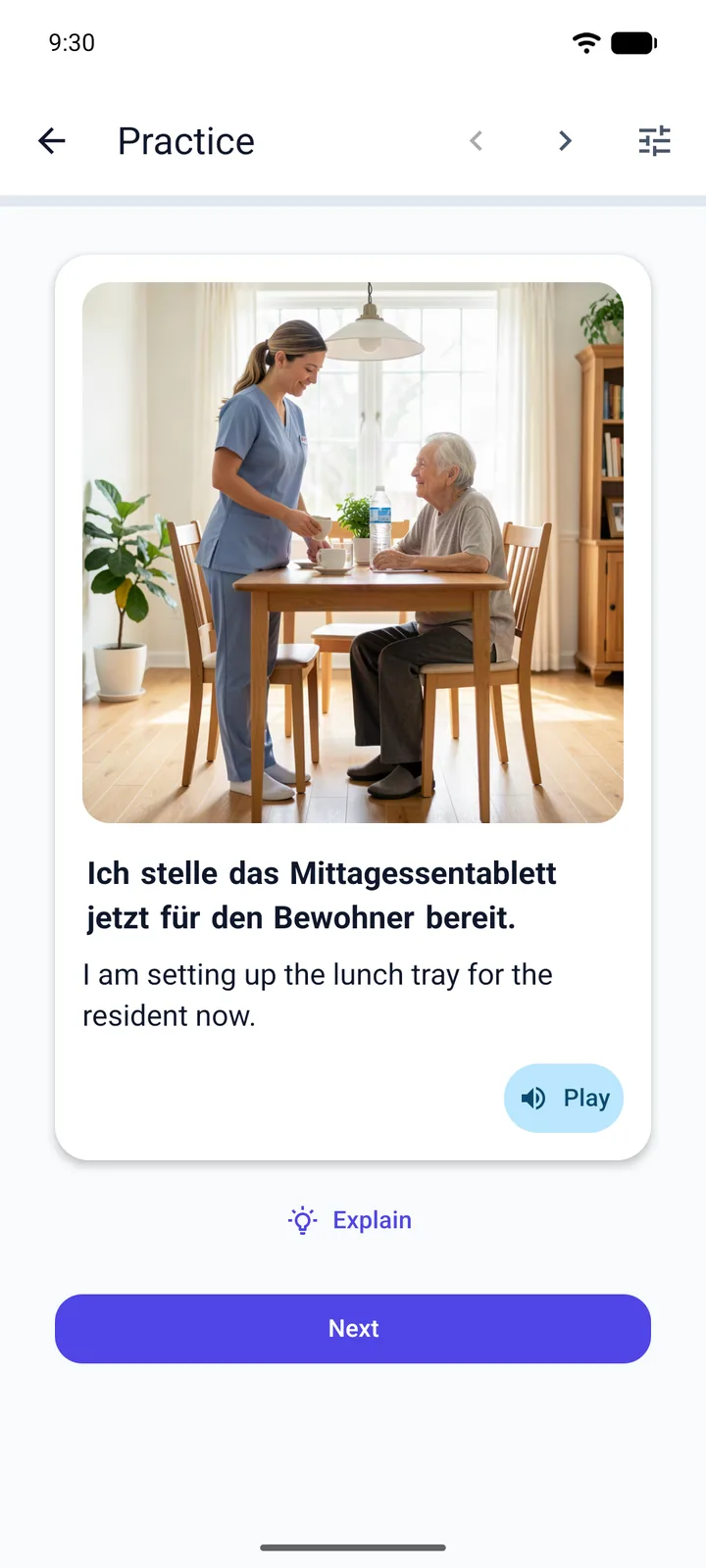
The core exercises, spaced repetition and a limited number of new scenarios each week are free. Premium adds pronunciation, voice tasks, Make Yourself Understood, What Would You Say?, In Your Own Words, listening comprehension, cultural nuance and grammar exercises.
Viglot is independent of any nursing school, exam provider or authority. It does not replace your training or practice instructor, its phrases are not clinical guidance, and it cannot promise a training place, a visa, recognition or a salary.
Care-routine German: phrases for every shift
The phrases below are written for a care home, where residents get Sie and colleagues usually du. They help with communication only: how you carry out care follows your facility’s standards and what your practice instructor shows you.
Morning care (Morgenpflege)
The rule that matters most: say what you are about to do before you do it, and ask before you touch or uncover anyone.
| German | Use it to |
|---|---|
| Guten Morgen, Frau Schneider. Haben Sie gut geschlafen? | greet a resident and ask about the night |
| Ich bin Olena und helfe Ihnen heute beim Waschen. | introduce yourself and the task |
| Darf ich die Decke ein Stück zurückschlagen? | ask permission before uncovering someone |
| Ist Ihnen das Wasser warm genug? | check that the resident is comfortable |
| Möchten Sie sich das Gesicht selbst waschen? Hier ist der Waschlappen. | let the resident do what they still can |
| Ich helfe Ihnen jetzt, sich auf die Seite zu drehen. | announce a movement before it happens |
| Welche Bluse möchten Sie heute anziehen, die blaue oder die weiße? | offer a simple choice |
| Tut Ihnen etwas weh? Zeigen Sie mir bitte, wo. | ask about pain and where it is |
| So, jetzt setzen Sie sich langsam auf. Ich halte Sie. | help someone sit up and reassure them |
Helping with meals and keeping the fluid chart (Essen anreichen, Trinkprotokoll)
Keep a calm pace, and report what you notice: how much the resident ate and drank, whether they choked, whether they refused something.
| German | Use it to |
|---|---|
| Das Mittagessen ist da. Heute gibt es Fisch mit Kartoffeln und Möhren. | say what is on the plate |
| Möchten Sie selbst essen, oder soll ich Ihnen helfen? | ask how much help the resident wants |
| Vorsicht, die Suppe ist noch heiß. | warn about something hot |
| Lassen Sie sich Zeit, wir haben keine Eile. | take the pressure off |
| Möchten Sie noch einen Schluck Tee? | offer a drink |
| Frau Weber hat nur die Hälfte gegessen und 200 Milliliter Tee getrunken. | report how much someone ate and drank |
| Ich trage das gleich ins Trinkprotokoll ein. | say you are recording it on the fluid chart |
| Bis 14 Uhr sind es insgesamt 700 Milliliter. | give the running total for the day |
| Sie hat sich beim Trinken zweimal verschluckt. | report that someone choked while drinking |
A short handover at shift change (Übergabe)
At handover, structure beats perfect grammar: go room by room, say what was different, what you already did, and what a qualified nurse needs to look at.
| German | Use it to |
|---|---|
| Ich fange mit Zimmer 12 an. | give your report a structure |
| Herrn Krüger geht es heute nicht so gut wie sonst. | say that something is different from usual |
| Mir ist aufgefallen, dass … | report an observation |
| Sie hat über Schmerzen im Knie geklagt. | pass on a complaint |
| Das habe ich im Pflegebericht dokumentiert. | say that it is in the care notes |
| Das sollte sich bitte eine Fachkraft ansehen. | pass on something outside your role |
| Habe ich das richtig verstanden: …? | check that you understood an instruction |
Sample: a care helper hands over to the late shift
Olena: Ich fange mit Zimmer 12 an. Herr Krüger war heute Morgen sehr müde und wollte lange nicht aufstehen. Zum Frühstück hat er nur ein halbes Brötchen gegessen.
Markus: Hat er genug getrunken?
Olena: Bis jetzt 800 Milliliter, das steht im Trinkprotokoll. Mir ist noch aufgefallen, dass die Haut an seiner rechten Ferse gerötet ist. Ich habe es dokumentiert.
Markus: Gut, dass du das sagst. Ich schaue es mir gleich an.
Olena: In Zimmer 14 hatte Frau Yılmaz Besuch von ihrer Tochter. Danach war sie richtig gut gelaunt und hat ihr Mittagessen ganz aufgegessen.
Markus: Schön. Sonst noch etwas?
Olena: Nein, das war alles. Danke dir!
A resident with dementia who does not want to get up
With dementia, arguing rarely works. Short sentences, one step at a time, a choice between two things and coming back later work better. Write down what happened for the next shift.
| German | Use it to |
|---|---|
| Guten Morgen, Herr Krüger. Ich bin Olena, ich arbeite hier. | introduce yourself again, every time |
| Sie möchten noch liegen bleiben? Das verstehe ich. | acknowledge how he feels |
| Schauen Sie mal, die Sonne scheint. Der Kaffee ist schon fertig. | give a friendly reason to get up |
| Möchten Sie zuerst die Socken anziehen oder zuerst das Hemd? | offer a small choice instead of a yes-or-no question |
| Gut, dann komme ich in zehn Minuten wieder. | step back and try again later |
| Sie sind hier sicher. Ich bleibe bei Ihnen. | calm someone who is anxious |
| 7:30 Uhr: Bew. lehnt Morgenpflege ab. 8:00 Uhr erneut angeboten, Bew. stimmt zu. | document a refusal in the care notes |
The phone: relatives who call
Phone calls are hard in any foreign language: no face, no gestures. These phrases help you take a call, get a name and number right, and pass a question on to the nurse in charge.
| German | Use it to |
|---|---|
| Seniorenzentrum Am Park, Wohnbereich 2, Olena Kovalenko. Guten Tag. | answer the phone at work |
| Mit wem spreche ich, bitte? | ask who is calling |
| Können Sie Ihren Namen bitte buchstabieren? | ask someone to spell their name |
| Einen Moment bitte, ich hole die zuständige Pflegefachkraft. | get the nurse in charge |
| Das kann Ihnen die Pflegefachkraft besser beantworten. Sie ruft Sie zurück. | pass on a question you should not answer |
| Unter welcher Nummer erreichen wir Sie? | ask for a callback number |
| Ich wiederhole: null eins sieben zwei … | read a number back to check it |
At vocational school: discussing a case study
In a care training, you often talk through case studies in class: the resident, the risks, what you would do and why.
| German | Use it to |
|---|---|
| In unserem Fallbeispiel geht es um Frau M., 84 Jahre alt. | introduce the case |
| Sie liegt viel im Bett. Deshalb besteht ein erhöhtes Dekubitusrisiko. | name a risk and its cause |
| Als Maßnahme schlage ich vor, sie regelmäßig umzulagern und die Haut täglich zu kontrollieren. | propose measures |
| Aus der Praxis kenne ich das so: … | bring in your experience from work |
| Können Sie das Fachwort bitte an die Tafel schreiben? | ask the teacher to write a term down |
| Ich bin nicht sicher, ob ich das richtig verstanden habe. Meinen Sie …? | check your understanding politely |
Words you will see in the care notes
| Term | Meaning |
|---|---|
| die Grundpflege | basic care: washing, dressing, eating, going to the toilet |
| die Behandlungspflege | care ordered by a doctor, such as wound care or medication; mostly done by qualified staff |
| der Pflegebericht | the daily care notes |
| das Trinkprotokoll / das Ein- und Ausfuhrprotokoll | fluid chart / intake and output chart |
| lagern, umlagern, die Lagerung (heute oft: positionieren) | positioning someone in bed, changing their position |
| die Prophylaxe (Sturz-, Dekubitus-, Pneumonieprophylaxe) | prevention (of falls, pressure sores, pneumonia) |
| die Mobilisation, der Transfer | getting someone moving; moving them, for example from bed to wheelchair |
| die Vitalzeichen (Puls, Blutdruck, Temperatur) | vital signs (pulse, blood pressure, temperature) |
| o. B. (ohne Befund), AZ (Allgemeinzustand), Bew. (Bewohnerin / Bewohner) | common abbreviations: nothing abnormal found; general condition; resident |
| die Wohnbereichsleitung, die Pflegedienstleitung (PDL) | the unit lead; the director of nursing |
| die Praxisanleiterin / der Praxisanleiter | the practice instructor who trains you on the ward |
Sie or du, and the dialect question
Residents are adults with a long life behind them. Address them with Sie and their surname, Frau Schneider or Herr Krüger, and use a first name or du only if the resident offers it. Avoid the sing-song “we” (Na, haben wir schon gegessen?): many residents find it childish.
Among colleagues, du is normal in most care teams. With doctors, the director of nursing and relatives, start with Sie. When in doubt, Sie is never wrong.
Many older residents grew up speaking a regional variety, and some return to it as they age. You don’t need to speak it, but you will hear it every day:
| You hear | Where | Standard German |
|---|---|---|
| Grüß Gott | Bavaria, Baden-Württemberg, Austria | Guten Tag |
| Servus | Bavaria, Austria | Hallo / Tschüss |
| Moin | the north, at any time of day | Hallo / Guten Tag |
| …, gell? | the south and southwest | …, nicht wahr? |
| die Semmel | Bavaria, Austria | das Brötchen |
| die Schrippe | Berlin | das Brötchen |
| schaffen | Swabia | arbeiten |
| heuer | Bavaria, Austria | dieses Jahr |
When you don’t understand, say so kindly and ask. Older people are usually glad to explain a word, and it often starts a good conversation.
Entschuldigung, das Wort kenne ich noch nicht. Was bedeutet das?
Typical mistakes on the ward
Most misunderstandings in care come from a handful of habits, not from a lack of grammar. Watch out for these:
- Nodding when you did not understand. A wrong guess about an instruction can hurt a resident. Repeat the instruction in your own words (Habe ich das richtig verstanden: …?) or ask again. Colleagues prefer a question to a mistake.
- Commands instead of requests. Aufstehen! sounds harsh to a resident. Möchten Sie jetzt aufstehen? or Ich helfe Ihnen jetzt beim Aufstehen. sounds respectful and still makes clear what happens next.
- Vague reports. “He is not good” does not help the next shift. Say what you saw: how much he ate and drank, where it hurts, what was different from usual.
- Mixing up similar words. lagern and legen, Bewohner and Bewohnerin, sich verschlucken and schlucken: in care notes, one small change alters the meaning.
- Learning words without their article. Learn das Trinkprotokoll, die Lagerung, der Pflegebericht as a whole, or you will guess the article every time you use the word.
An eight-week practice plan alongside your shifts
This plan assumes 15 to 20 minutes a day, for example on the way to work, plus one longer session on your day off. Each block also works as a scene you type into Viglot. Never use real residents’ names when you practice.
Weeks 1–2: morning care and meals
Learn the morning-care and meal phrases until you can say them without looking. Note three unknown words from each shift and look them up. On your day off, talk through the whole morning routine out loud.
Weeks 3–4: handover and documentation
After each shift, give a one-minute handover out loud at home about invented residents: what was different, what you did, what a nurse should check. Then write it as two or three lines of care notes. Record yourself once a week.
Weeks 5–6: difficult conversations and the phone
Practice the dementia and phone phrases, especially spelling names and reading numbers back. Listen to how experienced colleagues talk to a resident who refuses care, and note their phrases.
Weeks 7–8: the classroom
Explain a training topic such as fall prevention out loud in three minutes, like a case study: the resident, the risk, the measures, your reasons. Applying for a training place? Prepare your work experience the same way.
Notes by home language
Every first language makes some parts of German easier and others harder. Here is what to practice most, depending on yours.
If your first language is Ukrainian
Ukrainian has no articles, so der, die and das need extra attention: learn every care word with its article. The case system will feel familiar, but German word order will not: the verb goes in second place, and in clauses with dass or weil it moves to the very end (“Mir ist aufgefallen, dass sie wenig getrunken hat”). Practice the sounds ü and ö, and keep a clear German g: the Ukrainian г is closer to a German h. Sie works much like the polite Ви, with the verb in the plural form. Viglot explains everything in Ukrainian.
If your first language is Persian
Persian has no grammatical gender, so der, die and das are new: learn every word with its article. The verb at the end of the sentence is familiar from Persian and helps in German clauses with dass or weil, but in a main clause the verb comes second. German words often start with two or three consonants (Schmerzen, Strümpfe, sprechen); try not to add a vowel before or between them. The vowels ü and ö are worth daily practice, and so is the spelling: German w is the Persian v sound (Wasser), while German v is often said like f (vorsichtig). Viglot explains in Persian (Farsi), fully right-to-left.
If your first language is Arabic
The sounds p and b need practice, because they change meaning in care words: Puls, Pflege and Pause against Bluse, Bett and Bauch. The same goes for e and i, and for ü and ö, which Arabic does not have. German has three genders instead of two, and a word’s gender rarely matches Arabic, so learn every noun with its article. You already know a gap between standard language and dialect from Arabic, and German residents’ dialect works much the same way. In Viglot, you can choose Syrian, Egyptian or Modern Standard Arabic for your explanations.
If your first language is Albanian
Albanian has genders and cases, which makes German grammar less of a shock, but the article works differently: Albanian attaches it to the end of the word, German puts it in front (das Zimmer). Watch the spelling: German z sounds like the Albanian c (Zimmer, Zeit), and a German s before a vowel sounds like the Albanian z. The polite ju works much like Sie, but German care homes keep Sie with residents even after years. Viglot explains everything in Albanian.
If your first language is Turkish
You already have ü and ö, a real advantage. Turkish has no articles and no gender, so learn every care word with der, die or das. The verb at the end is familiar from Turkish and helps in clauses with dass or weil, but in a main clause it comes second. Avoid adding a vowel to consonant clusters at the start of a word (Schmerzen, Strümpfe). Sie and du work much like siz and sen, but family words such as teyze or amca have no place on the ward: calling a resident Oma or Opa sounds disrespectful in German, so use Frau or Herr and the surname. Viglot explains everything in Turkish.
If your first language is French
Many care terms look familiar (Prophylaxe, Mobilisation, Temperatur), which helps with reading, but German says them its own way: -tion sounds like “tsion”, and German has no nasal vowels. German also pronounces the h at the start of a word (Hilfe, Hunger) and the consonants at the end. The French u is the German ü, so that sound comes easily. Watch false friends: in a care home or hospital, a Station is a ward. Sie and du follow vous and tu, though du comes quickly among colleagues. In Viglot you can learn German from French or from Arabic.
If you learn German through Russian
Russian has no articles, so learn every care word with der, die or das. The German cases will feel familiar, the word order less so: the verb goes in second place, and to the end after dass or weil. Russian has no h sound, so Hilfe and Hunger easily come out with a rough ch; practice a soft breath instead. Long and short vowels change meaning in German (Bett and Beet, Stadt and Staat), and ü and ö need daily practice. Sie works much like Вы. Viglot explains everything in Russian.
If your first language is Spanish
German pronounces the h (Hilfe, Hunger), the z sounds like ts (Zimmer, Zucker), the w is a real v with the lower lip touching the teeth (Wasser), and the j sounds like the Spanish y (ja). Long and short vowels change meaning, and ü and ö are new. Avoid adding an e before s plus consonant at the start of a word (Spritze, Strümpfe, Schmerzen). Sie and du follow usted and tú, but in German care homes Sie stays with residents for good. Viglot explains everything in Spanish.