
German for nurses: the language you need on the ward
You trained as a nurse abroad and want to work in Germany, but general courses and apps teach you to order a coffee, not to hand over a patient, write the nursing report or call the doctor. Viglot closes that gap: you type your own ward situation, and Viglot turns exactly that scene into phrases, exercises and spoken role-plays. Below: why general courses fall short, how Viglot works, German phrases for six ward situations, the mistakes that matter most and a plan for between shifts.
What the ward asks of your German
Nursing German is not one skill but a handful of conversations that come back every shift. You hand over your patients to the next shift in a few minutes. You write what you observed and did in the nursing report. You call a doctor who speaks fast and can’t see what you see. You explain a procedure to a patient in plain words, and you answer a worried daughter at the bedside. None of this is exotic, and all of it has to work the first time.
If you are also aiming for a nursing language exam, such as the Fachsprachprüfung Pflege, telc Deutsch B1·B2 Pflege or the Goethe-Test PRO Pflege, this is the language you are working towards there too.
Which language certificate you need and which exams count differ by country and German Land, and they change. Check the current rules with the authority that grants your licence (the Recognition in Germany portal helps you find it) and the current exam format on your provider’s page, for example telc or the Goethe-Institut. This guide is about the language itself.
Why a general course or app falls short
General courses and language apps are built for everyone, so they teach what everyone needs: ordering a coffee, booking a holiday, talking about your hobbies. Their grammar is a good foundation, and you need it. But almost nothing they practise happens on your ward:
- The wrong words. You learn Speisekarte and Urlaub. The ward needs Bedarfsmedikation, Positionswechsel and Trinkprotokoll, at the speed of a handover.
- The wrong conversations. Small talk about the weekend does not prepare you for a handover, a phone call with a doctor, a patient who refuses his tablets or a relative who is frightened.
- One register instead of two. Courses teach one polite standard German. On the ward you switch all day between technical terms for colleagues and everyday words for patients.
- Clean audio instead of real speech. Course recordings are slow and clear. Real handovers are fast and full of abbreviations, doctors are in a hurry, and older patients speak the way people speak in their region.
- Writing for the wrong reader. Course writing tasks are letters and opinion essays. Your writing on the ward is the nursing report: short, factual, with times.
What closes the gap is practice built from your own work: the scenes of your ward, spoken out loud until the words come without thinking. That is what Viglot is built for.
How Viglot closes that gap
You create a course from your language into German, choose your level and type one scene as the topic, in your own language or in German. Viglot builds a scenario around that scene: phrases with a picture, audio and a translation into your language, and every exercise uses that scene and its words. The more specific the scene, the more specific the words. Topics that work well:
- Übergabe im Frühdienst auf der Inneren
- Anruf bei der Stationsärztin wegen niedrigen Blutdrucks
- Gespräch mit der Tochter einer Patientin über Sturzgefahr
- Einem Patienten vor der OP erklären, was nüchtern bedeutet
- Or in your own language: “Night-shift handover on the cardiology ward”
Each problem of the ward then gets its own kind of practice:
- You freeze when you have to speak. Voice tasks are spoken role-plays in your scene with a conversation partner who stays in character: a handover, a call to the doctor, a worried daughter. Before you start, you see the situation, your goal and the success criteria, and you can reveal example phrases. Afterwards you see whether you met each criterion, with feedback and corrections on what you said.
- A patient doesn’t understand you. In Make Yourself Understood, you type to a partner who misunderstands on purpose, as a confused patient might, and rephrase until your meaning lands. What Would You Say? describes a situation in your language; you answer out loud in German and compare with a model answer.
- Technical term for the doctor, everyday word for the patient. In Your Own Words has you say a sentence again with different words and the same meaning: the switch from Dekubitus to wund gelegene Stelle. Grammar exercises make you build the sentences yourself, not just recognise them.
- Fast speech at the bedside. Listening comprehension plays a dialogue set in your scene, and cultural nuance asks you about a real German custom in it, then explains it.
- Words gone by the next shift. Spaced repetition brings each ward word back just before you would forget it. Explanations and task briefings come in your language, including Persian and Arabic with a right-to-left layout.
- An exam ahead. Type “telc Deutsch B1·B2 Pflege” as the topic, and Viglot plans a syllabus for it, unit by unit at your level, each unit set in an everyday scene. Your own ward scenes bring the specialist words, so alternate both in one course.
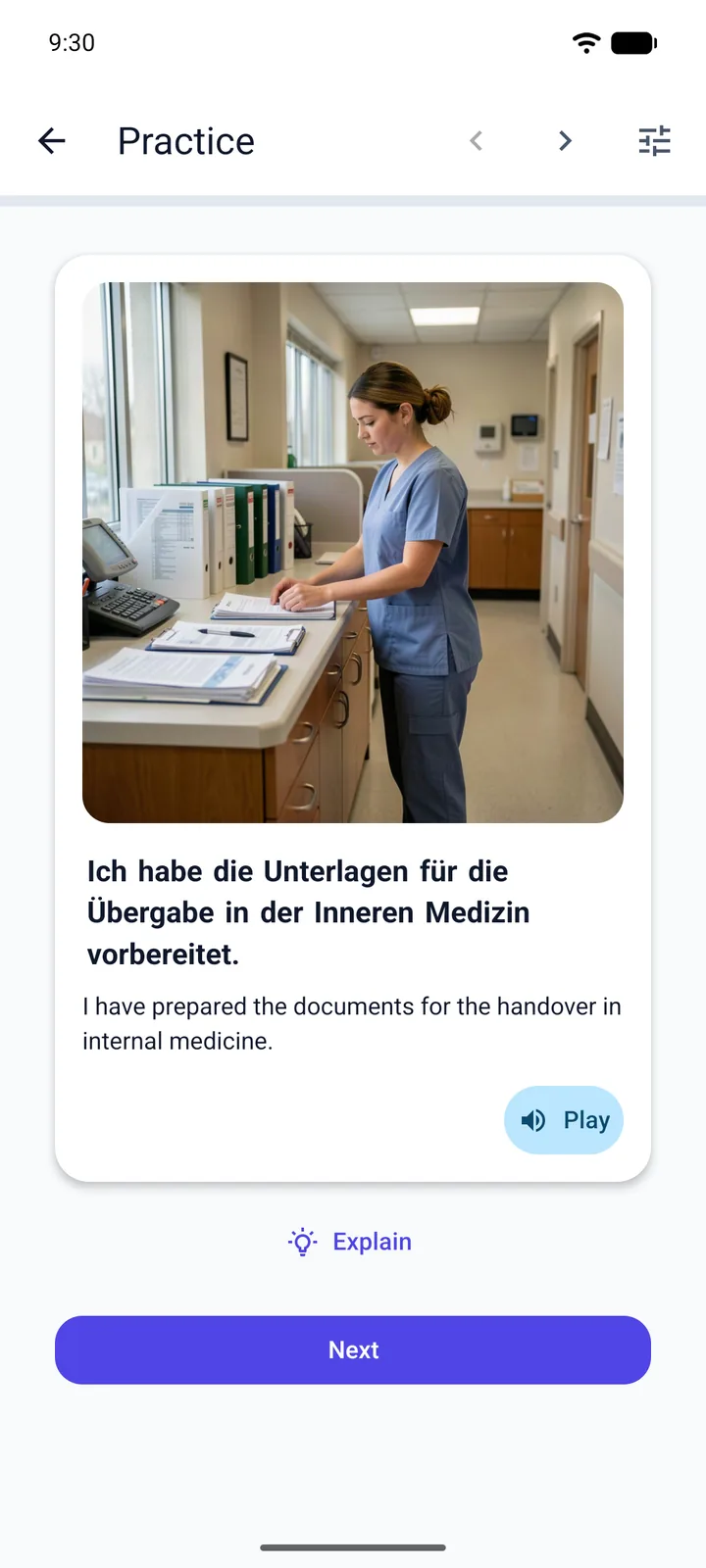
The core exercises, spaced repetition and a limited number of new scenarios each week are free; pronunciation, voice tasks, Make Yourself Understood, What Would You Say?, In Your Own Words, listening comprehension, cultural nuance and grammar exercises are Premium.
What Viglot is not: it is not affiliated with telc, the Goethe-Institut, ÖSD or any recognition authority, it does not simulate a full mock exam, and it cannot guarantee that you pass or that your qualification is recognised. Its scenarios are generated language practice, not reviewed clinical guidance. Use it next to the official practice tests and your ward’s own standards.
Ward German: phrases for six situations
The phrases below are language examples, written by us, for situations every nurse meets. They are not clinical guidance: follow your ward’s standards and your doctors’ orders. Colleagues usually say du to each other; patients, relatives and doctors you don’t know well get Sie.
1. Handover (Übergabe) at the start of the early shift
A good handover is short and always in the same order: who, why they are here, what happened, what is still open. Speak in short sentences and finish with a question.
| German | What it does |
|---|---|
| Ich übergebe euch Zimmer 12, Frau Berger, 78 Jahre. | open with room, name and age |
| Sie ist seit gestern bei uns, mit Verdacht auf Lungenentzündung. | say why the patient is here |
| Die Nacht war ruhig, sie hat ab zwei Uhr durchgeschlafen. | sum up the night |
| Vitalzeichen stabil, Blutdruck 130 zu 80, kein Fieber. | report vital signs (the blood pressure is read out as 130 zu 80) |
| Um fünf hat sie ihre Bedarfsmedikation gegen Schmerzen bekommen. | report medication given as needed |
| Sie trinkt zu wenig. Bitte achtet auf die Trinkmenge. | ask the next shift to watch something |
| Sie ist sturzgefährdet und steht nur mit Begleitung auf. | flag a fall risk |
| Offen ist noch die Blutabnahme um acht. | name what is still to do |
| Habt ihr noch Fragen zu Zimmer 12? | close and invite questions |
Sample handover, night shift to early shift
Zimmer 7, Herr Schulte, 81 Jahre, vorgestern nach einem Sturz zu Hause aufgenommen, Schenkelhalsfraktur links, gestern operiert. Die Nacht war unruhig: Gegen eins wollte er allein aufstehen und war zeitlich nicht orientiert. Ich habe ihn beruhigt, die Klingel liegt in Reichweite, das Bett ist ganz unten. Schmerzen nach Bedarfsmedikation bei 3 von 10. Der Verband ist trocken. Trinkmenge seit gestern Abend nur 400 Milliliter, bitte weiter anbieten. Offen: Mobilisation mit der Physiotherapie um zehn, und die Tochter ruft heute Vormittag an. Fragen dazu?
2. The nursing report (Pflegebericht)
The Pflegebericht is read by the next shift and by the doctors, and it is the record of what happened. Write what you observed and did, with the time, in short phrases; leave out opinions. “Patient is difficult” is an opinion. “Patient pulls at the IV line and refuses to be repositioned” is an observation.
| German | What it does |
|---|---|
| Pat. gibt Schmerzen im rechten Knie an, NRS 6. | record pain the patient reports, on the 0–10 scale |
| Metamizol 500 mg p. o. als Bedarfsmedikation lt. AO verabreicht. Nach 30 Min. NRS 3. | record what you gave, with drug, dose, route and the doctor’s order, and its effect |
| Pat. wirkt unruhig, zupft am Zugang. | describe behaviour, not a judgement |
| Haut am Steiß gerötet, nicht wegdrückbar. Positionswechsel alle zwei Stunden. | document a skin finding and the plan |
| Pat. lehnt Mobilisation ab, Grund: Müdigkeit. Ärztin informiert. | document a refusal, the reason and who you told |
| Trinkmenge bis 14 Uhr: 600 ml. Zum Trinken motiviert. | record fluid intake |
| Tochter telefonisch über den Sturz informiert. | record a call with relatives |
Sample report entry, night shift
22:30 Pat. wach, gibt Schmerzen im OP-Gebiet an, NRS 5. Metamizol 500 mg p. o. als Bedarfsmedikation lt. AO verabreicht. 23:15 NRS 2, Pat. schläft. 03:00 Verband trocken, Vitalzeichen im Normbereich. 05:30 Pat. zur Toilette begleitet, Gang mit Rollator sicher. Pat. über Mobilisation mit der Physiotherapie um 10 Uhr informiert.
3. Calling the ward doctor about a drop in blood pressure
On the phone you can’t point or show. Many wards use a fixed order for such calls: situation, background, your assessment, what you need. Say your name and ward first, and repeat any order back.
| German | What it does |
|---|---|
| Guten Abend, hier ist Leyla Ahmadi, Pflegefachkraft auf der 3B. | say who and where you are |
| Ich rufe wegen Herrn Weber an, Zimmer 14. | name the patient |
| Sein Blutdruck ist in der letzten Stunde von 125 zu 80 auf 85 zu 50 gefallen. | state the problem with numbers |
| Puls 110. Er ist blass und kaltschweißig, aber ansprechbar. | add what you see |
| Er hat heute früh seine Blutdrucktabletten bekommen und kaum getrunken. | give the background |
| Ich mache mir Sorgen. Können Sie bitte sofort kommen und ihn sich ansehen? | say clearly what you need |
| Ich wiederhole: … Ist das richtig? | read an order back |
| Können Sie das bitte etwas langsamer sagen? | slow the doctor down without apologising for your German |
4. Talking with a daughter about fall risk
Relatives want to know two things: what happened, and what you are doing about it. Plain words work better than technical ones here, and naming their worry calms the conversation.
| German | What it does |
|---|---|
| Ihre Mutter ist heute Nacht beim Aufstehen gestürzt. | say what happened, plainly |
| Die Ärztin hat sie gleich untersucht und spricht nachher selbst mit Ihnen. | say what was done and leave the findings to the doctor |
| Ich verstehe, dass Sie sich Sorgen machen. | acknowledge the worry |
| Wir möchten verhindern, dass das noch einmal passiert. | turn to prevention |
| Könnten Sie ihr feste Hausschuhe mitbringen, die hinten geschlossen sind? | ask relatives to help |
| Bitte erinnern Sie sie daran, vor dem Aufstehen zu klingeln. | enlist them in the plan |
| Wir schauen heute Nacht öfter nach ihr. | say what the team will do |
5. A patient who refuses his tablets
Ask before you explain: the reason is often simple, such as swallowing problems, fear of side effects or not knowing what a tablet is for. If the answer is still no, accept it calmly and say what happens next.
| German | What it does |
|---|---|
| Herr Brandt, hier sind Ihre Tabletten für heute Mittag. | offer the medication |
| Darf ich fragen, warum Sie sie heute nicht nehmen möchten? | ask for the reason |
| Die kleine weiße ist für den Blutdruck, die gelbe gegen das Wasser in den Beinen. | explain each tablet in everyday words |
| Fällt Ihnen das Schlucken schwer? Ich frage mal nach, ob es das Medikament auch als Saft gibt. | offer a solution |
| Sie müssen sie nicht nehmen. Ich sage aber der Ärztin Bescheid. | respect the decision and say what happens next |
| Ich nehme sie wieder mit und frage Sie in einer halben Stunde noch einmal. | take the tablets back and offer them again later |
6. Explaining fasting before surgery
Nüchtern is a word many patients misunderstand, so say what it means in practice and check that they understood: ask them to repeat it in their own words. The times depend on your hospital’s instructions, so they are left open here.
| German | What it does |
|---|---|
| Morgen früh werden Sie operiert. Dafür müssen Sie nüchtern sein. | introduce the topic |
| Das heißt: Ab … Uhr bitte nichts mehr essen, auch keine Bonbons und keinen Kaugummi. | say what nüchtern means in practice |
| Wasser oder Tee ohne Zucker dürfen Sie noch bis … Uhr trinken. | explain what is still allowed |
| Mit leerem Magen ist die Narkose sicherer. | give the reason in one sentence |
| Ihre Morgentabletten nehmen Sie nur, wenn die Ärztin es sagt. | cover medication |
| Können Sie mir mit Ihren eigenen Worten sagen, was Sie vor der OP nicht mehr dürfen? | check understanding (teach-back) |
Technical terms and everyday words
Nursing German has two registers. With colleagues and doctors, and in the report, you use the technical term. With patients and relatives, you use the everyday word. On the ward you switch between them every hour.
| With colleagues and in the report | With patients and relatives | Meaning |
|---|---|---|
| der Dekubitus | eine wund gelegene Stelle | pressure ulcer |
| die Hypotonie | zu niedriger Blutdruck | low blood pressure |
| die Dyspnoe | die Atemnot, schlecht Luft bekommen | shortness of breath |
| die Obstipation | die Verstopfung | constipation |
| die Miktion | Wasser lassen, auf die Toilette gehen | passing urine |
| das Analgetikum | das Schmerzmittel | painkiller |
| die Mobilisation | aufstehen und ein paar Schritte gehen | getting the patient moving |
| die Vitalzeichen | Puls, Blutdruck, Atmung und Temperatur | vital signs |
| die Sturzprophylaxe | damit Sie nicht hinfallen | fall prevention |
| nüchtern | nichts essen, damit der Magen leer ist | fasting before a procedure |
Two more things nobody teaches in class. First, many older patients still call every nurse Schwester, whatever the official job title; take it as friendly. Second, patients speak the way people speak in their region. In Bavaria and Austria you will hear Grüß Gott instead of Guten Tag and gell? at the end of a sentence, and some older patients speak broad dialect. Ask without embarrassment: Wie meinen Sie das?
Mistakes that cause real misunderstandings
Most mistakes on the ward are harmless: a wrong article or ending rarely confuses anyone. A few cause real misunderstandings, and they are worth practising on purpose.
- Numbers back to front. German says the units before the tens: fünfundachtzig is 85, not 58. With blood pressure, pulse and doses, write the number down while you listen, and read it back.
- “Half past” that isn’t. halb acht means 7:30, not 8:30, and in some regions viertel acht means 7:15. When a time matters, repeat it as digits: sieben Uhr dreißig.
- The verb at the end. After weil, dass or wenn, the verb goes to the end: …, weil er kaum getrunken hat. Under pressure many learners fall back on the word order of their first language. Practise your handover sentences until the order is automatic.
- Verbs that split. In Er steht nur mit Begleitung auf, the meaning sits in the small word at the end. Ich nehme Blut ab and Er hat abgenommen (he has lost weight) use the same verb. Listen to the end of the sentence before you act.
- Switching between du and Sie. Saying du to a patient by accident sounds disrespectful. Choose Sie and keep it, including Ihr and Ihnen.
- Abbreviations nobody explained. lt. AO, p. o., NRS: every ward uses its own set. Ask for your ward’s list in your first week and learn it like vocabulary.
- Nodding when you didn’t understand. Saying yes to an order you didn’t catch is the most dangerous mistake of all. Können Sie das bitte wiederholen? is always professional.
A plan you can follow between shifts
Shift work makes long study sessions unrealistic. What works is a short daily routine that uses your shifts as material: 10 to 15 minutes a day, plus one longer session on a day off.
- Every day: 10–15 minutes Review the words that are due (on the bus, in your break), then do one short exercise from a ward scene. Small and daily beats long and rare.
- After each shift: one note Write down one moment where words failed you: a question you didn’t understand, a word a patient used, a call that went badly. That moment becomes your next practice topic.
- Twice a week: speak out loud Give a handover from the template above to your phone and listen back. Then hold one role-play: a call to the doctor, a talk with relatives, a patient who says no.
- Once a week: write a report Write five or six lines of a Pflegebericht about an invented patient and compare them with the phrasing above. If your practice instructor (Praxisanleitung) has two minutes, ask for corrections.
- Before an exam: the official practice test Work through your provider’s official practice test under real conditions: once early to see where you stand, and again shortly before the date.
One rule for every app and notebook: never use real patient names or data in your practice. Change names, ages and details; the language stays the same.
Notes by first language
Your first language decides which parts of German come easily and which need extra practice. A few notes for speakers of the languages this guide is written in.
If your first language is Persian
Persian has no grammatical gender and no articles, so learn every ward word together with its article: der Verband, die Spritze, das Bett. The verb at the end of a German subordinate clause will feel familiar; the verb in second place in a main clause needs practice. Persian words don’t start with two consonants, so watch for an extra vowel in Schmerz, Spritze or Station. The sounds ü and ö are new, and German v is usually pronounced like f, as in Verband; only in borrowed words such as Visite does it sound like v. The good news: the difference between شما and تو maps almost exactly onto Sie and du.
If your first language is Turkish
You already have ü and ö, which many learners struggle with. What needs attention: Turkish has no grammatical gender and no articles, so learn each noun with der, die or das. German z is pronounced ts, as in Zimmer, Zugang and Zucker. The Turkish verb comes last; in a German main clause it comes second, so practise short handover sentences until that order is automatic. Sie and du work much like siz and sen. If you work as a care assistant for now, our guide to German for care assistants fits your daily work.
If your first language is Arabic
Arabic has no p sound, and on the ward it matters: Puls, Pflaster, Pflege. Practise p and b in pairs until your colleagues hear the difference. German also has more vowels than Arabic, so e and i, o and u can blur: liegen (to lie) and legen (to lay) are different instructions. Arabic gender does not predict German gender, so learn every noun with its article. Writing in Latin script at speed takes practice too: write short reports by hand, not only on the phone. The Arabic version of this guide is written in Modern Standard Arabic; in the app you can choose Syrian or Egyptian Arabic as the language your explanations and task briefings come in.
If you speak Croatian, Bosnian, Serbian or Montenegrin
Your case system is a real advantage: German has fewer cases than your language, and the idea of endings that change is familiar. Articles are new, and German gender often differs from yours: das Krankenhaus is neuter, die Station feminine. Learn every noun with its article. Word order needs practice, especially the verb at the end after weil or dass. The sounds ü and ö are new, and German distinguishes long and short vowels: Bett and Beet. The difference between ti and vi matches du and Sie.
If your first language is Albanian
Your letter y is the German ü, so über, Tür and Übergabe come easily; ö needs practice. Albanian puts the article at the end of the word, German puts it in front, and the genders often don’t match, so learn der, die or das with every noun. Practise the verb in second place and at the end of the sentence until it sits. The difference between ju and ti matches Sie and du, so keep Sie with every patient.
If your first language is Ukrainian
Watch the letters g and h. Ukrainian г sounds close to German h, so learners sometimes mix the two: Galle and Halle, Gang and Hang. Your case system helps with German endings, but articles are new: learn every noun with der, die or das. Reading German handwriting in reports takes practice if you mostly write in Cyrillic. The difference between ти and ви matches du and Sie. If you work at assistant level for now, see our guide to German for care assistants.
If your first language is Romanian
Many technical terms will look familiar, because they come from Latin: Hypotonie, Mobilisation, Analgetikum. The everyday words patients use are Germanic and new: Verstopfung, Schmerzmittel, wund gelegen. Spend most of your practice on that everyday column. Romanian puts the article at the end of the word, German in front, so learn each noun with der, die or das. Sie works much like dumneavoastră, and ü and ö are the new sounds.
If your first language is Polish
German h is a soft breath, not the Polish h or ch: Hals, Herz, Hilfe. Polish cases make German endings feel manageable, but articles are new, so learn each noun with der, die or das. Polish addresses people as Pan and Pani with a third-person singular verb; German Sie takes a plural verb: Haben Sie Schmerzen? The sounds ü and ö need practice. If you work as a live-in carer in a private home, our guide to German for live-in carers fits your situation better.
If you learned nursing in French
Your French medical vocabulary is a head start: Hypotonie, Infusion and Patient are close to what you know. Watch the false friends: die Ambulanz is usually an outpatient department, and the vehicle is a Krankenwagen or Rettungswagen. Pronounce every h: Hals, Herz, Hüfte. Put the stress on the first syllable of most German words. Your French u is the German ü, and your ou is the German u. Vous and tu match Sie and du.
If you read this in Russian
German h is a soft breath, not the Russian х: Hals, Herz, Hilfe. Your case system helps with German endings, but articles are new: learn every noun with der, die or das. Russian lets you place words freely; German fixes the verb in second place and at the end of subordinate clauses. Reading German handwriting in reports takes practice if you mostly write in Cyrillic. The difference between ты and вы matches du and Sie.
If your first language is Spanish
Watch the false friend die Station: in a hospital it is the ward. Spanish words don’t start with s plus a consonant, so avoid an extra e in Station, Spritze and Stuhlgang. Pronounce the h at the start of a word (Hals, Hüfte), keep b and w apart, and practise long and short vowels and the new sounds ü and ö. Your medical Latin helps with the technical terms; spend most of your practice on the everyday words patients use. Sie works much like usted.