
Swedish for elderly care: the Swedish your shift really needs
If you work as an undersköterska, a care aide or in home care, your shift asks for Swedish that most courses never practice: understanding a resident who speaks quietly or in dialect, reporting a fall to the nurse in a few clear sentences, writing a neutral note, calming a worried daughter on the phone. Viglot lets you type that exact situation and turns it into a lesson with phrases, exercises and a spoken role-play, explained in your language. This guide shows why general courses fall short, how Viglot closes the gap, and the Swedish of eight real shift situations.
Why a general Swedish course doesn’t get you there
Most language apps and general courses teach the Swedish of a tourist or a newcomer: ordering coffee, the weekend, hobbies and holidays. That is a useful start, but it doesn’t help when a resident with dementia refuses a shower, or a nurse on the phone asks exactly how a fall happened. You can be fluent at the café and still freeze at handover.
Language-wise, the heart of the job is hearing what an older person says, even quietly, slowly or in dialect, and passing it on accurately to a nurse, a colleague or a relative, out loud and in writing.
SFI and general courses build a solid base, mostly around everyday topics. A care shift asks for more:
- Specialized vocabulary: trycksår (pressure ulcer), vid behov (as needed), signeringslista (signing sheet), larm (call alarm).
- Documentation: short, objective, past tense, no guessing.
- Reporting: a structured report to a nurse under time pressure.
- Phone calls: no face, no gestures, often a bad line.
- Residents: dementia, hearing loss, old-fashioned words and regional dialects.
- Colleague talk: fast, informal Swedish at handover, full of abbreviations.
So what moves you forward is not more general Swedish, but the words and conversations of your own unit, practiced out loud until they hold up under pressure. That is exactly the practice Viglot gives you.
How Viglot solves this: you practice your own shift
Viglot has no ready-made care course, and you don’t need one. You type a situation from your shift, and Viglot builds the whole lesson from that one scene, explained in your language. So you practice the conversations you will really have, out loud and every day, without needing a partner.
- Type your shift as the topic Create a course from your language to Swedish at your level, and type a scene from your work as the topic, in Swedish or in your own language. Every exercise of the scenario uses that scene and its words, and the more specific the scene, the more specific the vocabulary.
- Learn the phrases, then use them You get phrases with pictures, native-sounding audio and a translation into your language, and spaced repetition brings each word back before you forget it. The same scene then returns in listening, speaking and writing exercises.
- Speak it out loud In voice tasks you talk with a conversation partner who stays in character. Before you start you see the situation, your goal and the success criteria, and you can reveal example phrases. Afterwards you see whether you met each criterion, with feedback and corrections on what you said.
Topics that work well, typed exactly like this:
- Rapportera till sjuksköterskan med SBAR efter ett fall
- Skriva en avvikelserapport
- Ringa anhöriga om en försämring
- Överlämning mellan dag- och kvällspass
- Morgonbesök i hemtjänsten hos en brukare med demens
- Or in your own language: “Giving an SBAR report to the nurse after a resident’s fall”
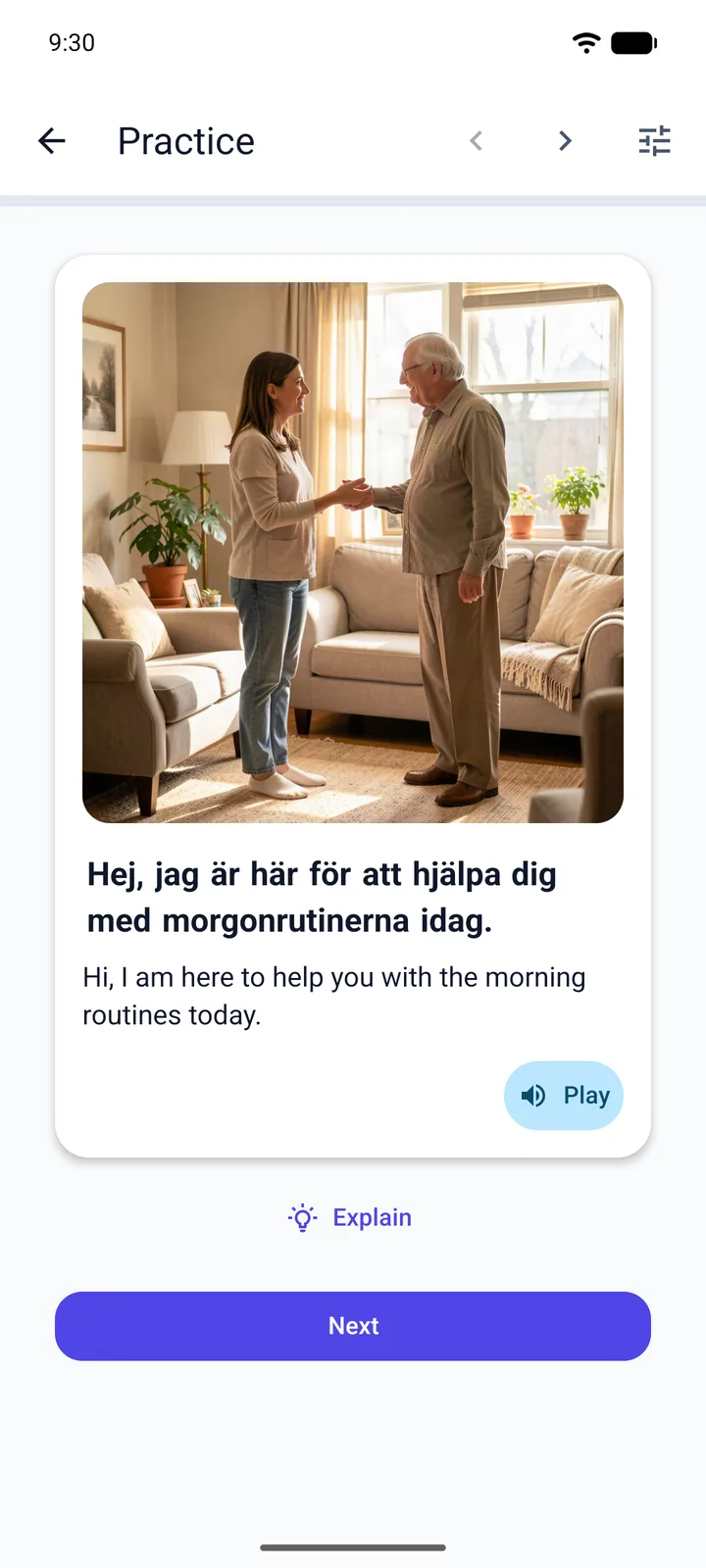
Your shift problem, and how you practice it
- Your report or phone call stalls under pressure. Voice tasks: you give the SBAR report, take the call with a worried son or talk with a resident who doesn’t want help right now. You will often play the care worker, though roles come from the scene.
- You know what to say, but not fast enough. What Would You Say?: read a situation in your own language, answer out loud in Swedish and compare with a model answer.
- A resident doesn’t follow you. Make Yourself Understood: a typed exchange in which your partner misunderstands on purpose, so you rephrase and explain until your meaning lands.
- Handover is too fast to follow. Listening comprehension: a dialogue set in your scene, with the roles and words you have just learned.
- The nurse can’t make out your words on the phone. Pronunciation exercises with the phrases of your own scene.
- Swedish care culture works differently from what you know. Cultural nuance: a question about a real Swedish custom in your scene; you answer first, then it is explained.
- Your notes sound like colleague talk. In Your Own Words: say or write a sentence again in other words with the same meaning, for example from casual to neutral. Grammar exercises make you produce the Swedish yourself instead of only recognizing it.
Translations, explanations and voice-task briefings come in your own language, without going through English; the conversations themselves are in Swedish.
If you also follow a course with an official syllabus, such as SFI or Swedish as a second language at Komvux, type its name as the topic: Viglot plans it unit by unit at your level, each unit set in an everyday scene. For care vocabulary your typed shift scenes work better, so alternate the two in one course. Our exam and syllabus guide explains how it works.
The core exercises, spaced repetition and a limited number of new scenarios each week are free. Pronunciation, voice tasks, Make Yourself Understood, What Would You Say?, In Your Own Words, listening comprehension, cultural nuance and grammar exercises are Premium.
Viglot is independent, not affiliated with Socialstyrelsen, any municipality or any employer, and it does not assess or certify your level. Its scenarios are generated practice material, not clinical guidance; your workplace’s routines and the nurse’s instructions always come first. Language requirements in elderly care differ and change, so check the current rules with your employer and Socialstyrelsen.
The Swedish your shift needs: eight situations
The phrases and samples below are original practice examples. Every workplace has its own routines and forms, so always follow yours and the instructions of the nurse in charge.
First, a note on register: du, names and respect
Swedish uses du with almost everyone, residents and managers included; ni to one person can even sound odd. A few very old residents prefer it, and then you follow their wish. Respect comes from other things: using the resident’s name, asking instead of telling (“Får jag …?”, “Vill du …?”), giving time, and avoiding pet names such as “gumman” or “vännen”, which many older people find belittling. Documentation is neutral: third person, past tense, facts, and the resident’s own words in quotation marks.
1. SBAR: reporting to the nurse after a fall
SBAR is a reporting structure widely used in Swedish health and social care: Situation, Bakgrund (background), Aktuellt tillstånd (current condition), Rekommendation (what you propose or need). It keeps your report short and complete, which matters most when you are nervous and speaking your second language.
Sample: an SBAR report by phone
S: Hej, det är Amira, undersköterska på avdelning Lönnen. Jag ringer om Karl Svensson i rum 12. Jag hittade honom på golvet i hans rum för ungefär fem minuter sedan.
B: Han är 87 år och har demens. Han tar blodförtunnande läkemedel och går vanligtvis med rollator.
A: Han ligger på golvet bredvid sängen. Han är vaken och svarar på tilltal, men säger att det gör ont i höger höft. Jag ser ingen blödning. Jag har inte flyttat honom, och en kollega sitter hos honom.
R: Kan du komma och bedöma honom innan vi flyttar honom? Är det något jag ska göra medan jag väntar?
| Phrase | Use it to |
|---|---|
| Jag ringer om … i rum … | say who the call is about |
| Det hände för ungefär … minuter sedan. | say when it happened |
| Han/hon är vaken och svarar på tilltal. | describe how alert the person is |
| Hon säger att det gör ont i … | pass on what the resident says |
| Jag har inte flyttat honom. | say what you have and haven’t done |
| Kan du komma och titta på henne? | ask the nurse to come |
| Kan du upprepa det? Jag vill vara säker på att jag har förstått rätt. | check an instruction |
2. Avvikelse: writing a deviation report
An avvikelse is an incident that happened, or nearly did: a fall, a missed dose, a call alarm that failed. Your workplace has a routine for reporting it, and the report is not about blame. Write what happened, when, what you did and whom you informed, and describe rather than interpret: “hittades på golvet” (was found on the floor), not “föll för att hon var stressad” (fell because she was stressed).
Sample: a short, objective deviation report
Kl. 07.40 hittades Karl Svensson liggande på golvet bredvid sängen i rum 12. Han uppgav smärta i höger höft. Hans rollator stod vid fönstret, utom räckhåll från sängen. Larmet låg på nattduksbordet. Sjuksköterskan kontaktades kl. 07.45 och kom till rummet kl. 07.55. Anhörig (dotter) informerades av sjuksköterskan kl. 08.30.
| Phrase | Use it to |
|---|---|
| … hittades liggande på golvet. | describe what you found without guessing how it happened |
| Hon uppgav att … | report what the resident said |
| Sjuksköterskan kontaktades kl. … | record who was informed, and when |
| Enligt signeringslistan har kvällens läkemedel inte getts. | report a missed dose |
| Larmet fungerade inte när det testades. | report faulty equipment |
3. Genomförandeplan: reading and following the implementation plan
The genomförandeplan describes how each resident’s support is carried out: what the person wants, what they can do themselves, and how and when you help. Reading it carefully, and saying so when it no longer fits, is part of the job.
| Phrase | Use it to |
|---|---|
| Enligt genomförandeplanen vill Ingrid duscha på kvällen. | refer to what the plan says |
| Vad står det i genomförandeplanen om måltiderna? | ask a colleague about the plan |
| Ingrid vill klara så mycket som möjligt själv. | describe the resident’s own wishes |
| Hon klarar inte längre av att resa sig själv. Ska vi uppdatera planen? | suggest an update when things change |
4. Rapport: handover between the day and evening shift
Handover is fast and informal, and it is where colleague Swedish is hardest to follow. Go resident by resident, say what has changed, and ask back when you are unsure: a question at handover is far better than a mistake in the evening.
| Phrase | Use it to |
|---|---|
| Inget särskilt att rapportera om rum 4. | say nothing has changed |
| Elsa har ätit dåligt i dag, bara halva lunchen. | report a change in eating |
| Han har varit orolig sedan i eftermiddags. | report restlessness or anxiety |
| Sjuksköterskan vill att vi håller koll på hennes vätskeintag. | pass on an instruction from the nurse |
| Vänta, kan du ta det sista en gång till? Jag skriver upp det. | ask a colleague to repeat |
5. Hemtjänst: a morning visit to a client with dementia
In home care you often work alone and short of time. With a person who has dementia, use short sentences, one question at a time and a choice between two things rather than open questions. Don’t argue about facts; check calmly instead.
Sample dialogue: a morning visit
Samir: God morgon, Gunnar! Det är Samir från hemtjänsten. Får jag komma in?
Gunnar: Vem är du? Var är Maria?
Samir: Maria jobbar inte i dag, så det är jag som kommer. Jag har varit här förut. Vi brukar dricka kaffe tillsammans.
Gunnar: Jaha. Ja, kom in då.
Samir: Har du sovit gott? Vill du äta frukost först eller klä på dig först?
Gunnar: Jag har redan ätit.
Samir: Okej. Då tittar vi i köket tillsammans. Vill du ha en kopp kaffe i alla fall?
Gunnar: Ja, kaffe vill jag gärna ha.
Samir: Bra. Jag sätter på kaffet, så kan du välja vilken tröja du vill ha i dag.
6. When a resident says no: självbestämmande
Self-determination (självbestämmande) is a core value of Swedish elderly care: a resident may say no to a shower, a meal or help right now. If you come from a care culture where insisting is a sign of good care, this can feel strange. The Swedish you need here is for accepting the no, offering again later or differently, and passing it on to colleagues and the nurse.
| Phrase | Use it to |
|---|---|
| Jag förstår att du inte vill just nu. | show that you heard the no |
| Du bestämmer. Ska vi göra det efter lunch i stället? | offer another time |
| Vad skulle kännas bättre för dig? | ask what the person would prefer |
| Är det okej om jag frågar igen om en stund? | ask permission to try again later |
| Jag skriver upp att du inte ville duscha i dag, så att kollegorna vet. | say that you will document it |
7. Calling a relative about a change
Open with your name and workplace, say early whether it is urgent, describe what you have seen, and leave medical questions to the nurse. What you may share depends on confidentiality and the resident’s own wishes, so check your workplace’s routine before you call.
| Phrase | Use it to |
|---|---|
| Hej, jag heter Fatima och jobbar på Solbackens äldreboende. Jag ringer om din mamma, Britt. | introduce yourself and the reason for the call |
| Det är inget akut, men jag ville berätta att … | say early that it isn’t an emergency |
| Hon har varit tröttare än vanligt de senaste dagarna. | describe a change you have noticed |
| Sjuksköterskan har tittat på henne och följer upp i morgon. | say what is being done |
| Det är en bra fråga. Ska jag be sjuksköterskan ringa upp dig? | hand a medical question to the nurse |
| Får jag ringa dig igen om något förändras? | agree on how to stay in touch |
8. Delegering: giving medication under delegation
Medication tasks that a nurse has delegated to you (delegering) are where small words carry big risks: times, doses, “vid behov” medication and the signing sheet. These phrases help you check, report and stop to ask whenever something is unclear.
| Phrase | Use it to |
|---|---|
| Det här ingår inte i min delegering. Kan du ta det? | say a task is outside your delegation |
| Signeringslistan stämmer inte med dosetten. Kan du titta på det? | report that the sheet and the pill organizer don’t match |
| Erik vill inte ta sina tabletter i kväll. Hur gör vi? | report a refused dose |
| Han fick sitt vid behovs-läkemedel klockan 14. | report an as-needed dose |
| Jag är osäker, så jag väntar tills jag har pratat med dig. | pause safely when unsure |
A practice plan built on the four skills
Aim for a routine you can keep alongside shift work: 20 to 30 minutes a day, spread over the four skills a care shift uses. Keep a short log of what you practiced, so you can show concrete progress whenever your Swedish comes up.
- Listening (hörförståelse) Listen to the news in easy Swedish, then the regular news on the same story. At handover, write down one new expression every shift, and ask colleagues from other regions to repeat a phrase: dialects are learned by hearing them.
- Reading (läsförståelse) Read your workplace’s routines and, with permission, your residents’ genomförandeplaner; for health topics, the patient information on 1177.se. Underline the words you would need to use yourself.
- Speaking (tal) Say one SBAR report out loud every day, about a real or invented situation, and record it once a week. Rehearse the calls you dread most (relatives, the nurse at night, the pharmacy) as a voice task or with a colleague.
- Writing (skriftlig färdighet) Write one short, objective note a day in documentation style: what happened, when, what you did, who you told. Once a week, ask a colleague, your language ombud (språkombud) if your workplace has one, or your teacher to read it with you.
A sample week
- Monday to Friday: 10 minutes of listening on the way to work, 10 minutes of speaking or writing after the shift.
- One day a week: record your SBAR report and listen back. Note one thing to do better.
- Weekend: review the week’s new words and add two lines to your log.
If you are not sure where you stand today, our guide to the CEFR levels describes what each level sounds like in conversation, and how to get from B1 to B2 covers the step from getting by to speaking precisely.
Notes by reader language
For Arabic speakers already working in Sweden
Pronunciation first, because it decides whether a nurse understands you on the phone. Arabic has no p, so puls easily turns into buls; practice p and b as a pair. Swedish has many more vowels than Arabic, with long and short versions, so drill sets like ful, full and fyll, and take extra care with y, u and ö. Swedish also starts words with clusters such as skr-, str- and spr- (skriva, sträcka, spruta): say them without adding a vowel in front.
In grammar, watch word order: the verb comes second, so I dag har hon ätit dåligt, not I dag hon har ätit. In a subordinate clause inte moves before the verb: … att hon inte vill duscha. And the respectful forms of address you may be used to, such as calling an older woman “hajja”, have no Swedish equivalent: here respect means the resident’s name, du and a question instead of an order.
In Viglot you can learn from Modern Standard Arabic, Egyptian or Levantine (Shami) Arabic, so explanations and voice-task briefings come in the Arabic you speak, with the interface in Arabic from right to left.
For Persian speakers
The mistake that matters most in a report: Persian uses one word, او, for “he” and “she”, so han and hon (and hans and hennes) easily get swapped. In an SBAR report that confuses the nurse, so practice speaking about real residents until the right pronoun comes automatically. Persian also has no grammatical gender and nothing like en and ett, so learn every noun with its article and its definite form: en dosett, dosetten; ett rum, rummet.
In Persian the verb comes last; in Swedish it comes second: I går kväll ringde dottern. Many Persian speakers put a vowel before s + consonant (eskriva), so practice sköterska, stol and spruta slowly. And Swedish workplace talk is direct: a short Kan du ta rum 4? is polite here, not rude, and an equally short answer is expected.
Learn the workplace terms exactly as colleagues say them: genomförandeplan (how a resident’s support is carried out), avvikelse (an incident to report), SBAR (the structure for reporting to the nurse) and delegering (when a nurse hands a task such as giving medication over to you).
In Viglot you learn Swedish from Persian, with a right-to-left interface, and you can type your topic in Persian or in Swedish.
For colleagues who search in Swedish, and for employers and language ombuds
Many care workers in Sweden speak languages this site isn’t available in, such as Somali, Tigrinya, Dari or Kurdish, and search in Swedish instead. Viglot does not offer those languages to learn from either; if you read English, Arabic or another of the app’s languages well, you can learn Swedish from that language.
If you already speak Swedish every day but feel unsure at work, the gap is usually written documentation and phone calls. Practice the past tense and the passive forms of documentation (hittades, kontaktades, uppgav), the neutral third person, and opening a call with your name, workplace and reason in one breath.
For managers and language ombuds: Socialstyrelsen publishes support material on language development in elderly care. Viglot is not an assessment tool, but it can be a self-study tool between workplace sessions: staff type a situation from their own unit and practice it in Swedish, with explanations in their own language.