
Japanese for care workers in Japan: the Japanese of a kaigo shift
A care (kaigo) shift in Japan runs on conversations a general course never practices: the morning handover, gentle words before every care task, a resident with dementia who wants to go home, a call to a worried family. Viglot turns any scene you type from your own shift into a full lesson with phrases, romaji, audio, exercises and spoken role-plays, explained in your own language. Below: a shift scene by scene, with phrases and romaji, how polite to be with whom, common mistakes and a six-week practice plan.
Why a general course leaves you short on the floor
General Japanese courses and apps teach everyday life: ordering coffee, shopping, holidays and hobbies. That helps you live in Japan, but it is not what a care home sounds like. In every handover you hear 排泄 (excretion), 褥瘡 (pressure sore), 体位変換 (repositioning) and 誤嚥 (aspiration). You speak gently and politely to people in their eighties and nineties, often hard of hearing, sometimes confused. You write care records that other staff and families read. And you pick up the phone.
Foreign care workers tend to name the same hard parts: the speed and shorthand of the handover, technical terms, the dialect of older residents, and phone calls with worried families. A course that teaches you to order coffee never gets there. What closes the gap is practicing the conversations of your own shift, out loud and with the words of your own floor, until they come out without thinking. That is exactly what Viglot is built for.
How Viglot helps: practice the conversations of your own shift
You type a scene from your shift, in your own language or in Japanese, and Viglot builds a whole lesson around that one scene: phrases with a picture, native-sounding audio, a romaji reading and a translation into your language, then exercises, listening and spoken role-plays that all use the same scene and words. Explanations come in your language, and spaced repetition brings the words back before you forget them. You practice your own conversations daily, without needing a partner. The more specific the scene, the more specific the vocabulary. Topics that work well:
- 夜勤から日勤への申し送り
- 認知症の利用者さんが「家に帰りたい」と言うとき
- ご家族に電話で転倒を報告する
- 介護記録を書く(食事量・排泄)
- 訪問介護で初めて利用者宅を訪ねる
- Helping an elderly resident eat lunch at a care home, with gentle words (声かけ)
Each part of the scenario answers a problem you meet on the floor:
- “I can read it, but I can’t say it in time.” Voice tasks are spoken role-plays with a conversation partner in character as a resident, a colleague or a family member. Before you start you see your goal and the success criteria and can reveal example phrases; afterwards you see whether you met each one, with corrections on what you said.
- “I need the right 声かけ without time to think.” What Would You Say? describes a situation in your language; you answer out loud in Japanese and compare with a model answer.
- “The resident or the family doesn’t follow me.” In Make Yourself Understood, a typed conversation, your partner misunderstands on purpose until you rephrase and your meaning lands.
- “I sound too blunt, or too stiff.” In Your Own Words has you say a sentence again in other words with the same meaning: the skill behind switching between care talk and business politeness.
- “The handover is too fast.” Listening comprehension gives you a dialogue set in the same scene with the same words; from A2 up, a short monologue as well.
- “I don’t know how things are done here.” Cultural nuance asks how a Japanese custom in that scene works; you answer, then it is explained.
- “Kanji is still a wall.” Every Japanese phrase comes with a romaji reading and its meaning in your language. When you can read kana and kanji, switch the reading off in the scenario settings (Show Transliteration).
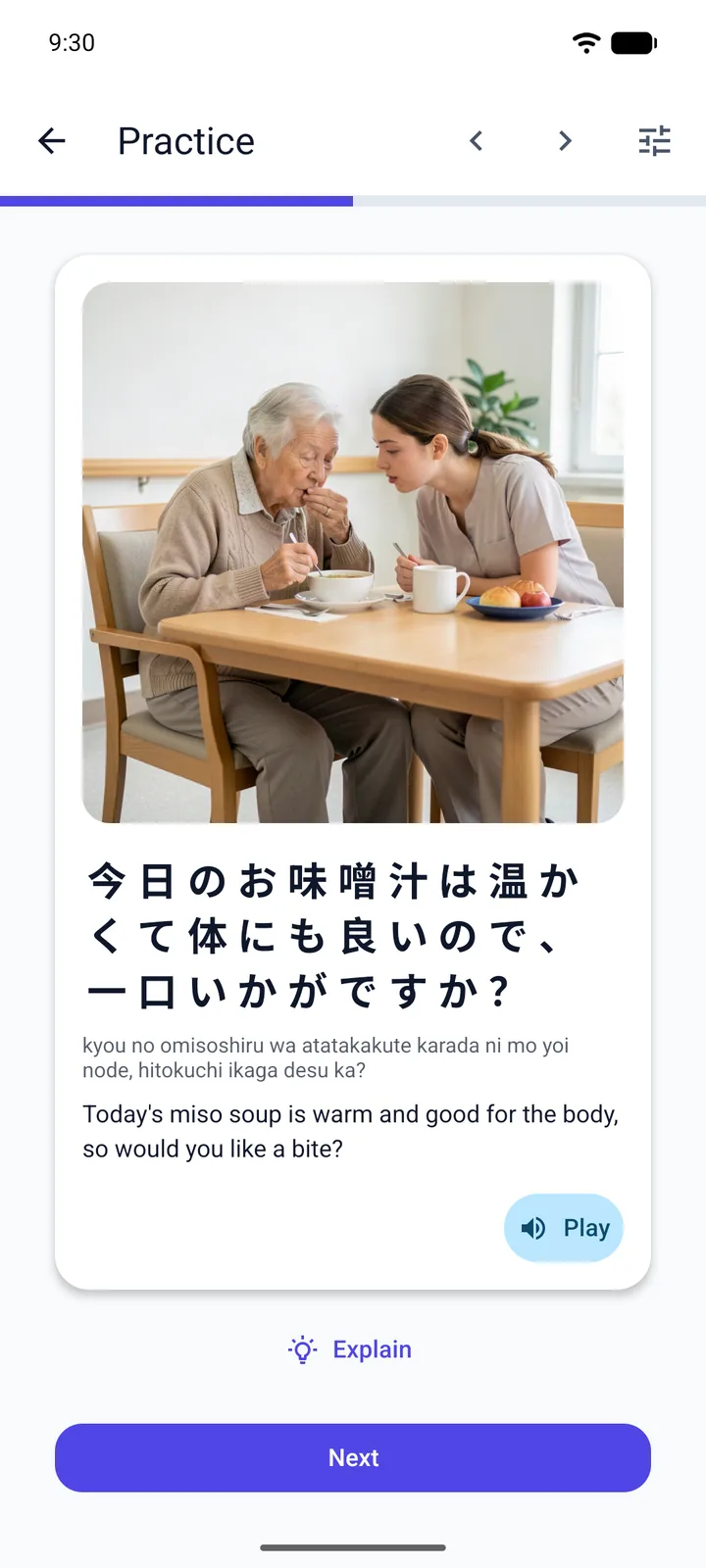
Preparing for a test such as JFT-Basic, the JLPT or 介護日本語評価試験? Type its name as the topic, and Viglot plans a syllabus for it, unit by unit at your level, each unit set in an everyday scene. For care vocabulary, typed shift scenes work better, so alternate both in one course.
The core exercises, such as flashcards and fill-in-the-blank, and spaced repetition are free, with a limited number of new scenarios each week. Pronunciation, voice tasks, Make Yourself Understood, What Would You Say?, In Your Own Words, listening comprehension, cultural nuance and grammar exercises are Premium.
Viglot is a daily practice app, not a care course or exam material: it is independent, has no mock tests and cannot promise a pass, a visa or a job. Its scenarios are generated language practice, so your facility’s procedures and senior colleagues always come first. For how Viglot handles exams, see our exam preparation guide.
A shift in eight scenes, with phrases
The phrases below are original examples written for this guide. Japanese stays as it is used at work; the romaji helps you read it, and the last column tells you what it means and when to use it. Facilities have their own routines and words, so treat these as a starting point and listen to how your seniors say things.
1. The handover from night shift to day shift (申し送り)
申し送り (mōshiokuri) is the short report at the change of shift: who slept, who ate, who needs watching. It is fast, factual and full of abbreviations. Report by resident, in time order, and finish with what the next shift must do.
| Japanese | Reading | Meaning and use |
|---|---|---|
| 夜勤から申し送りをします。 | Yakin kara mōshiokuri o shimasu. | “Here is the handover from the night shift.” Opens your report. The day shift or the leader asks for it with 申し送りをお願いします. |
| 田中さんは2時と4時の巡視ではよく休まれていました。 | Tanaka-san wa niji to yoji no junshi de wa yoku yasumarete imashita. | “At the 2 and 4 o’clock rounds, Mrs Tanaka was sleeping well.” The respectful 休まれる is used for the resident. |
| 3時ごろナースコールがあり、トイレ誘導しました。 | Sanji goro nāsu kōru ga ari, toire yūdō shimashita. | “Around 3 she pressed the call button, and I took her to the toilet.” |
| 排尿は2回、排便はありません。 | Hainyō wa nikai, haiben wa arimasen. | “Urinated twice, no bowel movement.” |
| 5時の体位変換のとき、仙骨部に発赤がありました。 | Goji no tai’i henkan no toki, senkotsubu ni hosseki ga arimashita. | “When I repositioned her at 5, there was redness over her sacrum.” |
| 看護師に報告済みです。 | Kangoshi ni hōkoku-zumi desu. | “Already reported to the nurse.” Always say who you told. |
| 日勤で様子観察をお願いします。 | Nikkin de yōsu kansatsu o onegai shimasu. | “Please keep an eye on it during the day shift.” |
| 以上です。 | Ijō desu. | “That’s all.” Closes your report. |
| 水分はどのくらい取れましたか。 | Suibun wa dono kurai toremashita ka. | “How much did she drink?” A typical question from the day shift. |
Sample: a short handover at 7 a.m.
夜勤(リナ):夜勤から申し送りをします。2階の山本さんですが、夜間は3回トイレ誘導しました。排尿3回、排便はありません。
日勤(佐藤):はい。睡眠はどうでしたか。
夜勤(リナ):1時ごろまで起きていらっしゃいましたが、その後はよく休まれていました。5時に体位変換をしたとき、右のかかとに少し発赤がありました。看護師に報告済みです。
日勤(佐藤):わかりました。日勤で様子を見ます。ほかにありますか。
夜勤(リナ):朝食前の水分は100ミリリットル取れています。以上です。
2. Gentle words before every care task (声かけ)
声かけ (koekake) means speaking to the resident before and during care: say who you are, say what you are about to do, ask instead of order, and thank them afterwards. Nobody should be moved, undressed or touched without a word first. It matters for safety and for dignity, and it is the Japanese you will use most often in a day.
| Japanese | Reading | Meaning and use |
|---|---|---|
| 山本さん、おはようございます。今日担当のリナです。 | Yamamoto-san, ohayō gozaimasu. Kyō tantō no Rina desu. | “Good morning, Mr Yamamoto. I’m Rina, I’m looking after you today.” |
| お手洗いに行きませんか。 | Otearai ni ikimasen ka. | “Would you like to go to the toilet?” An invitation, not an order. |
| 今から車いすに移りますね。 | Ima kara kurumaisu ni utsurimasu ne. | “We’re going to move over to the wheelchair now, all right?” |
| いち、にの、さんで立ちましょう。 | Ichi, ni no, san de tachimashō. | “Let’s stand up on one, two, three.” |
| 痛いところはありませんか。 | Itai tokoro wa arimasen ka. | “Does anything hurt?” |
| お湯の温度はいかがですか。 | Oyu no ondo wa ikaga desu ka. | “How is the water temperature?” Before washing or bathing. |
| ゆっくりで大丈夫ですよ。 | Yukkuri de daijōbu desu yo. | “Take your time.” |
| ありがとうございます。助かりました。 | Arigatō gozaimasu. Tasukarimashita. | “Thank you, that helped me a lot.” Thank them for cooperating. |
3. Helping at mealtimes (食事介助)
At meals you talk about the food, keep the pace slow and watch for coughing or choking (むせ, muse), which can be a sign of food going down the wrong way. Your facility will teach you the safe posture and technique; the language is what lets you keep the resident calm and spot a problem early.
| Japanese | Reading | Meaning and use |
|---|---|---|
| お昼ごはんの時間ですよ。 | Ohiru gohan no jikan desu yo. | “It’s lunchtime.” |
| 今日は鮭の塩焼きですよ。 | Kyō wa sake no shioyaki desu yo. | “Today it’s grilled salted salmon.” Say what the dish is. |
| まず、お茶を一口飲みましょうか。 | Mazu, ocha o hitokuchi nomimashō ka. | “Shall we start with a sip of tea?” |
| 熱いので気をつけてくださいね。 | Atsui node ki o tsukete kudasai ne. | “It’s hot, so be careful.” |
| ゆっくり、よく噛んでくださいね。 | Yukkuri, yoku kande kudasai ne. | “Slowly, and chew well.” |
| むせていませんか。大丈夫ですか。 | Musete imasen ka. Daijōbu desu ka. | “Are you coughing? Are you all right?” |
| もう少し召し上がりますか。 | Mō sukoshi meshiagarimasu ka. | “Would you like a little more?” 召し上がる is the respectful verb for eating. |
4. A resident with dementia says 「家に帰りたい」
“I want to go home” is one of the sentences you will hear most. Arguing (“This is your home now”) or a flat no usually makes things worse; what helps is to take the feeling seriously, listen, and give the person time and company. Your facility will have its own approach for each resident; these phrases help you follow it in Japanese.
| Japanese | Reading | Meaning and use |
|---|---|---|
| お家に帰りたいんですね。 | Ouchi ni kaeritai n desu ne. | “You want to go home.” Repeat the feeling back first. |
| お家で何か気になることがあるんですか。 | Ouchi de nani ka ki ni naru koto ga aru n desu ka. | “Is something at home on your mind?” |
| お家はどんなところですか。 | Ouchi wa donna tokoro desu ka. | “What is your home like?” Let them talk about it. |
| 少しお茶を飲んでから、一緒に考えましょうか。 | Sukoshi ocha o nonde kara, issho ni kangaemashō ka. | “Shall we have some tea first and think about it together?” |
| 私がそばにいますから、大丈夫ですよ。 | Watashi ga soba ni imasu kara, daijōbu desu yo. | “I’m right here with you, it’s all right.” |
| 何かあったら、いつでも呼んでくださいね。 | Nani ka attara, itsu demo yonde kudasai ne. | “If anything comes up, call me any time.” |
5. Calling a family after a fall
A phone call is hard in any foreign language: no face, no gestures, and a worried relative on the other end. Who makes this call differs between facilities, so learn your facility’s rule. If it is you, keep to this order: who you are, what happened and when, what was done, the current state, an apology for the worry, and a question at the end.
| Japanese | Reading | Meaning and use |
|---|---|---|
| お忙しいところ失礼いたします。さくら苑の介護職員のリナと申します。 | Oisogashii tokoro shitsurei itashimasu. Sakura-en no kaigo shokuin no Rina to mōshimasu. | “Sorry to call when you’re busy. My name is Rina, I’m a care worker at Sakura-en.” |
| 山本様のご家族の方でいらっしゃいますか。 | Yamamoto-sama no gokazoku no kata de irasshaimasu ka. | “Am I speaking with Mr Yamamoto’s family?” |
| 本日午前10時ごろ、お部屋で転倒されました。 | Honjitsu gozen jūji goro, oheya de tentō saremashita. | “Around 10 this morning he fell in his room.” |
| すぐに看護師が確認いたしました。今のところ、大きなけがはございません。 | Sugu ni kangoshi ga kakunin itashimashita. Ima no tokoro, ōkina kega wa gozaimasen. | “A nurse checked him right away. So far there is no serious injury.” |
| 念のため、本日は様子を見させていただきます。 | Nen no tame, honjitsu wa yōsu o misasete itadakimasu. | “To be safe, we will keep a close eye on him today.” |
| ご心配をおかけして申し訳ございません。 | Goshinpai o okake shite mōshiwake gozaimasen. | “We are very sorry to worry you.” |
| 何かご不明な点はございますか。 | Nani ka gofumei na ten wa gozaimasu ka. | “Is there anything you would like to ask?” |
Sample: the opening of the call
リナ:お忙しいところ失礼いたします。さくら苑の介護職員のリナと申します。山本様のご家族の方でいらっしゃいますか。
家族:はい、娘です。父に何かありましたか。
リナ:本日午前10時ごろ、お部屋で転倒されました。すぐに看護師が確認いたしまして、今のところ大きなけがはございません。
家族:そうですか……。頭は打っていませんか。
リナ:看護師が確認いたしましたが、頭を打った様子はございませんでした。念のため、本日は様子を見させていただきます。ご心配をおかけして申し訳ございません。
Notice that Rina says 看護師 (nurse) without さん. When you talk to someone outside your facility, you refer to your own colleagues without honorifics, the same way you would in a business call.
6. Writing the care record (介護記録)
The care record is read by the next shift, the nurses, the care manager and sometimes the family. Good entries are short and factual: the time, what you saw, the resident’s own words in quotation marks, what you did and whom you told. Leave out opinions such as “she was being difficult”. Meal amounts are usually written in tenths (割, wari), so 8割 means 80%.
| Record entry | Reading | Meaning and use |
|---|---|---|
| 昼食:主食8割、副食5割摂取。 | Chūshoku: shushoku hachiwari, fukushoku gowari sesshu. | “Lunch: ate 80% of the staple (rice) and 50% of the side dishes.” |
| 水分200ml摂取。 | Suibun nihyaku miririttoru sesshu. | “Drank 200 ml.” |
| 10:30 トイレにて排尿あり。 | Jūji han, toire nite hainyō ari. | “10:30 urinated in the toilet.” にて is the written form of で. |
| 排便なし(3日目)。 | Haiben nashi (mikka-me). | “No bowel movement (day 3).” |
| 「足が痛い」と話される。 | “Ashi ga itai” to hanasareru. | “Says ‘my leg hurts’.” Quote the resident’s exact words. |
| 15:00 居室にて床に座っているところを発見。看護師へ報告。 | Jūgoji, kyoshitsu nite yuka ni suwatte iru tokoro o hakken. Kangoshi e hōkoku. | “15:00 found sitting on the floor of her room. Reported to the nurse.” Write what you saw, not what you guess. |
Many facilities use tablets with set phrases, but you still choose the right one and add a free-text note when something unusual happens. Learn the kanji of the twenty or thirty words you write every day first.
7. The first home-care visit (訪問介護)
Home-visit care is a different setting from a care home. Whether you may do it, and when, depends on your status, your training and your employer, so ask them first. If you do, remember that in someone’s home you are a guest, and the language shows it.
| Japanese | Reading | Meaning and use |
|---|---|---|
| ごめんください。ひまわり訪問介護のリナです。 | Gomen kudasai. Himawari hōmon kaigo no Rina desu. | “Hello, may I come in? I’m Rina from Himawari home care.” Called out at the door. |
| お邪魔します。 | Ojama shimasu. | Said as you step inside: literally “I’m disturbing you.” |
| 台所をお借りしてもよろしいですか。 | Daidokoro o okari shite mo yoroshii desu ka. | “May I use your kitchen?” |
| これはどこに置けばよろしいですか。 | Kore wa doko ni okeba yoroshii desu ka. | “Where would you like me to put this?” Every home has its own order. |
| 前回から何か変わったことはありませんか。 | Zenkai kara nani ka kawatta koto wa arimasen ka. | “Has anything changed since my last visit?” |
| 次回は木曜日の10時に伺います。 | Jikai wa mokuyōbi no jūji ni ukagaimasu. | “I’ll come again on Thursday at 10.” 伺う is the humble verb for visiting. |
8. Understanding Kansai dialect (関西弁)
Tests use standard Japanese; many residents do not. In Osaka, Kyoto, Kobe and the surrounding area, older people speak Kansai dialect, and other regions have their own. You don’t need to speak it, but you do need to understand it. These are the forms you will meet first.
| Kansai | Standard Japanese | Meaning and use |
|---|---|---|
| あかん | だめ | “No good, not allowed.” |
| ほんま | 本当 | “Really, true.” |
| しんどい | つらい、疲れた | “I feel awful, I’m worn out.” Take it seriously and report it. |
| かまへん | かまわない | “That’s fine, I don’t mind.” |
| 行かへん | 行かない | “I’m not going.” The ~へん ending is the Kansai negative. |
| ちゃう | ちがう | “That’s not right, no.” |
| おおきに | ありがとう | “Thank you.” Heard more from older speakers. |
| なおしといて | 片付けておいて | “Put it away, please.” In western Japan なおす can mean to put away, not to repair. |
How polite to be, and with whom
Care Japanese has its own register. It is warmer than office Japanese and more polite than talk between friends, and it shifts with the person in front of you.
- Residents: use です/ます with a soft ね or よ at the end. Avoid casual speech and never talk to an older person the way you would talk to a child (no 「えらいね」 or 「〜しようね」 in a sing-song voice). Use the family name with さん, not a nickname, unless your facility and the resident have agreed on something else.
- Invite, don’t command: turn 「〜てください」 into 「〜ませんか」 or 「〜ましょうか」. 「お手洗いに行きませんか」 lets the resident decide.
- Respectful verbs for residents: 召し上がる (eat), お休みになる (sleep, rest), いらっしゃる (be, come). You don’t need many; these three cover most of a day.
- Families and outside callers: full business politeness, with 申します, いたします and ございます, and your own colleagues named without さん.
- Colleagues: polite but brief in the handover, and in the record a clipped written style that ends on a noun: 摂取。報告済み。
- Avoid あなた: it sounds distant or even rude to an older person. Use the name with さん, or leave the person out of the sentence altogether, as Japanese often does.
Common mistakes in care Japanese
Most mistakes on the floor are not grammar mistakes. They are words and tones that are correct in a textbook sense but wrong in a care home.
- Orders instead of invitations: 「立ってください」 is correct Japanese, but several times a day it sounds like a command. 「立ちましょうか」 or 「立てますか」 keeps the resident in charge.
- Long vowels and the small っ: おばさん (aunt, middle-aged woman) and おばあさん (grandmother, older woman) differ only in vowel length, and so do 主人 (husband) and 囚人 (prisoner); the small っ turns 来て (come) into 切って (cut). With residents who hear poorly, clear vowel length matters even more.
- Guessing in the record: 「転んだと思う」 (I think she fell) belongs in a conversation with the nurse, not in the record. Write what you saw: 「床に座っているところを発見」.
- Saying yes when you did not understand: a quick はい in the handover is how mistakes travel to the next shift. 「すみません、もう一度お願いします」 and 「〇〇はどういう意味ですか」 are the most useful sentences you can learn.
- Reading kanji you never say out loud: many learners can read 誤嚥 but cannot say ごえん in a fast handover. Practice every care word with your voice, not only with your eyes.
A six-week plan from everyday Japanese to the care floor
This plan assumes you already have basic everyday Japanese and start work in about six weeks. Every day: 15 minutes of review of the words you met before, one new scene, and speaking out loud. Twice a week, write three record entries by hand and check them with a colleague or teacher.
- Week 1: The words of the body and the day Body parts, daily routine and the core care words: 排泄, 入浴, 食事, 移乗, 体位変換, 褥瘡, 誤嚥. Learn to read and write them, not only to recognize them.
- Week 2: Care talk Practice the 声かけ for waking up, getting dressed, toilet, transfers and washing until each comes out without thinking. Say them out loud while you mime the task.
- Week 3: Meals and the care record Mealtime phrases, then the record: amounts in 割, fluid in ml, toileting, quoted words. Write one short record for every scene you practice.
- Week 4: The handover Report three residents in under two minutes, in time order, ending with what the next shift should do. Record yourself and listen back for long pauses and missing facts.
- Week 5: Families and phone calls Business politeness, the structure of a report call, and how to answer a worried or angry relative calmly. Practice without looking at the person: a phone call has no gestures.
- Week 6: Dementia care, home visits and dialect Phrases for confused or anxious residents, the home-visit routine, and listening to Kansai or your region’s dialect. If you are taking the care-Japanese test, finish with the official sample questions.
Check the current rules
Language requirements for care work in Japan differ by route and change over time. Check the current rules with the Immigration Services Agency’s page on care work and ask your employer or support organization what applies to you.
Notes by home language
If you speak Indonesian
Japanese sounds come fairly easily to Indonesian speakers: all five Japanese vowels exist in Indonesian, and most Japanese syllables end in a vowel. The traps are length. Practice long vowels (おばさん and おばあさん) and the small っ (きて and きって) until you hear the difference without thinking. The word order is new: the verb comes last, so in a fast handover the important part arrives at the end of the sentence. You already know respectful address from Bapak and Ibu; in Japanese it moves into the verb (召し上がる, いらっしゃる), so learn those few verbs early. Kanji is the biggest job, so start with the twenty or thirty words you write in every record.
If you speak Vietnamese
Many Japanese kanji words share a root with Sino-Vietnamese words (注意 and chú ý, 準備 and chuẩn bị, 安全 and an toàn), which helps you guess care terms. Japanese has no word tones like Vietnamese, only a light pitch pattern, so keep your voice smooth and don’t let Vietnamese tones slip in. Watch the small っ, long vowels and つ, and finish words on a vowel instead of a hard consonant. Vietnamese changes the pronoun with every person (ông, bà, cô, anh, em); Japanese simply uses the name with さん and leaves the pronoun out, so drop あなた entirely.
If you read Chinese
Kanji makes care records much easier to read, but watch the false friends. In Japanese 床 is the floor, not a bed, so 床に座っている means sitting on the floor; お湯 is hot water, not soup; 娘 is a daughter, not a mother; 走る means to run, not to walk. The sounds are a separate job: Chinese speakers often mix up た and だ or か and が, and long and short vowels. Your gap is spoken: polite speech, gentle 声かけ, older residents’ speech and dialect, so put your practice time into speaking and listening.
If you speak Thai
In Thai, ครับ or ค่ะ at the end makes a sentence polite. Japanese politeness sits in the verb ending (です, ます) and in word choice, and ね or よ at the end only add warmth, not respect. Japanese has no word tones like Thai, only a light pitch pattern, so keep your voice smooth. Practice long vowels, the small っ and the sounds つ, ざ and じ. The respect for older people you grew up with fits care work well; in Japanese it shows in gentle 声かけ and in asking instead of telling. Use romaji as a bridge, then learn kana and the kanji of the care record step by step.
If you learn in English
Many caregivers, for example from the Philippines, learn Japanese through English. If your first language is not available in the app, learn from English: translations, explanations and voice-task briefings then come in English. Two habits to break: “please” is not always ください, because 「〜ませんか」 is often kinder, and “you” is not あなた, because you use the name with さん. Romaji helps you start, but care records are written in kanji, so learn the common care words in their written form early.