
Medical German for the Fachsprachprüfung (FSP): Phrases, Drills and a Speaking Plan
If you trained as a doctor outside Germany and are working toward the Fachsprachprüfung (FSP), the medicine is rarely the problem. The German of a doctor’s day is: taking a history, explaining a procedure in plain words, presenting a case, writing the Arztbrief. General courses teach café and holiday German and barely let you speak. Viglot turns your own clinical scene into a lesson, so you practice exactly those conversations out loud, every day, with a conversation partner who stays in character. Below you also get the phrase tables, drills and a daily plan.
The German a doctor’s day runs on
As its name says, the Fachsprachprüfung is about your medical German, not about whether your diagnosis is right. That German comes from the same conversations you have at work every day:
- Talking with a patient. You take the history, then explain the likely diagnosis and the next steps in words the patient understands.
- Writing it down. You document what you heard in the compact, impersonal style of German medical records.
- Talking with colleagues. You present the case to physicians and answer their questions.
Two skills run through all three: switching between technical and everyday words, and getting your meaning across when a word will not come, by paraphrasing, asking back and summarizing. Both can only be trained by speaking.
Requirements differ and change
This guide is about the language, not the procedure. Who has to take which exam, and in what format, differs and changes. Check the current rules with the authority or medical chamber responsible for you; the official portal Recognition in Germany helps you find it.
Why general German courses and apps fall short
General courses and language apps teach the German of everyday life: ordering a coffee, booking a holiday, talking about your hobbies. That builds a useful base, but it is not what you will say on the ward or in the exam. You need the conversations of your own work: asking a patient where the pain radiates, explaining a colonoscopy in plain words, presenting a case to a senior physician, writing an Arztbrief. A course that never leaves the café cannot train those.
- Specialist vocabulary. Symptoms, tests, drug classes and anatomy are rare in general courses, and you need them in two registers.
- Workplace routines. A history, a consent conversation and a case presentation each follow a structure general courses never teach.
- Phone calls. Calls to family doctors, labs and relatives come without faces or gestures.
- Documentation. The impersonal, abbreviated style of German medical records is a genre of its own.
- Patients, not exercises. Patients speak colloquially, sometimes in dialect, and they misunderstand. You have to notice and repair that in real time.
- Speaking time. In a group course you speak for a few minutes per lesson. A fluent conversation with a patient needs hours of solo speaking behind it.
What you need is practice in your own clinical conversations, out loud and every day. That is the gap Viglot fills.
How Viglot solves this: you practice your own clinical conversations
Viglot is a language app that builds every lesson from one scene you describe. Type a situation such as “explaining a CT result to a worried patient”, in German or in your own language, and Viglot turns it into phrases with a picture, audio and a translation, exercises, listening and spoken role-plays, all in that one scene. Explanations come in your own language, and spaced repetition brings the words back until they stay. You practice your conversations every day, without needing a partner.
- No one to practice a history with? Talk it through in a voice task A conversation partner plays the patient, the relative or the senior physician and stays in character. Before you start you see the situation, your goal and the success criteria, and you can reveal example phrases. Afterwards you see whether you met each criterion, with feedback and corrections on what you said. The roles come from the scene; often you play the doctor.
- Terms you only know in one register? Say it both ways In Your Own Words has you say or write a sentence again with different words and the same meaning: the skill behind turning Fachsprache into everyday German for the patient.
- The word won’t come under pressure? Answer and explain out loud In What Would You Say?, you read a situation in your own language, answer out loud in German and compare your answer with a model answer. In Make Yourself Understood, your partner misunderstands on purpose and you rephrase and explain in writing until your meaning lands, just as you do when a patient doesn’t follow you.
- Patients talk fast? Train your ear, keep your words Listening comprehension plays a dialogue set in the same scene, and every word you learn comes back with spaced repetition until it sticks.
The more specific the scene, the more specific the words. Topics that work well, typed exactly like this:
- Anamnese bei akutem Thoraxschmerz in der Notaufnahme
- Patientenvorstellung bei der Oberärztin (Arzt-Arzt-Gespräch)
- Visite: einem Patienten seine Laborwerte erklären
- Telefonat mit dem Hausarzt wegen des Entlassbriefs
- Or in your own language: “Explaining a colonoscopy in plain words before the patient signs the consent form”
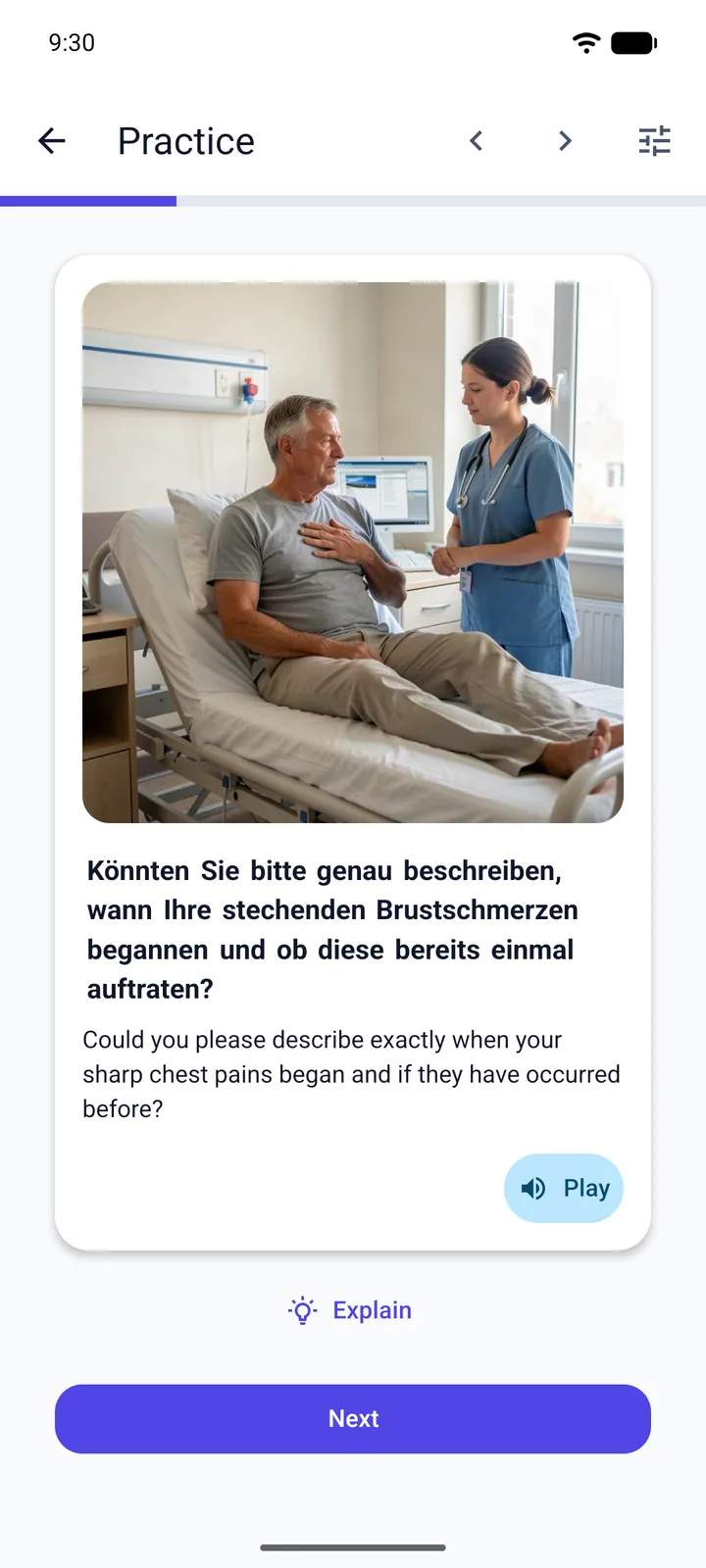
You can also type the exam name, such as “Fachsprachprüfung Medizin”. Viglot then plans a syllabus for it, unit by unit at your level, and each unit is set in an everyday scene. For clinical vocabulary, typed clinical scenes work better, so alternate both in one course.
Briefings, translations and the situations in What Would You Say? come in your own language, whether Turkish, Persian, Ukrainian, Arabic or any of 40+ languages, with a right-to-left interface for Persian and Arabic. The German stays German.
The core exercises, spaced repetition and a limited number of new scenarios each week are free. Pronunciation, voice tasks, Make Yourself Understood, What Would You Say?, In Your Own Words, listening comprehension, cultural nuance and grammar exercises are Premium.
Viglot is independent and not affiliated with any Ärztekammer, authority or exam body. It does not run mock exams and cannot promise a pass or recognition. Its content is generated for language practice and is not clinical guidance.
Five skills to train, each with a drill
For most doctors who learned German as adults, the hard part is not the medicine. It is spoken medical German: the right term, the plain word for the patient, the abbreviation in the notes, the fixed order of a presentation. These five skills make the difference, and each one has a drill you can do alone.
- Medical terminology Many doctors know the disease but not the German word for the symptom, the test or the drug class. Drill: learn each technical term together with its everyday word, and say both out loud in a sentence.
- Switching between medical and everyday language With the patient it is “Bauchschmerzen”, in the presentation “Abdominalschmerzen”. Drill: explain one finding a day twice, once to an imaginary patient and once to a senior colleague.
- Abbreviations German clinical writing is full of them. Drill: keep a running list (V. a., Z. n., o. B., AZ) and read notes aloud, expanding every abbreviation.
- Structured documentation German records follow a predictable order and an impersonal style. Drill: after every spoken history, write it up in the same fixed order, against a timer.
- Consent conversations Explaining a procedure, its risks and the patient’s right to decide follows conventions. Drill: one consent conversation a week, ending with a check that the patient understood.
German phrases for the conversations of your working day
The phrases and samples below are our own examples for language practice, not medical guidance. With patients, always use Sie and Herr or Frau plus the surname. Many ward teams use du among colleagues, but wait until it is offered, and use Sie with examiners.
Taking the history (Anamnese)
| Phrase | Use it to |
|---|---|
| Guten Tag, mein Name ist …, ich bin Assistenzärztin hier in der Notaufnahme. | introduce yourself and your role |
| Was führt Sie heute zu uns? | open with the main complaint |
| Seit wann haben Sie diese Beschwerden? | ask about the onset |
| Können Sie mir zeigen, wo genau es wehtut? | locate the pain |
| Strahlen die Schmerzen irgendwohin aus, zum Beispiel in den Arm oder in den Rücken? | ask whether the pain radiates |
| Wie würden Sie den Schmerz beschreiben: eher drückend, stechend oder brennend? | ask about the character of the pain |
| Auf einer Skala von 0 bis 10: Wie stark sind die Schmerzen gerade? | ask about intensity |
| Haben Sie Vorerkrankungen, zum Beispiel Bluthochdruck oder Zuckerkrankheit? | ask about past illnesses |
| Welche Medikamente nehmen Sie regelmäßig ein? | ask about medication |
| Sind bei Ihnen Allergien bekannt, zum Beispiel gegen Medikamente? | ask about allergies |
| Rauchen Sie? Und wie sieht es mit Alkohol aus? | ask about smoking and alcohol |
| Gibt es in Ihrer Familie Herz-Kreislauf-Erkrankungen? | ask about family history |
| Habe ich Sie richtig verstanden, dass …? | check that you understood |
| Gibt es noch etwas, das Sie mir sagen möchten? | close the history |
Sample: the first minute of a history in the emergency department
Ärztin: Guten Tag, Herr Lehmann. Mein Name ist Petrova, ich bin Assistenzärztin hier in der Notaufnahme. Was führt Sie heute zu uns?
Herr Lehmann: Ich hab seit heute Morgen so einen Druck auf der Brust. Das geht einfach nicht weg.
Ärztin: Das klingt unangenehm. Seit wann genau haben Sie den Druck?
Herr Lehmann: Seit ungefähr sieben Uhr, beim Treppensteigen fing es an.
Ärztin: Können Sie mir zeigen, wo genau Sie den Druck spüren? Strahlt er irgendwohin aus?
Herr Lehmann: Hier in der Mitte. Und manchmal zieht es in den linken Arm.
Ärztin: Danke, das ist wichtig. Ich fasse kurz zusammen: Seit heute Morgen haben Sie einen Druck in der Brustmitte, der manchmal in den linken Arm zieht. Habe ich das richtig verstanden?
Notice the moves: a short introduction, an open question, focused follow-ups and a summary the patient can confirm. The summary shows that you understood and gives the patient a chance to correct you.
Medical terms and the words patients use
Learn these in pairs. Use the left column in your presentation and your documentation, the middle column with the patient.
| Medical term | With the patient | Meaning |
|---|---|---|
| Abdominalschmerzen | Bauchschmerzen | abdominal pain |
| Dyspnoe | Atemnot, Luftnot | shortness of breath |
| Hypertonie | Bluthochdruck | high blood pressure |
| Myokardinfarkt | Herzinfarkt | heart attack |
| Apoplex | Schlaganfall | stroke |
| Pneumonie | Lungenentzündung | pneumonia |
| Ödeme | Wassereinlagerungen | swelling from fluid in the tissue |
| Obstipation | Verstopfung | constipation |
| Synkope | kurze Ohnmacht | fainting |
| Antikoagulation | Blutverdünnung | anticoagulation, “blood thinning” |
| Koloskopie | Darmspiegelung | colonoscopy |
| Sonografie | Ultraschall | ultrasound |
Real patients go further than the middle column. Expect everyday and regional expressions, and learn to translate them back into a finding:
| The patient says | What it usually means |
|---|---|
| Ich hab’s im Kreuz. | low back pain |
| Mir ist ganz schummrig. | dizziness, feeling faint |
| Ich hab Wasser in den Beinen. | leg swelling, possibly edema |
| Mein Zucker ist nicht gut eingestellt. | poorly controlled diabetes |
| Ich hab’s mit dem Magen. | stomach complaints of some kind, so ask more |
Explaining a procedure and getting consent (Aufklärung)
| Phrase | Use it to |
|---|---|
| Ich möchte Ihnen kurz erklären, welche Untersuchung wir planen und warum. | announce the explanation |
| Bei einer Darmspiegelung schauen wir uns Ihren Darm von innen an, mit einem dünnen, beweglichen Schlauch, an dessen Spitze eine kleine Kamera sitzt. | describe the procedure in plain words |
| Am Tag vorher trinken Sie eine Lösung, damit der Darm ganz sauber ist. | explain the preparation |
| Die Untersuchung ist in der Regel gut verträglich. Selten kann es zu einer Blutung kommen, sehr selten kann die Darmwand verletzt werden. | name the rare and very rare risks |
| Haben Sie bis hierhin Fragen? | invite questions |
| Können Sie mir mit Ihren eigenen Worten sagen, was morgen passiert? | check understanding (teach-back) |
| Sie können sich das in Ruhe überlegen. Die Entscheidung liegt bei Ihnen. | make clear the decision is the patient’s |
| Wenn Sie einverstanden sind, unterschreiben Sie bitte hier den Aufklärungsbogen. | ask for the signature |
Presenting a patient to a colleague (Arzt-Arzt-Gespräch)
A case presentation follows a fixed order. Learn the skeleton once, and every new case only needs filling in.
| Step | Phrases |
|---|---|
| Who and why | Ich möchte Ihnen Frau …, … Jahre alt, vorstellen. Sie stellte sich heute mit … vor. |
| Current complaint | Die Beschwerden bestehen seit … Begleitend berichtet sie über … |
| Past history and medication | An Vorerkrankungen sind … bekannt. Sie nimmt regelmäßig … ein. Allergien sind keine bekannt. |
| Systems, social and family history | Die vegetative Anamnese ist bis auf … unauffällig. Sozialanamnestisch lebt sie … |
| Working diagnosis | Ich habe den Verdacht auf … Differenzialdiagnostisch kommen … in Betracht. |
| Next steps | Als weiteres Vorgehen würde ich … vorschlagen. |
| Handling questions | Das habe ich nicht erfragt, das würde ich nachholen. Darf ich kurz in meinen Notizen nachsehen? |
Sample presentation to a senior physician
Ich möchte Ihnen Frau Schubert vorstellen, eine 71-jährige Patientin, die sich heute mit seit drei Tagen zunehmender Dyspnoe und produktivem Husten mit gelblichem Sputum vorstellte. Begleitend berichtet sie über Fieber bis 38,6 °C und Abgeschlagenheit. An Vorerkrankungen sind eine arterielle Hypertonie und ein Diabetes mellitus Typ 2 bekannt. Sie nimmt regelmäßig Ramipril und Metformin ein, Allergien sind keine bekannt. Noxen: Nikotin- und Alkoholkonsum werden verneint. Die vegetative Anamnese ist bis auf einen verminderten Appetit unauffällig. Sozialanamnestisch lebt sie allein, wird aber von ihrer Tochter unterstützt. Ich habe den Verdacht auf eine ambulant erworbene Pneumonie. Differenzialdiagnostisch kommen eine akute Bronchitis und eine kardiale Dekompensation in Betracht. Als weiteres Vorgehen würde ich eine körperliche Untersuchung, ein Labor mit Blutbild und Entzündungsparametern sowie einen Röntgen-Thorax in zwei Ebenen vorschlagen.
Writing it down: documentation and discharge letters
German clinical writing is impersonal and compact. These sentence patterns appear in admission notes and in the Arztbrief, the letter that goes to the family doctor.
- Die stationäre Aufnahme erfolgte aufgrund von …
- Anamnestisch berichtete die Patientin über …
- Bei Aufnahme befand sich die Patientin in reduziertem Allgemein- und gutem Ernährungszustand.
- Laborchemisch zeigte sich ein erhöhtes CRP.
- Unter der eingeleiteten Therapie besserte sich der Zustand rasch.
- Wir entlassen die Patientin in gutem Allgemeinzustand in Ihre weitere hausärztliche Betreuung.
- Wir bitten um eine Kontrolle der Entzündungsparameter in einer Woche.
| Abbreviation | Written out | Meaning |
|---|---|---|
| V. a. | Verdacht auf | suspected |
| Z. n. | Zustand nach | status after, history of |
| o. B. | ohne Befund | no abnormal findings |
| AZ / EZ | Allgemeinzustand / Ernährungszustand | general condition / nutritional state |
| DD | Differenzialdiagnose | differential diagnosis |
| b. B. | bei Bedarf | as needed |
On the phone with the family doctor
Phone calls are one of the hardest parts of the first months on the ward: no face, no gestures, and often a hurried listener. One structure works every time: who you are, which patient, why you are calling, what you need, and a read-back.
| Phrase | Use it to |
|---|---|
| Guten Tag, hier ist …, Assistenzarzt auf der Inneren, Station 4. | say who and where you are |
| Ich rufe wegen Ihrer Patientin Frau …, geboren am …, an. | identify the patient |
| Es geht um ihre Entlassung morgen. | give the reason for the call |
| Könnten Sie mir bitte die aktuelle Medikation durchgeben? | ask for information |
| Ich wiederhole kurz, um sicherzugehen: … | read back what you heard |
| Den vorläufigen Arztbrief bekommt die Patientin morgen mit. | say how the letter will reach them |
A note on tone: German clinical politeness leans on the subjunctive. “Ich würde vorschlagen …” and “Könnten Sie …?” sound professional; a bare imperative to a colleague or a “Sie müssen …” to a patient can sound abrupt, even when it is grammatically correct.
Typical mistakes and how to fix them
- Nouns without their article. “Pneumonie” alone is not enough. Learn die Pneumonie, das Ödem, der Infarkt, each with its plural, or your presentation fills up with small errors that distract the listener.
- The verb in the wrong place. Presentations are full of subordinate clauses that push the verb to the end: “…, die sich heute mit Atemnot vorstellte.” Practice the skeleton sentences until the verb lands there by itself.
- Too direct with patients. A string of bare questions sounds like an interrogation. Short softeners such as “Darf ich Sie fragen …?” or “Könnten Sie mir sagen …?” change the whole tone.
- Technical terms with the patient. “Sie haben eine Dyspnoe” does not reach most patients. Say the everyday word first, and add the term only if it helps.
- Spoken tense in writing. When you speak, you use the Perfekt: “Die Schmerzen haben gestern angefangen.” In documentation and letters, the Präteritum and the nominal style take over: “Die Aufnahme erfolgte aufgrund von …”.
- Not checking understanding. “Haben Sie das verstanden?” invites a quick yes. Ask the patient to say it in their own words instead.
A practice plan in four phases
The plan assumes solid general German. Give each phase as much time as you have; what matters most is that you speak every day.
Phase 1: vocabulary in pairs and a question bank
Build your term pairs system by system (heart, lungs, abdomen, nervous system, musculoskeletal) and review them daily with spaced repetition. Write your own question bank for the history, in the order you will ask, and say it out loud until it comes without thinking.
Phase 2: full histories, out loud and timed
Take one complete history a day from a short case description, speaking both sides, and record it. End each one with your explanation to the patient, in everyday words. Then write the documentation against a timer.
Phase 3: presentations and questions
Add the doctor–doctor part: present each case in the fixed order, then answer three questions you wrote in advance. Practice the register switch daily: the same finding for a patient and for a colleague.
Phase 4: complete cases with a partner
Rehearse complete cases, from the first question to the presentation, with a colleague, and use any official sample material the responsible authority publishes. Focus on repair: what you say when you do not understand the patient, and how you paraphrase a missing word.
A 30-minute daily routine
- 5 minutes: review today’s term pairs.
- 10 minutes: one history or one presentation, out loud, with a timer.
- 5 minutes: explain one diagnosis or procedure in everyday German.
- 10 minutes: write one short documentation or one Arztbrief paragraph.
Pharmacists and dentists
If you are a pharmacist or a dentist, the same method works for your field: learn technical and everyday terms in pairs, practice your counseling or consent conversations out loud, and write short notes in the impersonal style. Good Viglot topics are “Beratung in der Apotheke: Kundin fragt nach Wechselwirkungen mit Blutverdünnern” or “Aufklärung vor einer Wurzelbehandlung”.
Notes by first language
Your first language shapes which parts of German come easily and which need extra practice. Here are the points to watch for some of the languages our readers speak.