
Korean for foreign workers moving up toward E-7-4: speak Korean at work
Moving up at work in Korea, for example toward the E-7-4 skilled-worker visa, changes the Korean you need: from following instructions to giving them, explaining, reporting, and talking to superiors and officials. General courses and test prep rarely make you practise that out loud. Viglot does: you type a situation from your own job, and it becomes phrases, exercises and a spoken role-play you can repeat every day. Below: phrases for five real situations, the speech levels that matter at work, common mistakes and a study plan you can keep next to a full-time job.
Why a general Korean course falls short at work
Most Korean apps and courses teach the same everyday Korean: ordering coffee, shopping, hobbies, a trip. Test preparation, whether for EPS-TOPIK, TOPIK or KIIP, trains you for the test. Neither makes you say the Korean of your shift out loud, so many workers learn to talk at work by listening to colleagues, picking up casual speech and site slang along the way.
Moving up changes your role. A skilled worker with years in the company shows new arrivals what to do, reports faults and sits down with the boss to talk about the future. All of that is spoken, much of it to people above you, which in Korean means choosing the right speech level. A general course rarely teaches this, because it depends on your job:
- Vocabulary from your field: machine parts, welding, crops and livestock, nets and decks, the names of tools and defects.
- Workplace talk: instructions, reports, safety warnings and asking for permission, each with its own fixed phrases.
- Phone calls, where you can’t point or read faces: calling the office when you are sick, or a supplier about a late delivery.
- Paperwork: work logs, safety signs, pay slips, contracts and immigration forms.
- Dialect: in the south-east, home to many factories and shipyards, coworkers often speak Gyeongsang dialect. A solid base in standard Korean makes it much easier to follow.
So the fastest way forward is to practise the conversations of your own line, deck or farm, out loud, until they come easily. That is what Viglot is built for.
How Viglot lets you practise your own work conversations
You create a Korean course at your level and type a situation from your own job, in your own language or in Korean, for example “신입 외국인 근로자에게 작업 순서 설명하기” (explaining the work steps to a new foreign worker). Viglot builds the whole lesson from that one scene: phrases with a picture, native-sounding audio and a translation, exercises that reuse the same words, listening, and spoken role-plays with a conversation partner who stays in character. Explanations and task briefings come in your language, and spaced repetition brings each word back before you forget it. The more specific your scene, the more specific the words. You practise your own conversations, every day, without needing a partner.
Each exercise answers a problem you meet at work:
- “I have to brief new workers, not just listen.” In a voice task you speak with a conversation partner who stays in character: you play the senior worker, they play the new arrival, the team leader or the officer. Before you start you see the situation, your goal and the success criteria, and you can reveal example phrases. Afterwards you see whether you met each criterion, with feedback and corrections on what you said.
- “I freeze when something comes up suddenly.” What Would You Say? describes a situation in your language; you answer out loud in Korean and compare with a model answer.
- “People don’t get what I mean.” In Make Yourself Understood you type to a partner who misunderstands on purpose, and rephrase until your point gets across.
- “I talk to coworkers in -요, but the boss needs -습니다.” In Your Own Words has you say a sentence again in other words with the same meaning, for example in another speech level, and grammar exercises make you build the sentences yourself instead of just recognising them.
- “Real speech is fast, and the customs are new.” Listening comprehension plays a dialogue set in your scene (from A2 also a monologue), and cultural nuance asks what people would do in that situation in Korea, then explains the custom.
- “I’m taking TOPIK or KIIP too.” Type the exam or program name as a topic and Viglot plans a syllabus for it, unit by unit at your level, each unit set in an everyday scene. Your own typed scenes cover your job better, so alternate both in one course.
- “Explanations in Korean are too hard for me.” Viglot works across 40+ languages, so you can learn Korean from Vietnamese, Indonesian, Russian or Thai. Korean comes with a Latin-script reading that you can switch off in the scenario settings once Hangul feels easy.
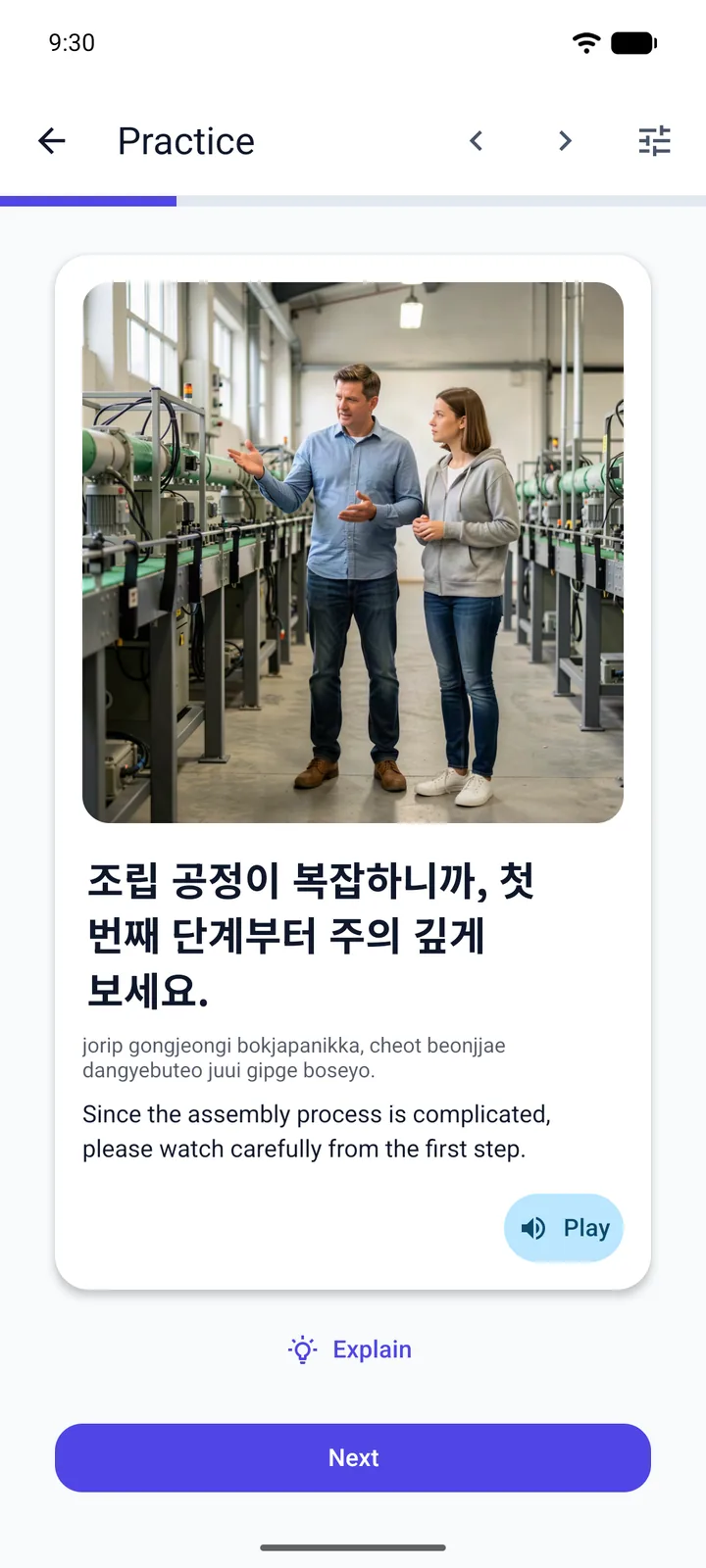
The core exercises and spaced repetition are free, with a limited number of new scenarios each week. Premium covers every speaking and comprehension exercise: pronunciation, voice tasks, Make Yourself Understood, What Would You Say?, In Your Own Words, listening comprehension, cultural nuance and grammar exercises.
Korean for five real situations
Each row gives the Korean, a reading in the official Revised Romanization (which does not mark tensed sounds, so 있습니다 is written itseumnida but sounds closer to “it-sseum-ni-da”) and what it means. Learn them as whole sentences, say them out loud and swap in the words from your own job. Each situation also works as a topic in Viglot.
1. Briefing a new worker on the work steps
As a senior worker, you explain the steps, check that the new person understood and put safety first. Polite 해요체 (the -요 ending) is right here, even with someone younger: it is friendly without talking down.
| Korean | Reading | Meaning |
|---|---|---|
| 오늘은 제가 작업 순서를 설명해 드릴게요. | Oneul-eun jega jageop sunseo-reul seolmyeonghae deurilgeyo. | Today I’ll walk you through the work steps. |
| 먼저 안전화하고 장갑부터 착용하세요. | Meonjeo anjeonhwa-hago janggap-buteo chagyonghaseyo. | First, put on your safety shoes and gloves. |
| 이 버튼을 누르기 전에 꼭 주변을 확인하세요. | I beoteun-eul nureugi jeone kkok jubyeon-eul hwaginhaseyo. | Always check around you before you press this button. |
| 불량품은 이 빨간 상자에 따로 넣어 주세요. | Bullyangpum-eun i ppalgan sangja-e ttaro neoeo juseyo. | Put defective parts separately in this red box. |
| 한번 해 보세요. 제가 옆에서 볼게요. | Hanbeon hae boseyo. Jega yeop-eseo bolgeyo. | Give it a try. I’ll watch from right here. |
| 천천히 해도 괜찮아요. 안전이 먼저예요. | Cheoncheonhi haedo gwaenchanayo. Anjeon-i meonjeoyeyo. | It’s fine to go slowly. Safety comes first. |
| 모르는 게 있으면 언제든지 물어보세요. | Moreuneun ge isseumyeon eonjedeunji mureoboseyo. | If anything is unclear, ask me any time. |
2. Reporting a defect to the team leader (반장님)
A good report answers four questions in order: what, where, since when, and what you already did. Lead with the formal -습니다 ending for the report itself; polite -요 questions such as 보시겠어요? are fine in between. Finish by asking how to proceed, so the decision stays with your superior.
| Korean | Reading | Meaning |
|---|---|---|
| 반장님, 잠깐 보고드릴 게 있습니다. | Banjangnim, jamkkan bogodeuril ge itseumnida. | Excuse me, I have something to report. |
| 2번 라인에서 불량이 계속 나오고 있습니다. | I-beon rain-eseo bullyang-i gyesok naogo itseumnida. | Line 2 keeps producing defective parts. |
| 오전 10시쯤부터 용접 부분에 틈이 생기고 있습니다. | Ojeon yeol-si-jjeum-buteo yongjeop bubun-e teum-i saenggigo itseumnida. | Since about 10 a.m., gaps have been showing up in the welds. |
| 일단 기계를 멈추고 불량품은 따로 빼 두었습니다. | Ildan gigye-reul meomchugo bullyangpum-eun ttaro ppae dueotseumnida. | I’ve stopped the machine for now and set the defective parts aside. |
| 사진을 찍어 놨는데 보시겠어요? | Sajin-eul jjigeo nwanneunde bosigesseoyo? | I took photos. Would you like to see them? |
| 어떻게 처리하면 될까요? | Eotteoke cheorihamyeon doelkkayo? | How should I handle it? |
3. Talking to the boss (사장님) about your future at the company
A conversation with the boss about staying on, a new contract or your plans deserves preparation. Ask for time first, say clearly what you want and why it helps the company too, and offer to handle the paperwork. Use mostly -습니다, with a polite -요 question where it fits, and always the honorific -(으)시- toward the boss.
| Korean | Reading | Meaning |
|---|---|---|
| 사장님, 바쁘신데 잠깐 시간 괜찮으세요? | Sajangnim, bappeusinde jamkkan sigan gwaenchaneuseyo? | I know you’re busy, but do you have a moment? |
| 숙련기능인력 비자로 바꾸고 싶어서 말씀드리려고 합니다. | Sungnyeon-gineung-illyeok bija-ro bakkugo sipeoseo malsseumdeuriryeogo hamnida. | I’d like to talk to you about switching to the skilled-worker visa. |
| 그동안 많이 가르쳐 주셔서 감사합니다. | Geudongan mani gareuchyeo jusyeoseo gamsahamnida. | Thank you for everything you’ve taught me so far. |
| 앞으로도 여기서 계속 일하고 싶습니다. | Apeuro-do yeogiseo gyesok ilhago sipseumnida. | I want to keep working here. |
| 새 계약 조건도 한번 상의드리고 싶습니다. | Sae gyeyak jogeon-do hanbeon sang-ui-deurigo sipseumnida. | I’d also like to discuss the terms of a new contract with you. |
| 필요한 서류는 제가 준비하겠습니다. | Piryohan seoryu-neun jega junbihagetseumnida. | I’ll prepare the documents we need. |
4. Asking about documents at the immigration office
Officers speak fast and use administrative words. Have your questions ready, and know how to ask them to slow down or repeat. That is not a weakness: it is what fluent people do.
| Korean | Reading | Meaning |
|---|---|---|
| 두 시에 예약하고 왔습니다. | Du si-e yeyakago watseumnida. | I have an appointment at two o’clock. |
| 체류 자격 변경 때문에 왔는데요. | Cheryu jagyeok byeongyeong ttaemune wanneundeyo. | I’m here about changing my visa status. |
| 어떤 서류가 필요한지 알려 주시겠어요? | Eotteon seoryu-ga piryohanji allyeo jusigesseoyo? | Could you tell me which documents I need? |
| 이 서류는 회사에서 받아 와야 하나요? | I seoryu-neun hoesa-eseo bada wa-ya hanayo? | Do I need to get this document from my company? |
| 죄송하지만 조금만 천천히 말씀해 주시겠어요? | Joesonghajiman jogeumman cheoncheonhi malsseumhae jusigesseoyo? | Sorry, could you speak a little more slowly? |
| 제가 이해한 게 맞는지 다시 한번 확인해도 될까요? | Jega ihaehan ge manneunji dasi hanbeon hwaginhaedo doelkkayo? | May I check once more that I understood correctly? |
5. Introducing yourself in class or at a new workplace
In a KIIP class, on a new team or at a company dinner, you will introduce yourself many times. Keep it to six or seven sentences: name and country, how long you have been in Korea, your job, one difficulty you overcame, your goal, and a polite closing. Here is an original sample:
Sample: a self-introduction
안녕하세요. 저는 베트남에서 온 응우옌 반 남입니다. 한국에 온 지 5년이 됐고, 지금 김해에 있는 자동차 부품 공장에서 일하고 있습니다. 처음에는 한국말을 잘 못해서 많이 힘들었지만, 지금은 새로 온 동료들에게 일을 가르쳐 주기도 합니다. 앞으로 한국어를 더 열심히 공부해서 숙련기능인력 비자를 받고 싶습니다. 잘 부탁드립니다.
Hello. I’m Nguyen Van Nam from Vietnam. I came to Korea five years ago and now work at a car-parts factory in Gimhae. At first it was hard because my Korean was weak, but now I sometimes teach newly arrived colleagues their work. I want to keep studying Korean hard and get the skilled-worker visa. I look forward to working with you all.
Speech levels at work
Korean grammar changes with the person you are talking to. At work, five habits keep you on safe ground:
- -습니다 / -ㅂ니다 (formal): for reports, meetings, the boss and officials. It can sound stiff with friends, but it is never rude.
- -아요 / -어요 (polite): for most everyday talk, including with coworkers and new arrivals.
- Honorific -(으)시- and special verbs: when you speak to or about someone above you or older than you: 드시다 instead of 먹다 (eat), 주무시다 instead of 자다 (sleep), 계시다 instead of 있다 (be somewhere).
- Titles, not names: call people above you by their title plus 님: 반장님, 과장님, 사장님. Avoid 당신 for “you”; in conversation it can sound confrontational. Usually you simply leave “you” out.
- Casual speech (반말): only with close colleagues who invite it. Korean coworkers may speak casually to you; don’t copy that tone back to your superiors.
Speaking with older people
In Korea, how you speak to older people matters as much as what you say. On a farm the owner is often older, in a small town many of your neighbours are, and if you work in care, older people are the people you look after all day. Address them as 어르신 rather than by name, use honorific speech (드시다, 주무시다, 계시다), say what you are about to do before you do it, and keep your sentences slow and clear. In care work, a short spoken handover (인수인계) at the end of a shift is part of the job: who ate, who slept badly, what changed.
| Korean | Reading | Meaning |
|---|---|---|
| 어르신, 식사 준비됐습니다. 천천히 드세요. | Eoreusin, siksa junbidwaetseumnida. Cheoncheonhi deuseyo. | Your meal is ready. Take your time. |
| 어젯밤에 잘 주무셨어요? | Eojetbam-e jal jumusyeosseoyo? | Did you sleep well last night? |
| 어디 불편하신 데는 없으세요? | Eodi bulpyeonhasin de-neun eopseuseyo? | Is anything bothering you? |
| 일어나실 때 제가 부축해 드릴게요. | Ireonasil ttae jega buchukae deurilgeyo. | I’ll support you when you stand up. |
| 302호 어르신은 점심을 반 정도 드셨습니다. | Sambaegi-ho eoreusin-eun jeomsim-eul ban jeongdo deusyeotseumnida. | (Handover) The resident in room 302 ate about half of lunch. |
| 오후에는 특별한 변화가 없었습니다. | Ohu-eneun teukbyeolhan byeonhwa-ga eopseotseumnida. | (Handover) There were no particular changes this afternoon. |
Caring for older people in another language? Our guides to Japanese for care workers and Swedish for elderly care cover the same work in other countries.
Common mistakes at work
These are the mistakes that cause the most misunderstandings on the job. Each one is easy to fix once you know it.
- Dropping the ending. Tired or in a hurry, many learners leave off -요 or -습니다. To a team leader, 했어 sounds rude; 했어요 or 했습니다 does not.
- Mixing the two number systems. Korean says the hour with native numbers (열 시, ten o’clock) but minutes, dates, money and line numbers with Sino-Korean ones (십 분, 2번 라인). Mixing them up is a common reason a time or a quantity gets misheard.
- Plain, aspirated and tense consonants. 불 (fire), 풀 (grass, glue) and 뿔 (horn) differ only in the first sound. In safety warnings that difference matters, so practise such pairs out loud and record yourself.
- 주다 or 드리다. When you do something for someone above you, use -아/어 드리다 (설명해 드릴게요, I’ll explain it to you). -아/어 주세요 is for asking someone to do something for you.
- Saying 네 when you didn’t understand. A nod and a 네 can turn into a wrong part or an accident. Ask instead: 다시 한번 말씀해 주시겠어요? Repeating an instruction back to check is normal and safe.
- Site slang in reports. Many workplaces use words borrowed from Japanese, such as 기스 for a scratch. Understand them, but use the standard word (흠집) when you report to the office or write it down.
A study plan next to a full-time job
After a long shift, you need a plan that is small enough to keep. Twenty to thirty minutes a day beats a three-hour session on Sunday.
- Make the basics automatic Consolidate everyday vocabulary and the -요 and -습니다 endings until you no longer have to think about them. Each week, take one situation from your own job and learn its phrases until you can say them without looking.
- Explain, don’t just list Read something short in Korean every day: safety notices, your pay slip, news headlines. Practise connecting sentences with -는데, -아서 and -기 때문에, so your reports explain causes rather than list facts. Keep speaking: describe your day’s work out loud on the way home.
- Give longer explanations and opinions Now practise saying why a process should change or how to prevent a defect, and handling conversations that leave your script: a question you didn’t expect, a phone call, a coworker speaking dialect. Keep at least one speaking session a week on situations from your job, because no written test will train that for you.
A realistic week: on workdays, 10 minutes of vocabulary review and 10 to 20 minutes of one scenario or speaking task; at the weekend, one longer speaking task or your class homework. Record yourself once a week and listen back for the endings you drop.
Notes by home country
Language tips for speakers of your language: what comes easily, and what to practise most.
For workers from Vietnam
Vietnamese has a large layer of Sino-Vietnamese words, and many of them have Sino-Korean twins: 안전 (an toàn, safety), 주의 (chú ý, caution), 준비 (chuẩn bị, preparation). Use them as memory hooks, but learn the Korean pronunciation, because the sounds have drifted apart. Politeness in Vietnamese lives in pronouns (anh, chị, em); in Korean it lives mostly in the verb ending, and “you” is usually left out, so practise the endings instead of looking for the right word for “you”. Give extra attention to final ㄹ and to how a final consonant links into the next syllable (있어요 sounds like 이써요). You can type your scene in Vietnamese, for example:
Giải thích quy trình làm việc cho công nhân mới ở nhà máy (với vai trò tổ trưởng)
For workers from Indonesia
Indonesian puts the verb in the middle of the sentence; Korean puts it at the end, and that ending carries what matters most: polite or not, done or not, a request or a report. Train yourself to listen to the end of every sentence. Indonesian does not separate plain, aspirated and tense consonants, so ㄱ/ㅋ/ㄲ and ㅂ/ㅍ/ㅃ need extra practice, as do the vowels ㅓ and ㅗ. Your habit of saying Bapak or Ibu carries over well: in Korean, address people by their title plus 님. On deck or in a shipyard, the Korean you need is short, loud and safety-first. Typed scenarios that fit, in Korean or in Indonesian:
- 어선 갑판에서 신입 선원에게 안전 교육하기
- 조선소에서 용접 불량을 반장에게 보고하기
Memberi pengarahan keselamatan kepada awak kapal baru di dek kapal ikan
For workers from Central Asia and Koryo-saram
If you speak Russian, you already know the difference between вы and ты, and that helps: Korean separates polite speech from 반말 in a similar spirit, but in the verb ending rather than the pronoun. Korean ㅡ is close to Russian ы, a handy anchor; ㅓ and ㅗ need practice. The tense consonants (ㄲ, ㄸ, ㅃ, ㅆ, ㅉ) have no Russian equivalent, and consonants before ㅣ should not be softened the Russian way. Some Koryo-saram grew up hearing Korean at home, often a regional variety, but never studied the formal standard Korean used in reports and at the immigration office: if that is you, focus on the -습니다 endings and the honorific verbs. Viglot teaches Korean from Russian, with explanations and briefings in Russian. You can type your scene in Russian, for example:
Сообщить мастеру о поломке станка на заводе
For workers from Thailand
Thai speakers have a head start on politeness: ending a sentence with ครับ or ค่ะ works much like the Korean -요 ending, so the habit of never ending “bare” with a superior carries over. Thai unaspirated ก and ป sound close to Korean ㄲ and ㅃ, and aspirated ข and พ close to ㅋ and ㅍ; the new sound to train is the plain series (ㄱ, ㄷ, ㅂ), which sits in between and turns voiced between vowels. Standard Korean has no tones, so pitch does not change a word’s meaning; at the end of a sentence it does the work instead: 해요? rises as a question, 해요. falls as a statement. If you work on a farm, add the names of your crops, animals, machines and the weather to your scenarios. You can type your scene in Thai, for example:
อธิบายขั้นตอนการทำงานในฟาร์มให้คนงานใหม่ฟัง (ในฐานะหัวหน้าทีม)
What Viglot is, and isn’t
Viglot is a daily practice app for speaking, listening and vocabulary. It is independent and not affiliated with any Korean authority or exam provider. It offers no mock exams, cannot award certificates and cannot promise you a pass, a job or a visa; its generated content is language practice, not legal advice.
Visa rules, including how your Korean is assessed, are set by the Korean authorities and change, and many pages online describe older versions. Before you plan an application, check the current rules on HiKorea or with your immigration office.